Hyperliquid
Hyperliquid is a decentralized exchange (DEX) built on its Layer-1 blockchain. It combines the efficiency of centralized platforms with the transparency of decentralized systems. The platform provides fast transactions, low fees, and advanced trading tools, supporting spot trading, perpetual futures, and outcome-based prediction markets without reliance on intermediaries.[2] Hyperliquid is positioned as a general on-chain financial infrastructure layer, with its native DEX as one application among many built on the same chain.[3]
Overview
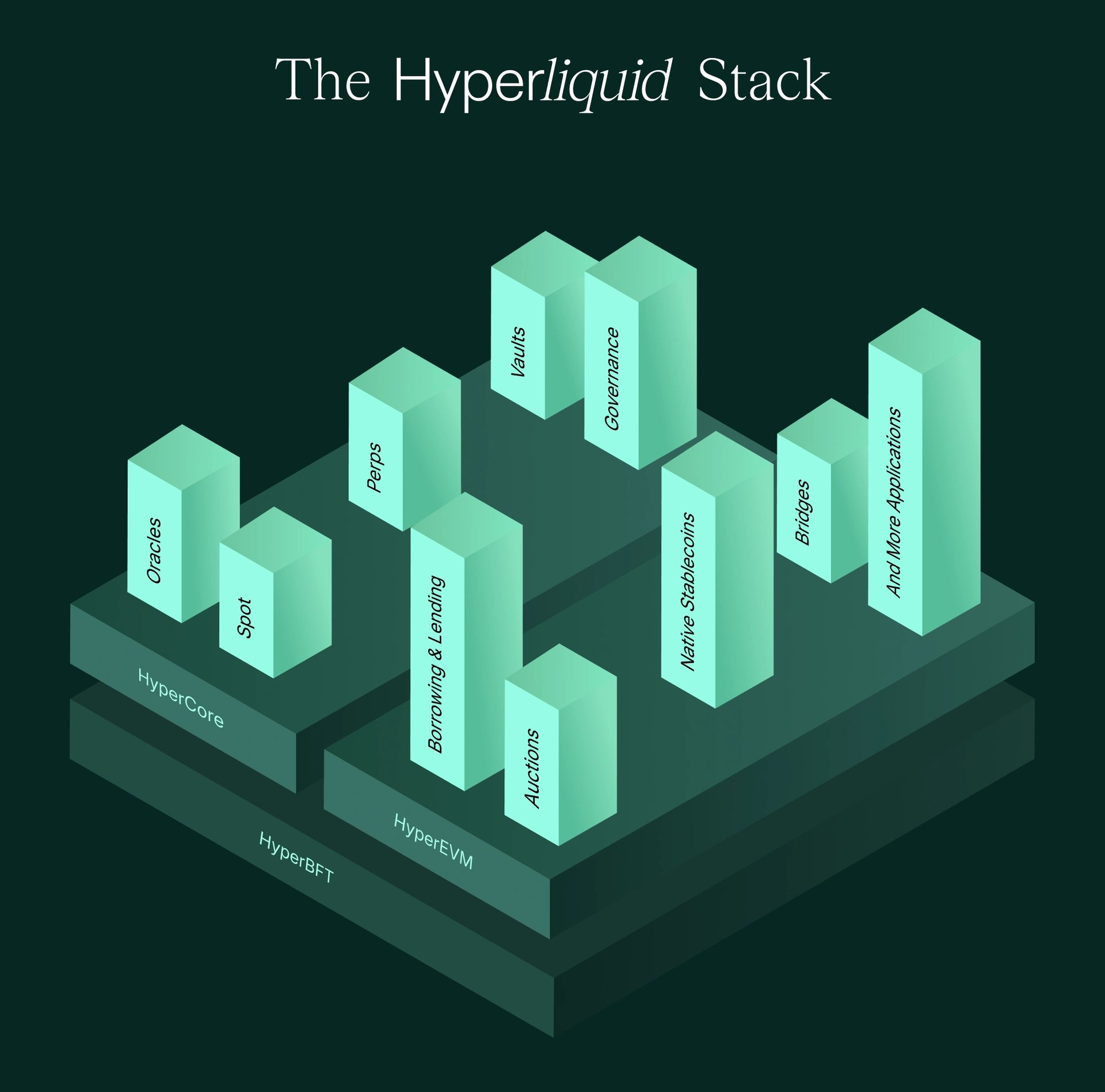
Hyperliquid is a Layer 1 blockchain designed for an on-chain financial system. It integrates liquidity, user applications, and trading activity on a single platform, supporting spot markets, perpetual futures, and outcome-based prediction markets.[2] It uses a custom consensus algorithm, HyperBFT, based on Hotstuff and its successors, optimized for specific requirements.
The blockchain's state execution consists of HyperCore and HyperEVM. HyperCore supports fully on-chain perpetual futures and spot order books, processing up to 200,000 orders per second with a one-block finality. HyperEVM extends Ethereum-compatible smart contract functionality to Hyperliquid, allowing users to build on its financial infrastructure and use the chain as a general-purpose financial layer rather than only a perpetuals exchange.[2][3]
Features
HyperEVM
HyperEVM is an integrated Ethereum Virtual Machine (EVM) within Hyperliquid's Layer-1, secured by the same HyperBFT consensus as HyperCore. This design allows seamless interaction between the EVM and HyperCore, enabling the use of assets across spot and perpetual order books. HyperEVM utilizes a dual-block architecture, splitting throughput between fast, smaller blocks and slower, larger blocks to balance transaction speed and block size. Fast blocks occur every 2 seconds with a 2M gas limit, while slow blocks happen every minute with a 30M gas limit. The system’s throughput is expected to increase with future upgrades. HyperEVM launched on mainnet in February 2025 and, by early 2026, over 170–175 projects had deployed applications on it, turning Hyperliquid into a broader programmable ecosystem beyond its core exchange.[20][21]
HyperEVM’s smart contracts can interact directly with Hyperliquid’s core functionalities, including on-chain spot and perpetual futures order books, enhancing compatibility with the platform’s trading infrastructure. The execution model of Hyperliquid allows both the L1 and HyperEVM to operate sequentially, enabling the EVM to access the state of the blockchain from the previous block and submit actions for the next block, ensuring consistent and predictable operations. ERC-20 tokens on HyperEVM are fungible with their native counterparts on Hyperliquid, offering minimal fees and deep liquidity for token trading and use within decentralized applications (dApps).[4][5][6]
HyperBFT
HyperBFT is Hyperliquid’s consensus algorithm, designed for high-frequency trading while ensuring security and consistency. Based on the HotStuff protocol, it enables block confirmation in under a second, with a median latency of 0.2 seconds and the capacity to process over 200,000 transactions per second. As optimizations continue, throughput could exceed 1 million orders per second. HyperBFT maintains Byzantine Fault Tolerance, allowing the network to function even if up to one-third of validators act maliciously. It also ensures a shared state across Hyperliquid’s Layer-1 and HyperEVM, providing seamless data availability and synchronization.[6]
Vaults
HyperCore vaults enable strategies to leverage the same features as the DEX, including liquidations and high-throughput market-making. Unlike simple token rebalancing vaults, these vaults allow more complex strategies.
Users can deposit into a vault to earn a share of its profits, with vault owners receiving 10% of the total profits. Protocol vaults do not have fees or profit-sharing. Vaults can be managed manually or automated by market makers. Each strategy carries risk, and users should evaluate performance before depositing.[7]
Hyperliquidity Provider
The Hyperliquidity Provider (HLP) protocol vault is designed for market making and liquidation. It earns a share of trading fees. The HLP allows the community to provide liquidity and share in the profits, making strategies typically reserved for select entities more accessible. HLP is fully community-owned and does not collect fees. Profits are distributed proportionally among depositors. Withdrawals are possible four days after the most recent deposit.
HLP aims to offer an alternative to traditional market-making deals often required for liquidity in early-stage DeFi projects, ensuring profits benefit users instead. Hyperliquid’s core contributors, who have a market-making background, initially provided liquidity during closed alpha. To address concerns about potential advantages or asymmetric information, the team’s strategies are housed in a publicly accessible vault.
HLP’s strategy uses tick data from Hyperliquid and centralized exchanges to determine fair prices. It executes orders through market-making and taking strategies to provide continuous liquidity. While the strategy operates off-chain, all vault positions, open orders, trade history, deposits, and withdrawals are visible on-chain for transparency.
Over time, external market makers are expected to contribute large volumes to Hyperliquid. Open-sourcing the API and SDK facilitates onboarding, and increased participation is expected to improve the strategy's risk management and efficiency.[8]
Liquidator Vault
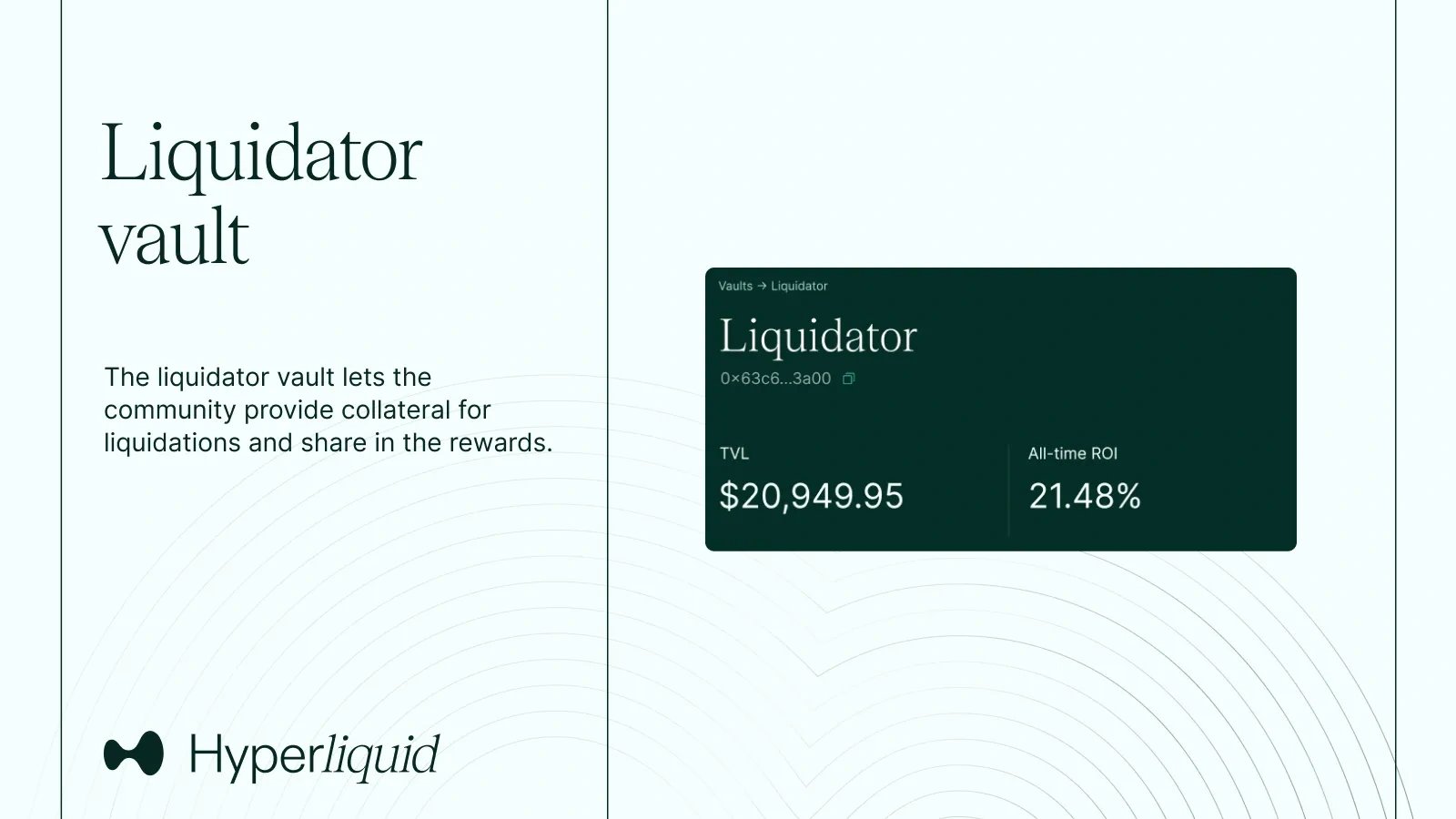
The liquidator vault allows the community to provide collateral for liquidations and share profits. All liquidations occur on-chain and can be tracked through the explorer. Currently, liquidations are decentralized through the liquidator vault, with profits distributed among depositors.
While liquidations may later be accessible via API, the liquidator vault is currently the only way to profit from liquidations. It funds a strategy that capitalizes on liquidations of overleveraged traders, helping maintain stability during volatile periods. Deposits are open to anyone, and withdrawals are allowed after a short lock-up period. The vault only executes trades when a position is liquidatable and exits immediately after liquidation.
The liquidator vault is decentralized and profitable, with performance metrics publicly available. ROI and APY calculations account for historical performance, adjusting for vault lifetime to reduce statistical noise.[9]
HYPE

HYPE is the native governance token of Hyperliquid, allowing holders to participate in protocol decisions through Hyperliquid Improvement Proposals (HIPs). It is used for gas fees on the HyperEVM, for staking and validator security, and as the unit in which governance and the protocol’s Assistance Fund are denominated; the maximum supply remains capped at 1 billion tokens.[2][3]
HYPE’s long-term allocation is structured as 31.0% to the genesis community airdrop, 38.89% reserved for future emissions and rewards, 23.8% to contributors, 6.0% to the foundation, and 0.3% to community grants.[21][20] Hyperliquid did not raise venture capital, and distribution is framed around community usage and contributor incentives rather than investor allocations.[21] A large share of protocol trading fees is routed to the Assistance Fund, which conducts ongoing HYPE buyback-and-burn operations, linking network usage to gradual reduction of the circulating supply over time.[21][20]
Developments
HIP-3: Builder-Deployed Perpetuals
Hyperliquid Improvement Proposal 3 (HIP-3), launched in October 2025, upgraded the protocol to support permissionless deployment of perpetual futures markets by external builders.[21][20] Under HIP-3, builders who stake a significant amount of HYPE can list new perpetual contracts without prior governance approval, selecting both the underlying assets and the oracle feeds that satisfy the protocol’s quality criteria. This change enabled a broader range of markets, including real-world asset perpetuals such as stocks and commodities, to be offered on Hyperliquid while keeping listing risks aligned through the staking requirement.[21]
Hyperliquid Delists JELLYJELLY
On Wednesday, 27th of March 2025, Hyperliquid faced a liquidity crisis after Solana-based meme coin JELLYJELLY pumped nearly 500% due to a potential whale manipulation. The pump triggered a temporary 700K profit.[10][11]
Hyerliquid added that the perpetuals exchange’s primary liquidity pool, HLP, has clocked a positive net income of around $700,000 in the past 24 hours.[12]
Gracy Chen, CEO of cryptocurrency exchange Bitget, criticized Hyperliquid’s handling of the on its perpetual exchange, saying it put the network at risk of becoming “FTX 2.0.”[13]
Hyperliquid Facilitates First On-Chain $1B Bitcoin Bet
In May 2025, a trader known as James Wynn, operating under the pseudonym “moonpig,” executed a high-profile leveraged trade on the decentralized exchange Hyperliquid.[15]
Utilizing 40x leverage, Wynn opened a long position on Bitcoin that expanded to over 28.4 million in margin, capitalized on Bitcoin's price movements, yielding significant unrealized profits as the cryptocurrency's value approached $112,000.[16]
Subsequently, Wynn reversed his market stance by closing the long position and initiating a 17 million reduction in overall profits. However, a rapid rebound in Bitcoin's price to $110,000 led to the liquidation of the short position. Despite this setback, Wynn's trading activities have been notable for their scale and impact on market dynamics.[17]
These trading maneuvers have drawn significant attention to Hyperliquid, a decentralized derivatives exchange built on the HyperEVM blockchain. The platform offers features such as real-time order books and deep liquidity without requiring KYC compliance. Wynn's high-stakes trades have not only highlighted the platform's capabilities but also influenced market sentiment and activity, as evidenced by increased on-chain engagement and a surge in the platform's native token, HYPE.[16][17]
Prediction Markets and Options (HIP-4)
On May 2, 2026, following the passing of Hyperliquid Improvement Proposal (HIP) 4, the platform launched native prediction markets and options on mainnet as “outcome-based trading.”[20] HIP-4 introduces outcome contracts, which are fully collateralized binary or bounded contracts that settle to 0 or 1, or within a fixed range, according to objective data sources, with no leverage and no liquidations.[21] The prediction markets went live on the platform with initial wagers available on mainnet gas prices and Blast gold odds.[18]