Merlin Chain
Merlin Chain is a Bitcoin sidechain founded by Jeff Yin and launched by Bitmap Technology, built with Polygon CDK and designed to scale Bitcoin-native assets, protocols, and applications through a zero-knowledge-inspired infrastructure that enhances Bitcoin’s capabilities on Layer 1. Launched on mainnet in February 2024, it focuses on extending the Bitcoin ecosystem while maintaining a sidechain architecture connected to the base network.[1][17][12]
Overview
Merlin Chain focuses on enhancing scalability, efficiency, and functionality within the Bitcoin network. It operates as a Bitcoin sidechain built with Polygon CDK, using a ZK-rollup-inspired architecture to batch and validate transactions while remaining separate from Bitcoin’s base layer. In the long term, the project aims to evolve into a Bitcoin zero-knowledge rollup Layer 2 that can post proofs back to Bitcoin for on-chain verification once such proof verification is feasible. To advance this transition, Merlin Chain collaborates with partners such as BitcoinOS, a Bitcoin scaling project that provides the BitSNARK proof system and Grail Bridge, and Nubit, a Bitcoin-native data availability network, for zero-knowledge proof verification on Bitcoin and data availability.[2][6][17]
The platform supports EVM compatibility and integrates with Bitcoin-native wallets, enabling users to access major Bitcoin Layer 1 protocols like BRC-20 and Bitmap, a Bitcoin metaverse and NFT collection. By bridging Bitcoin with over 40 Ethereum chains, Merlin Chain supports cross-chain interactions to broaden asset use cases. In addition, its launchpad system supports asset inscription and valuation within the Bitcoin ecosystem, and its Merlin’s Seal incentivization event helped the network reach a peak total value locked of over $3.5 billion in March 2024.[2][3][9][17]
Key Modules
ZK-Rollup Network
The ZK-Rollup Network in Merlin Chain is the core module that batches transactions and secures them with zero-knowledge proofs. It enhances scalability and security by aggregating transaction data into batches, verified with zero-knowledge proofs and anchored to Bitcoin's mainnet via Taproot. It integrates nodes for data processing, a zkProver using SNARK technology for transaction validation, and a database for storing Merkle Tree and transaction details. This architecture inherits Bitcoin's security and supports EVM compatibility. It also reduces costs through optimized data usage and aims to provide higher performance with fast finality and scalability for large-scale user demands.[4]
Decentralized Oracle Network
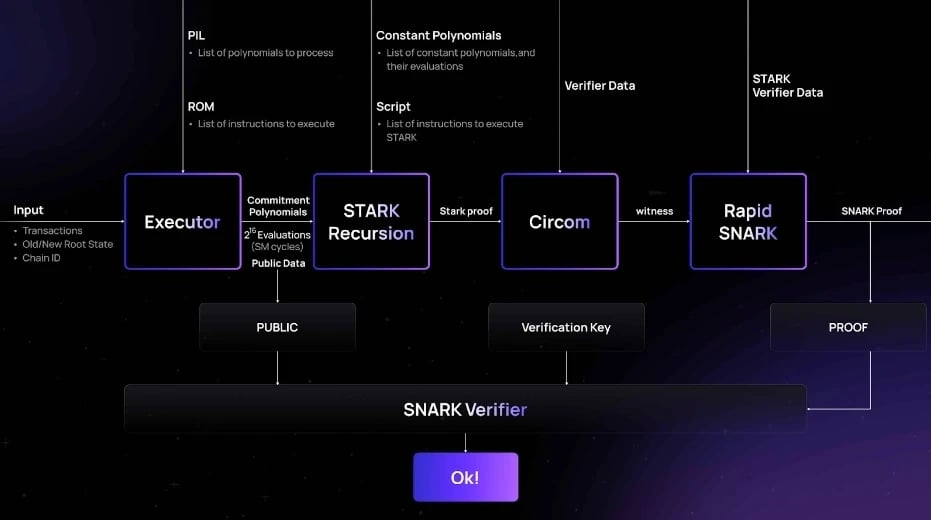
Merlin Chain’s Decentralized Oracle Network provides data processing and validation for the system’s sequencer and staking functions. Merlin Chain’s Decentralized Oracle Network securely processes and stores data by distributing tasks across sequencer nodes, which batch transactions, generate ZK state proofs, and upload data to Bitcoin's Taproot. Users can verify transactions through ZK proofs without exposing details, ensuring transparency and security. The system reduces centralization risks with fraud-proof mechanisms, multi-signature protocols, and cold storage. It supports staking multiple assets and automates staking and rewards through smart contracts. It also offers real-time monitoring and a flexible withdrawal system for enhanced user control and liquidity.[5]
Data Availability
The Data Availability module in Merlin Chain ensures that block data is publicly accessible and verifiable. Merlin Chain collaborates with Celestia and Nubit, a Bitcoin-native data availability network, to enhance data availability by ensuring transparent and verifiable block data publication. Its solution provides public access to network states, allowing anyone to view and store Merlin Chain’s data. Once confirmed on the data availability network, rollups and applications manage historical data storage. Nodes verify the availability of new blocks, ensuring data completeness and consistency across the network.[6]
Two-Step ZKP Submission Mechanism
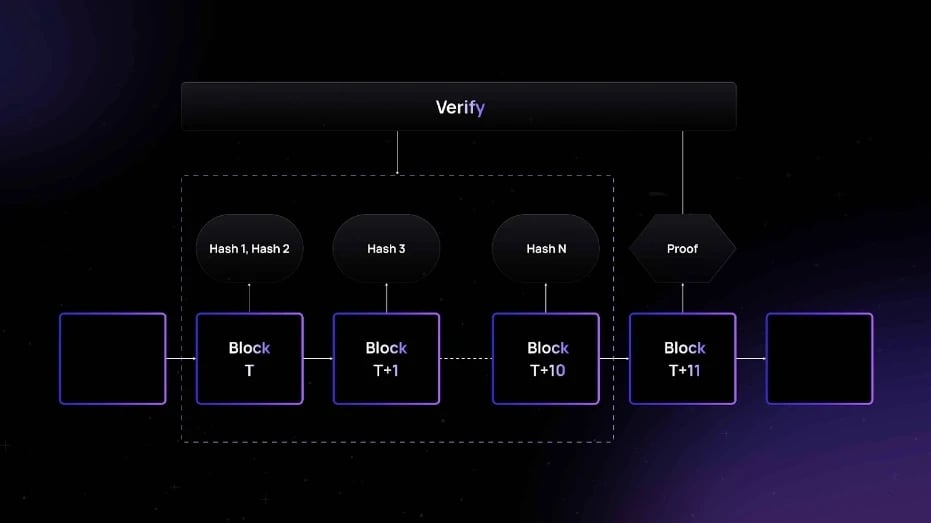
The Two-Step ZKP Submission Mechanism is designed to decentralize proof generation while preventing race attacks. Merlin Chain implements a Two-Step Zero-Knowledge Proof (ZKP) submission mechanism, inspired by Lumoz, to enable decentralized Proof of Work (PoW). In the first step, provers generate a ZKP for a sequence, calculate its hash, and submit it along with their address to a chain-level smart contract. This initial hash submission is open for T+10 blocks. After the T+11 block, provers can submit the complete ZKP, which validates previously submitted hashes. Verified provers are rewarded based on their stake proportion. This approach prevents race attacks, incentivizes continuous participation, and enhances system efficiency, security, and reliability.[7]
Fraud Detection
The Fraud Detection module provides a framework for proving correctness and challenging invalid computations. Merlin Chain employs a fraud-proof mechanism to ensure data integrity and security, utilizing two roles: Prover and Verifier. Provers pre-sign transactions and convert programs into binary circuits composed of NAND logic gates, with each gate's behavior represented by a leaf script. These scripts are organized into a Merkle Tree, with the Merkle Root submitted to a Taproot address. Verifiers retrieve the Merkle Root, validating its authenticity. If discrepancies are suspected, a challenge-response process is initiated, requiring the Prover to supply evidence supporting the root’s accuracy. This mechanism strengthens data correctness and mitigates fraudulent activity.[8]
Merlin Phantom
Merlin Phantom is an asset exchange protocol launched on Merlin Chain. It enables the interchange of Bitcoin-based assets such as RUNES, a Bitcoin fungible token standard, BRC-20 tokens, BRC-420, a Bitcoin NFT and metadata standard, and Ordinals NFTs. Developed collaboratively by UniCross, a bridge and trading protocol, and Merlin Chain, it aims to improve liquidity and broaden the use cases for BTC assets, providing users with expanded opportunities within the ecosystem.[10]
Tokenomics
Merlin Chain Token ($MERL)
The total supply of MERL is capped at 2,100,000,000 tokens, which will be gradually released over four years, beginning with the Token Generation Event (TGE). MERL runs on a BRC-20 standard and serves multiple functions within the Merlin Chain ecosystem, playing a key role in governance, security, and transaction efficiency.[11][13]
Token Utility
- Governance: MERL holders can participate in the decision-making process by voting on proposals, supporting community-driven governance.
- Staking: MERL can be staked to enhance network security, help prevent Sybil attacks, and penalize malicious actors.
- Transaction Fees: MERL is used for paying transaction fees within the Merlin Chain ecosystem, including Layer 3 networks.
- Delegating to Consensus Nodes: Token holders can delegate MERL to consensus nodes or stake it to operate one, supporting decentralization and scalability.
- Native Liquidity and Collateral: MERL can be used as liquidity and collateral, aiding transactions and supporting lending mechanisms within the network.[11]
Governance and Security
In addition to its utilities, MERL underpins Merlin Chain’s governance and security mechanisms. MERL token holders can vote on governance proposals that influence protocol upgrades, incentive programs, and other ecosystem parameters.[11][17] Staking and delegating MERL to consensus nodes contributes to network security by helping to prevent Sybil attacks and aligning node operators with correct behavior, with the possibility of slashing staked tokens in cases of malicious activity.[11][17] Merlin Chain’s bridge and core contracts have undergone third-party security audits, including an audit by ScaleBit that used code review, automated testing, and formal verification techniques to identify vulnerabilities and recommend fixes.[18]
Allocation
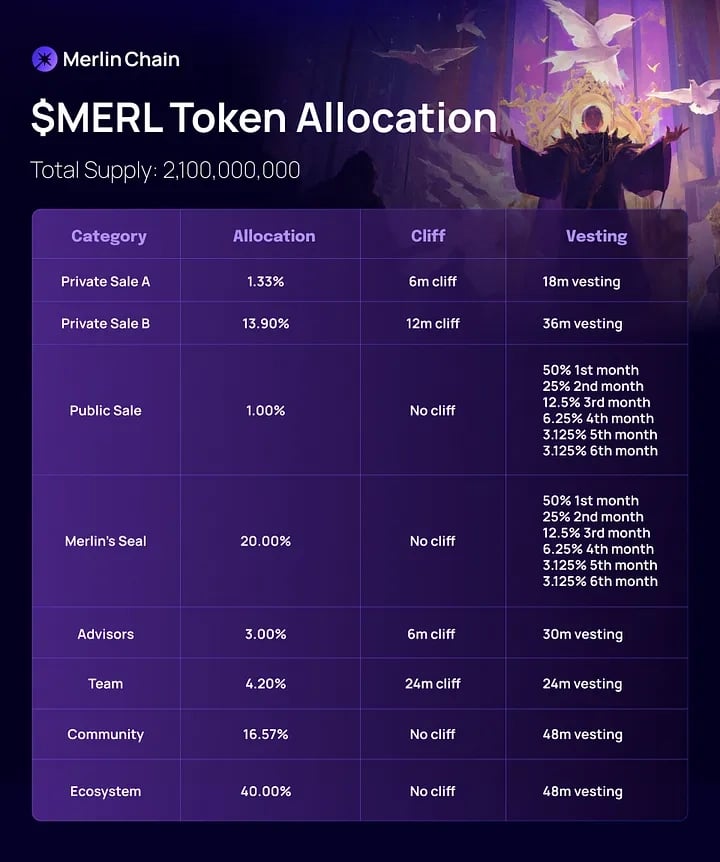
MERL’s initial four-year post-TGE allocation distributes 20% of the total supply to Merlin’s Seal participants, 1% to a public sale, 15.23% to private investors, 3% to advisors, and 4.2% to the team, with 16.57% earmarked for community incentives and 40% reserved for ecosystem grants and programs.[11][17]
Merlin's Seal
Merlin's Seal is a staking event on Merlin Chain, where participants can earn M-points and claim $MERL, the governance token. 20% of the total $MERL supply is allocated as rewards. In this event, users stake assets, and their value is converted to $BTC to calculate daily M-points, which determine their share of $MERL.
Beyond basic staking, rewards also include benefits for providing liquidity on Merlin Swap, a decentralized exchange on Merlin Chain, participating in DeFi protocols, and staking ETH. Supported assets include BTC, BRC-20 tokens, Bitmap, a Bitcoin metaverse and NFT collection, BRC-420 tokens, a Bitcoin NFT and metadata standard, ETH, USDT, and USDC. Users can stake via wallets like UniSat, OKX, and Bitget. Team leaders and members can earn bonus rewards based on total staked value.[14]
M-Token
M-Token is a representation of Layer 1 assets staked on the Merlin Chain during the "Merlin's Seal" event. When users stake assets such as Bitcoin or Ethereum on the Merlin Chain, they receive corresponding M-Tokens. Participants can mint M-Tokens with no gas fees and exchange them 1:1 for their original assets once they are unlocked. M-Tokens also facilitate interactions with NFT assets by including metadata like the Layer 1 NFT number and inscription ID.
Users can claim their original assets by destroying the corresponding M-Tokens during the unlocking process, which began in April 2024.[15][16]