Subscribe to wiki
Share wiki
Bookmark
Sumex
0%
Sumex
Sumex is a chain-agnostic, non-custodial application designed to function as a "SuperApp" for cryptocurrency users. The platform aims to unify access to trading, investing, and earning opportunities across both centralized finance (CeFi) and decentralized finance (DeFi) ecosystems from a single interface. [1] [2]
Overview
Sumex is positioned as a Web3 aggregator that bridges the gap between the typically siloed worlds of CeFi and DeFi. The platform's core design allows users to connect their existing centralized exchange (CEX) accounts and non-custodial Web3 wallets, enabling aggregated portfolio management and cross-platform activity without the service taking custody of user assets.
According to project announcements, Sumex was launched at the end of January 2026, targeting an initial cohort of approximately 20,000 "OG & Early Bird" users and and reached over 30,000 users in the first month of operation. [1] [3]
The platform intends to serve a wide spectrum of crypto participants, from beginners who can engage with guided quests and learn-to-earn campaigns, to advanced traders and investors leveraging sophisticated tools. A key component of the Sumex is its campaign infrastructures for crypto protocols.
This system is designed to enable projects launch performance-based user acquisition campaigns that reward verifiable financial activity, such as trading volume, on-chain transactions, or liquidity provision. The goal is to focus on sustaining user activity and capital involvement, rather than encouraging low-quality participation. [2] [3]
Products
Sumex's product suite is centered around its SuperApp, which integrates multiple tools and dashboards into a unified and coherent environment. [1]
SuperApp
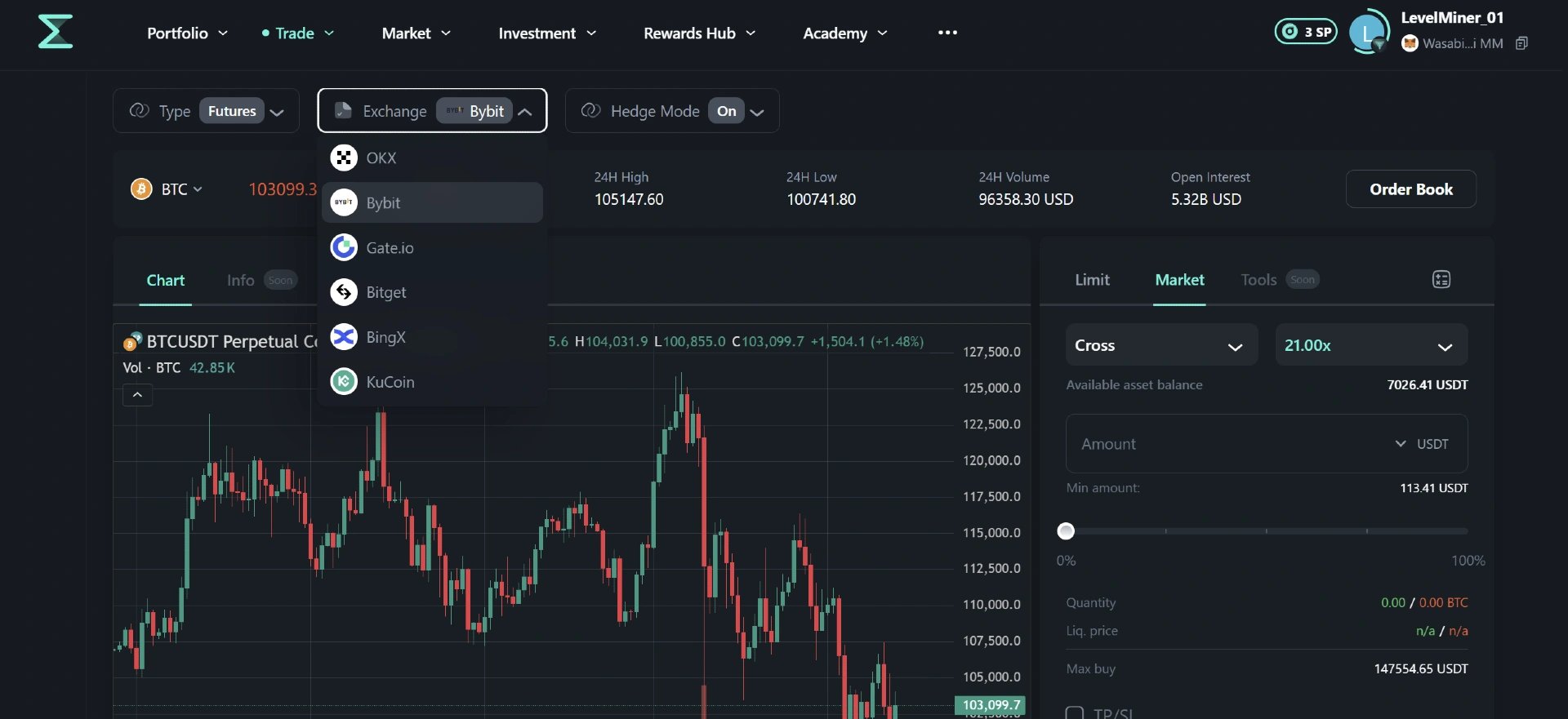
The core product is the Sumex SuperApp, which functions as the central hub for all user activity. It integrates functionalities from both CeFi and DeFi into a single application. [3]
Key components of the app include:
- Portfolio Overview: An aggregated dashboard for tracking assets and performance across connected CEX accounts and Web3 wallets. [1]
- Market Overview: A tool for broad market analysis, providing users with data and insights on market trends. [1]
- Spot & Futures Trading: Integrated interfaces that allow users to execute spot and futures trades on various exchanges directly from the Sumex platform. [1]
- Swap Aggregator: A cross-chain swap tool designed to find efficient trading routes for assets across different blockchain networks. [1]
- Investment Hub: A discovery engine for users to find and compare passive income opportunities, including staking, lending, and liquidity vaults. [1]
- Rewards Hub: An in-app portal where users can find and participate in "Complete & Earn" campaigns and quests launched by partner protocols. [1]
Features
Sumex aims to solve the problems of crypto tribalism and Web3 fragmentation by offering a range of features that facilitate a unified crypto management experience and create value for partner protocols. The platform's design emphasizes user control, interoperability, and data-driven rewards. [1]
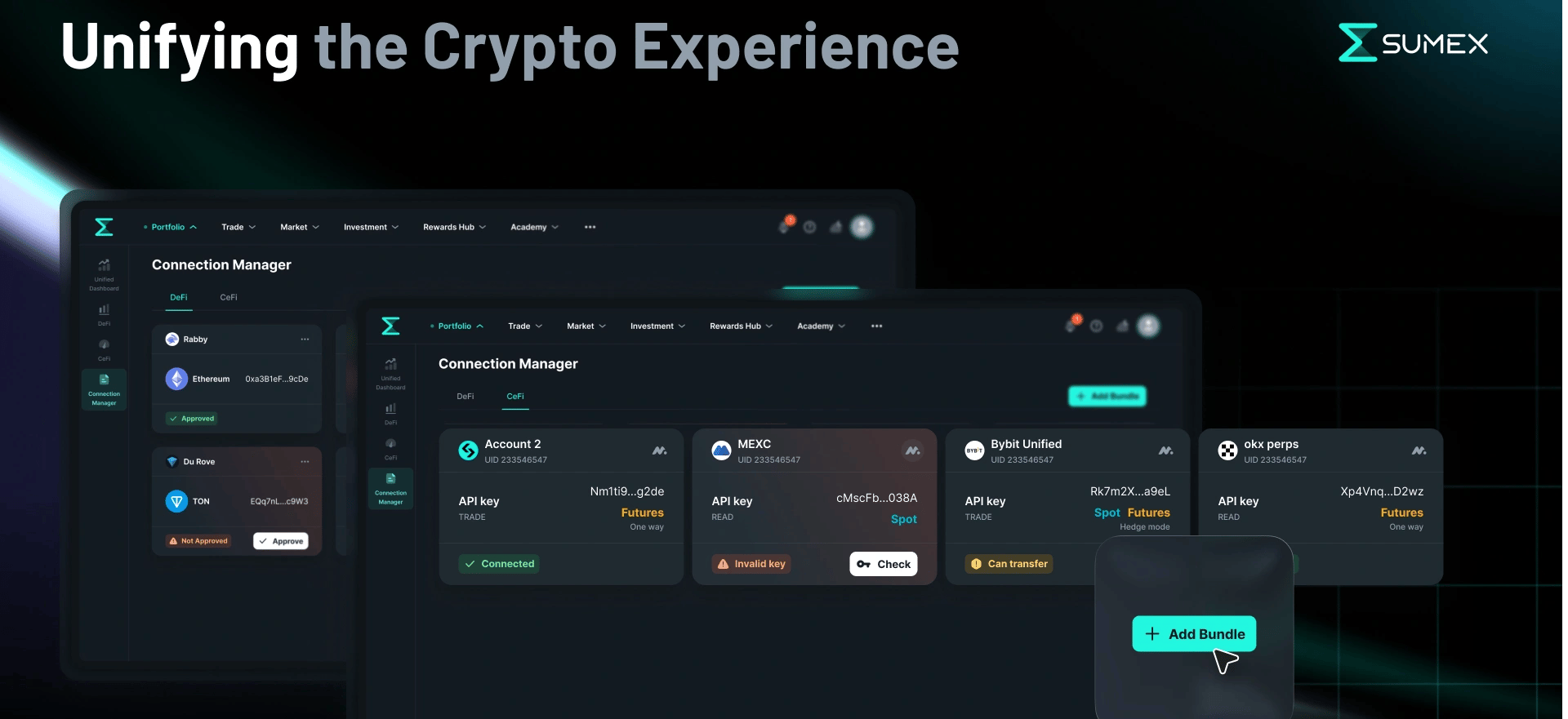
Its primary features include its non-custodial and chain-agnostic design. The non-custodial architecture ensures that users maintain control over their private keys and funds at all times. The chain-agnostic nature allows the platform to interact with assets and protocols across a variety of different blockchains, providing a more holistic view of the market. [1] [3]
For partner protocols, Sumex provides a specialized campaign and analytics platform. This allows projects to create engaging quests from daily tasks to elaborate campaigns that reward users for specific, verifiable actions rather than simple social engagement.
These actions can include achieving certain trading volumes on a CEX, performing on-chain transactions, providing liquidity to a specific pool, or demonstrating patterns of user retention. Sumex states it can provide deep analytics on these campaigns due to its Analytic Layer, offering insights into participant activity, the amount of capital moved, and the long-term "stickiness" of users and their capital after rewards are distributed. [2]
Other notable features include aggregated trading tools like copy trading, a curated discovery engine for passive income streams, and the integration of AI-powered assistance to help guide user strategy and identify market opportunities. Based on available micro an macro data, the sumex analytics layer aggregates information without KYC or personal data. [1]
Ecosystem
The Sumex ecosystem is designed to connect several key participants: individual users, crypto protocols, centralized exchanges, and decentralized protocols. Users interact with the SuperApp to manage their assets and access opportunities. Protocols and projects utilize the platform to launch user acquisition campaigns aimed at attracting active and capitalized participants. The platform intends to build an extensive ecosystem through integrations with numerous blockchains, exchanges, and protocols
Centralized and decentralized exchanges are integrated to provide the trading venues, and data feeds for the for the analytics tools. At the time of the launch, Sumex supports trading across a number of notable exchanges such as: OKX, Binance, Bybit, Bitget, BingX, Gate, Kucoin, Hyperliquid, while the roadmap indicated future integrations of other major players [1] [3]
Sumex aims to become completely chain-agnostic, while supporting EVM-compatible networks like Ethereum, BNB or Polygon, TON and Solana blockchains at the launch. It also aims to support Stellar, Tron and Sui in the future.
Its integration plan also covers major DeFi protocols such as Aave and Lido, providing users access to leading lending and liquid staking services. [1]
Use Cases
The platform is designed with distinct use cases for its two primary user groups: individual crypto participants and protocol developers.
For Individual Users
- Connect CEX accounts and Web3 wallets for unified portfolio tracking
- Trade across multiple exchanges through a single interface
- Execute cross-chain and on-chain swaps via routing aggregation
- Discover and access passive income opportunities
- Participate in campaigns, quests, and trading competitions
- Analyze performance and optimize strategies using integrated tools
For Protocols and Projects
- Launch performance-based campaigns tied to real user activity
- Incentivize on-chain actions such as liquidity provision or protocol usage
- Target users based on behavior, capital allocation, and retention
- Measure campaign effectiveness through detailed analytics.
For protocols, Sumex's use cases focus on providing a more effective and data-rich alternative to traditional airdrop and social engagement campaigns. [2] [3]
Architecture
Sumex is built upon a non-custodial and chain-agnostic technical framework which which is structured into distinct layers, including Connectivity, Trading, On-chain, GameFi, and Analytics. This architecture serves as the foundation for its function as an aggregator. The system is designed to cater to all crypto users by allowing connection to the users' existing Centralized Exchange (CEX) accounts, likely via API keys, and their personal non-custodial Web3 wallets.
This model allows the platform to read balances, track performance, and initiate user-approved actions without taking direct custody of the underlying assets or private keys as well as without the need for KYC or even registration.. [1] [3]
See something wrong?