Beldex
Beldex is a privacy-focused cryptocurrency and Proof-of-Stake (PoS) blockchain ecosystem whose native coin, Beldex (BDX), supports optional-privacy transactions and decentralized applications such as BChat and BelNet.[11] Launched in March 2018, the project operates its own PoS mainnet secured by masternodes and is listed by major exchanges and company databases as associated with Seychelles and Malaysia.[1][28][22] Beldex is led by founder and chairman Afanddy B. Hushni and co‑founder and CEO Kim, who oversee network development and the expansion of the surrounding ecosystem.[28][22]
Compare Cryptoassets
Select an asset to compare its price and other stats against Beldex.
 ?
?Ecosystem map
Explore the wikis Beldex is connected to and their relationships on the map.
Overview
The Beldex platform is built around a decentralized, privacy-focused cryptocurrency network that uses its native BDX coin, derived from Monero, to support confidential peer-to-peer transactions. The protocol allows users to choose between public and private transfers, using privacy techniques inherited from Monero to obscure transaction details when private transfers are selected.[1][11]
The Beldex blockchain is secured by a network of masternodes under a Proof-of-Stake consensus model and is designed to host privacy-preserving applications, including the BChat messaging service and the BelNet decentralized VPN. As of August 2026, a Beldex wallet application was available for Android devices, allowing users to hold and transfer BDX on mobile.[26][9]
Building on this infrastructure, Beldex aims to integrate BDX into retail and e-commerce, creating a broader utility for the token within a crypto ecosystem that seeks to eliminate intermediaries and enhance transactional freedom.[2][3][4][5]
BDX Token
The Beldex Token (BDX) is a coin that serves as the native token of the Beldex platform. It is designed for integration across the Beldex ecosystem, including payments, staking, and application use. BDX aims to differentiate from other coins by focusing on privacy and security features, building on the mechanisms used in Monero.[6][7][8]
Tokenomics
The total supply of BDX is 9.9 billion and is divided into eight categories, which are allocated to various wallets for specific purposes. These categories are circulation, ecosystem development, seed and venture capital allocation, marketing, team allocation, exchange liquidity, legal operations, and early adopter rewards.[10]
As of December 10th, 2021, the allocation to each category was the following: [10]
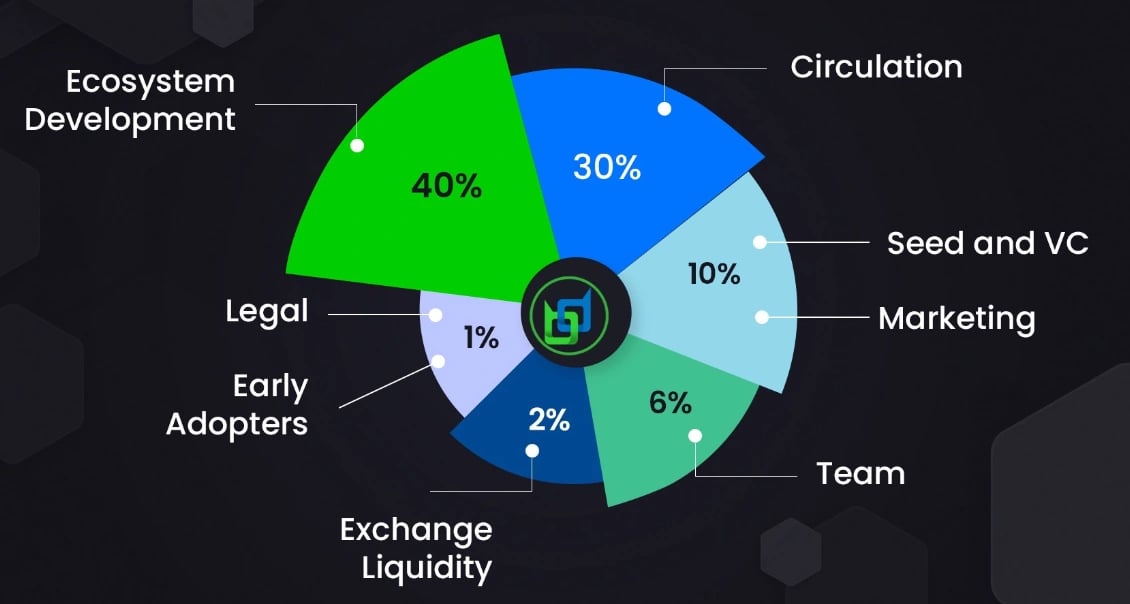
For each quarter, 130,680,000 BDX is released from these categories according to their vesting schedules and used for their stated purposes. For example, in the first three quarters of 2022, a total of 392,040,000 BDX (3.9% of the total supply) was released from the ecosystem development fund for the development and expansion of the Beldex ecosystem. This updated distribution, in effect from October 1st, 2022, is shown below as a percentage of the total supply.[10]
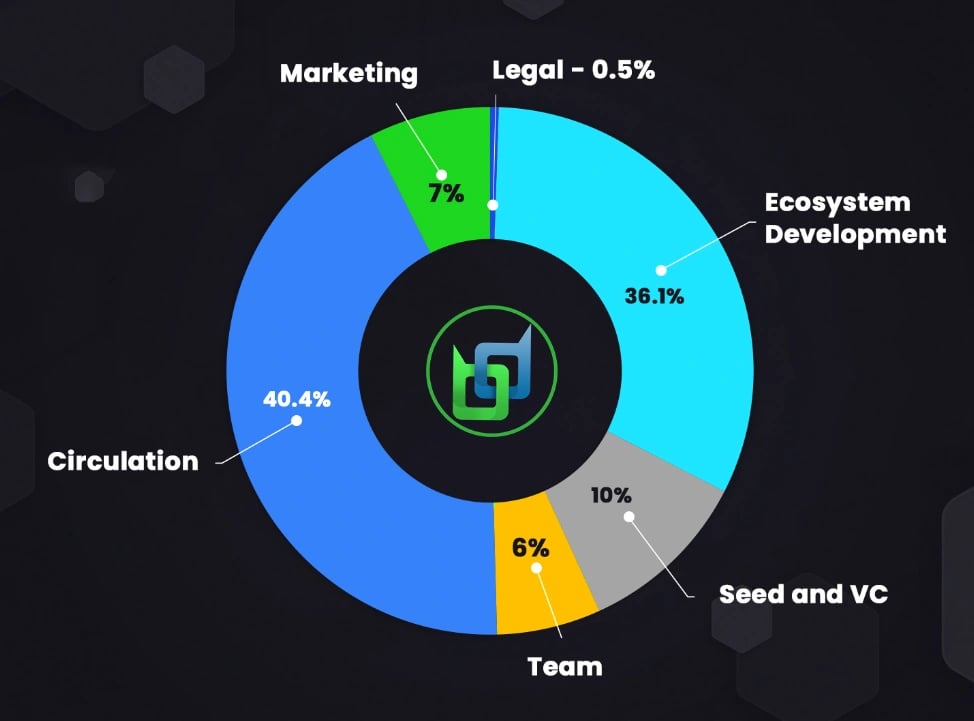
As of June 30, 2026, BDX tokenomics continued to follow this quarterly release schedule from the ecosystem development and Seed & VC wallets, with 18 planned releases having occurred, each of 130,680,000 BDX from the Ecosystem Development wallet.[30][31] In the same June 30, 2026 update, Beldex reported that the Ecosystem Development wallet still held more than approximately 1.6 billion BDX and that the Seed & VC wallet held just over approximately 214 million BDX, reflecting balances at that date rather than fixed long‑term totals.[30]
Beldex Proof of Stake
In the Beldex Proof of Stake (PoS) system, users stake BDX on nodes in order to participate in the validation of blocks on the network. The more BDX a user stakes, the higher the user’s chances of being selected to validate a block, and the lower the difficulty for that node. The POS system on Beldex is based on delimited competition among nodes.[11]
In the POS consensus, every 30 seconds, a node is selected at random to produce a block, which is then sent to a quorum vote consisting of 11 other participating validator nodes. If at least 7 out of 11 validator nodes attest to the block's authenticity, it is broadcast to the network as a valid block. Afterward, a new quorum is formed and the process repeats. Beldex also provides pool staking via masternodes, where the hardware is shared among several individuals who collectively provide the stake amount.[11]
Master Nodes
Beldex masternodes are validator nodes that construct and validate blocks under the network’s PoS consensus, helping to maintain ledger integrity and overall network security.[11] In addition to block production and validation, secure masternodes route traffic for privacy-focused services such as BelNet and BChat, forming the backbone infrastructure for these applications.[11][12] Masternode operators receive a share of block rewards in return for providing uptime, meeting performance requirements, and delivering these routing and validation services.[11]
Block rewards
Block rewards are incentives given to nodes or masternodes in a cryptocurrency network for validating and adding new blocks of transactions to the blockchain. When a node or masternode creates a new block, it is rewarded with a certain number of BDX coins, which are emitted as a new block reward. As of November 2021, the base block reward on the Beldex network was set to a constant value of 2 BDX.[11] With the Bucephalus hard fork on November 30th, 2021, the protocol increased block rewards to 10 BDX and introduced a split between masternode operators and a governance allocation, aligning incentives for both network security and protocol decision-making.[12][11] Masternodes that are found to provide the best services to the network are moved to the front of the reward queue, while those that are penalized are moved to the end of the queue.[11]
Master node staking requirements
Operating a Beldex masternode requires staking 10,000 BDX as collateral, which is locked in a time-locked output for as long as the node remains registered.[29][11] When an operator requests to unlock this stake, the collateral remains locked for an additional 15 days, during which it continues to accrue rewards until the unlock is finalized.[29] If a masternode is deregistered, the associated collateral is subject to a 30-day lock period before it can be reused or withdrawn, a design intended to discourage short-term churn and preserve network stability.[29]
B-Chat
B-Chat is an anonymous messaging application that uses BelNet, a decentralized Virtual Private Network (dVPN), to route messages. Launched on June 29th 2022, B-Chat contrasts with traditional messaging apps that rely on end-to-end encryption but typically use centralized infrastructure to relay and store messages.[27] With B-Chat, messages are routed to their destination through the shortest possible node distance while being encrypted at each hop. This routing design ensures that messages are not stored on a centralized data center, which makes them less vulnerable to attacks and government intervention. Additionally, B-Chat uses Beldex Secure Masternodes to ensure that messages can be sent even when the receiver is offline.[11]\
BelNet
BelNet is a private decentralized VPN that utilizes the Beldex Routing Protocol (BRP) to optimize communication between nodes and traverse traffic through the network with minimal load on the secure masternodes. This approach contrasts with traditional VPNs, which are typically managed by centralized systems. BelNet's Distributed Hash Table is maintained by masternodes, which ensures that new nodes must meet specific bandwidth and staking requirements to join the network. Governance is maintained by randomly assigned governing nodes that verify incoming new nodes and penalize those that fail to meet bandwidth requirements. This process is intended to keep the network decentralized and to offer greater privacy compared to traditional VPNs. Additionally, BelNet supports a wide range of internet protocols and uses a packet switching routing model, which allows for more efficient communication between nodes.[11]
Flash Transactions
Flash transactions are a feature of the Beldex blockchain that allows for faster confirmation of transactions. Unlike traditional blockchain transactions, which can take anywhere between 20–40 minutes to be confirmed, flash transactions take only a few seconds. This speed is achieved through a second-layer architecture that is similar to Bitcoin's Lightning Network, where the protocol selects the shortest possible route between flash channels and uses a channel path reducing algorithm to send the outputs to the receiver.[11][13]
Flash transactions are made possible through the use of masternodes, which confirm a transaction's authenticity by securing the key images associated with the unspent transaction outputs (UTXOs). Masternodes store each key image and hold it until the transaction is added to a block on the Beldex network. If the same key image is produced more than once, it signals a double-spending attempt and the corresponding duplicate transaction is rejected.[11][13]
Similar to Ethereum, flash transactions also enable a mechanism for competing transactions to pay a higher fee to be completed first. However, this prioritization process is several times faster and takes place outside the blockchain itself. Overall confirmation time on the blockchain is also significantly reduced due to the network's transition to a Proof-of-Stake (POS) consensus.[11][13]
Coin Burning
The Beldex coin burning mechanism is a method used to control inflation and support a stable market value. Network fees obtained from flash transactions are burned to contribute to this goal. Because flash transactions are instant, they have a higher fee than regular transactions, and these fees are burned immediately after the transaction is finished. Burning these fees is intended to help control inflation and provide more sustainable price discovery in the market.[11]
Bucephalus Hard Fork
On November 30th, 2021, the Bucephalus hard fork upgrade went live. The hard fork transitioned the Beldex blockchain from a Proof of Work (PoW) to a more energy-efficient Proof of Stake (PoS) consensus algorithm. By transitioning to PoS, Beldex aimed to improve the scalability and security of the network, as well as reduce its environmental impact.[12]
“This will make the Beldex network economical and reduce its carbon footprint." - CTO, Niyaz N.
The hard fork was projected to increase block creation speeds by 4 times, provide a 212.5% increase in rewards to master node operators, and allocate 37.5% of block rewards to governance. These changes were intended to increase the adaptability of the Beldex ecosystem and lay the foundation for the development of decentralized applications (DApps).
Obscura Hard Fork
The Obscura hard fork activated on the Beldex mainnet on December 7, 2025, at block height 4,939,540, introducing Bulletproofs++ zero‑knowledge range proofs in place of the network’s previous Bulletproofs scheme.[32][33] According to Beldex, this structural upgrade reduced average range‑proof sizes by roughly 38%, allowing transactions to be encoded more compactly while maintaining the same privacy guarantees.[32] The change is intended to enhance long‑term scalability by lowering the on‑chain footprint of private transfers and making it easier for nodes to process and store the ledger.[32]
By producing smaller proofs and optimizing verification, Obscura is described as improving transaction efficiency, node synchronization times, and the hardware requirements for running Beldex masternodes, while preserving the confidentiality properties of earlier transactions.[32][33] The fork is also positioned as a preparatory step for later consensus changes, with project communications indicating that it precedes a planned transition to a Verifiable Random Function (VRF)‑based consensus design.[32]
Team Members and Advisors
- Afanddy B. Hushni: Chairman
- Kim Beldex: Chief Executive Officer and Co-Founder
- Codeman-Crypto (cc): Chief Technology Officer
- Ziau: Chief Marketing Officer
- Sanada Yukimura: Blockchain Architect[[9]] - (#cite-id-1esszb0vj69)**[9]
Advisors
- Allard Dijk
- Dr. Mitchell Kraiwec-Thayer
- Dr. Dominique Schroder[9]
Partners
Exchange Partners
Masternode Partners
- MNO
- MasternodeBuzz
- nodehub.io
- MYCOINTAINER
- PerfectNodes
- Pecunia Platform
- GETBLOCK[9]
Roadmap
As of 2025–2026, the public roadmap listed planned items including the Obscura hard fork, Beldex Browser beta, and a swap feature on the mobile wallet, alongside LayerZero‑based cross‑chain deployments of BDX on networks such as Ethereum, Arbitrum, Base, BNB Smart Chain, Near, Hyperliquid, and Solana.[34] For 2026, the roadmap further outlined research and planned releases related to a VRF‑based consensus, pilot work with Fully Homomorphic Encryption (FHE), a BNS marketplace and MNApp store, and a decentralized identity system on a Beldex sidechain, which were presented as targets rather than completed milestones.[34]
2021 - POS has Launched
- Q1 - Wallets
- Q2 - Binance Smart Chain Bridge
- Q3 - POS Testing
- Q4 - BUCEPHALUS
2022 Ecosystem Development
- Wallet Release - Q1
- BCHAT Alpha Release - Q2
- Ecosystem Phase I - Q3
- Ecosystem Phase II - Q4
2023 EVM Integration
- Q1 - Ecosystem Phase III
- Q2 - Ecosystem Phase IV
- Q3 - EVM Integration Phase I
- Q4 - EVM Integration Phase II
Product Updates
In 2023, Beldex updated BChat and BelNet, focusing on improving usability, security, and network stability. New features were introduced, including group messaging in BChat and increased bandwidth for BelNet users. Additionally, in early 2024, Beldex launched a browser designed to enhance privacy by integrating BelNet, facilitating anonymous browsing with a focus on data protection.[14][15][16][9][17]\
Project updates for 2025 and early 2026 described continued releases of the Beldex Browser for Android with multi‑language support and integration of Web3 domains, along with BChat updates on Android, desktop, and iOS that added or refined features such as group messaging and text formatting.[35][31] The same communications reported improvements to BelNet and the Electron desktop wallet, including smarter routing, auto‑connect functionality, and additional language options intended to make the applications easier to use across different regions.[31]
Tokenomics Adjustments
In early 2024, Beldex modified its token-burning mechanism in response to the increased demand for flash transactions. This adjustment was aimed at improving the stability of BDX's market value. Additionally, a portion of block rewards was redirected to a community governance fund, allowing BDX holders to participate in voting on network-related proposals.[11]
Ecosystem Expansion
Throughout 2023, Beldex expanded its ecosystem through collaborations with DeFi and NFT projects and by progressing infrastructure for privacy-preserving applications, as part of a broader strategy to increase BDX utility across different digital environments.[19] The ecosystem was also extended through an e-commerce partnership with Uquid, which enabled BDX to be used for purchases within Uquid’s online marketplace.[21] In parallel, development updates highlighted continued work on Beldex Name Service (BNS), BelNet integration, and the privacy-focused browser, reflecting an emphasis on expanding the set of applications that can utilize the Beldex network.[19][14]
Ecosystem integrations continued into 2025–2026, with Beldex announcing additional exchange spot and futures listings, integrations with swap and liquidity platforms, and payment and wallet partnerships, including collaborations with providers such as HPX Cards, Aeon Pay, Alchemy Pay, Tangem, and Aerodrome DEX.[35][30]
Roadmap Developments
By the close of 2023, Beldex completed integration with the Ethereum Virtual Machine (EVM), enabling smart contract functionality on its network and supporting the creation of decentralized applications (DApps) with a focus on privacy.[25][17] This EVM work formed part of a broader research and development agenda that also explored sidechain architectures and other scalability enhancements.[23][24] For 2024, Beldex’s roadmap outlined plans to expand its masternode network and enhance decentralized governance, along with additional product and infrastructure updates, which subsequent project communications continued to reference as key areas of ongoing development.[22][17]