0% read
Last updated:
Triple Plus
Triple Plus is the blockchain and digital-asset ecosystem developed by Triple Plus Global. TPT Protocol is one current public-beta network within that broader ecosystem, focused on agent and service discovery and routing.[1]
Overview
Triple Plus Global develops the Triple Plus ecosystem, which encompasses the TPT token and related platform, P2P OTC trading, TPT Protocol’s public-beta agent and service discovery and routing network, and planned financial products. Triple Plus Global’s July 2026 public launch announcement described P2P OTC trading and Swap Staking, with invoice factoring in development and supply-chain finance and broader trade finance planned.[10] Current official documentation presents the agent and service network as one current offering: it aggregates listings from MCP registries, agent marketplaces, and x402 service directories into a searchable catalog. The network parses user intents into tasks, queries connected venues, ranks candidates using price, latency, track record, reputation, permissions, and preferences, and can compose a route involving multiple agents or services. It uses stablecoin payment rails and escrow for higher-value tasks; catalog discovery is distinct from execution, and readiness varies by venue.[1][7][8][9]
The official Triple Plus stack describes market integration, an aggregation engine, the Trust Engine, and financial verticals including invoice factoring, supply-chain finance, and trade finance.[9] The documentation describes the catalog as normalizing listings, capabilities, pricing, and ratings from connected venues. Execution follows policy constraints, and the protocol describes smart contracts and blockchain records for settlement and transaction activity. Financial products remain planned; participants and verification requirements vary by product.[8][7][1]
Technology and Architecture
TPT’s market integrations normalize listings, capabilities, pricing, and ratings from MCP registries, agent marketplaces, and x402 service directories into a searchable catalog. The documentation describes catalog synchronization separately from execution and displays execution readiness by venue.[8]
The documented routing sequence parses a user’s intent into a task, aggregates listings from connected venues, ranks candidates, composes an execution path where useful, and settles under policy constraints. Ranking considers price, latency, track record, reputation, permissions, and user preferences. Routes may involve multiple agents or services; discovery in the catalog does not itself mean that a venue is ready to execute a task.[7][8]
The protocol describes stablecoin payment rails for intent payments and escrow for higher-value tasks. Its proposed Trust Engine concept includes bonded capital, underwriting, payment-anchored reputation, and staked arbitration. These are described as planned token-related functions, and the documentation says Trust Engine functions are not live until announced.[1][7][9][6][11]
Products
Agent and Service Routing
Agent and service routing is the network’s present core offering in public beta. TPT Protocol aggregates listings from MCP registries, agent marketplaces, and x402 service directories into a normalized, searchable catalog of capabilities, pricing, and ratings. It parses user intents, queries connected venues, ranks candidates using price, latency, track record, reputation, permissions, and preferences, and can compose a route across multiple agents or services where useful.[1][7][8]
Catalog discovery and execution are distinct: connected listings can be searchable while execution readiness varies by venue. When a route is executed, the documented mechanism applies policy constraints and uses stablecoin payment, with escrow for higher-value tasks.[8][7]
P2P Trading
The P2P Trading platform is a live/beta product within the Triple Plus (TPT) ecosystem, enabling users to trade TPT tokens directly with one another without relying on a centralized exchange. Triple Plus announced P2P OTC trading as available at its July 8, 2026 public launch on Polygon, alongside Swap Staking.[10] Users create buy or sell orders by specifying their own price and trade amount, with tokens or stablecoins held in smart contract escrow until another participant accepts the order. Once matched, the transaction is settled automatically on-chain. Project documentation describes the market as supporting TPT distribution, liquidity, and price discovery.[2] Trading requires connecting a compatible wallet and completing the platform's verification process. The earlier documentation described TPT-based trading incentives; current token-utility documentation says trade mining has been replaced by incentives tied to bonded capital and verified activity. Transactions are described as executing without platform trading fees.[2][11]
Invoice Factoring
The Invoice Factoring marketplace is a planned component of the Triple Plus protocol that is intended to allow businesses to obtain immediate liquidity by selling unpaid invoices at a discount, while investors purchase those receivables and receive the full invoice value when the debtor makes payment. Businesses are expected to submit invoices and supporting documentation for verification before listing them on the platform, with investors evaluating opportunities based on factors such as discount rates, payment terms, debtor credit quality, invoice age, and seller history. Current official documentation continues to mark invoice factoring as planned and not live, with no committed launch timeline.[3]
The protocol is designed to tokenize verified invoices and use blockchain-based smart contracts to manage funding, settlement, and transaction records. Listed invoices must satisfy eligibility requirements, including documentation of the underlying commercial transaction and verification of both the seller and debtor. The platform is intended to support short-duration trade finance investments backed by commercial receivables, with pricing determined by market conditions and the perceived credit risk of each invoice. Current documentation says the product would build on the agent network's escrow, underwriting, reputation, and dispute-resolution infrastructure.[3]
Supply Chain Finance
The Supply Chain Finance platform is a planned feature of the Triple Plus protocol, still labeled “Planned (Q4 2026)” in official documentation updated in September 2026. It is intended to provide financing against verified purchase orders before goods are delivered.[4] Unlike invoice factoring, which finances completed sales after invoices have been issued, this product is designed to help suppliers access working capital earlier in the production cycle to cover expenses such as raw materials, manufacturing, and shipping. The platform is primarily aimed at suppliers serving larger organizations, including manufacturers, small and medium-sized businesses, seasonal businesses, and companies experiencing rapid growth. The proposed workflow involves verifying purchase orders through integrations with corporate procurement and order management systems before suppliers request financing from investors. Once funded, suppliers fulfill the purchase order, the buyer completes payment under the original commercial terms, and investors receive repayment after settlement. Because financing occurs before delivery, the model introduces additional delivery-related risk compared with invoice factoring and requires verification of both purchase orders and buyer commitments through integrated enterprise systems. Current documentation also identifies purchase-order verification, delivery confirmation, and anchor enterprise partners as requirements.[4]
Trade Finance
The Trade Finance platform is a planned future component of the Triple Plus ecosystem, currently marked for 2027, designed to digitize and automate international trade finance processes using blockchain technology.[5] The proposed platform is designed to replace paper-based instruments such as letters of credit and documentary collections with smart contract-based workflows for cross-border transactions. The platform would target importers, exporters, manufacturers, trading companies, and other participants involved in international supply chains. The proposed system would support digital trade documentation, automated verification of shipping and customs records, and programmable settlement based on predefined transaction conditions. It is also intended to integrate with banks, logistics providers, customs authorities, and freight operators to coordinate the movement of goods and payments through a shared digital workflow. Current documentation also describes proposed programmable letters of credit, multiparty coordination, document verification, and logistics integrations.[5] The project describes this product as a long-term expansion that would build upon the infrastructure developed for its invoice factoring and supply chain finance services.
TPT Token
TPT is the native token of the TPT Protocol. The July 8, 2026 launch announcement described Swap Staking alongside P2P OTC trading.[10] Current token documentation frames TPT as the collateral and bonding layer for the Trust Engine, rather than as a payment currency or fee-discount coupon; stablecoins are used for intent payments. Proposed functions include provider bonding and slashing, underwriting, staked arbitration, revenue capture, routing and data access, and later governance. The documentation says Trust Engine functions are not live until announced. It also marks fee discounts as retired and says trade mining has been replaced by incentives tied to bonded capital and verified activity. Earlier documentation described staking for investor access, discounted fee payments, and P2P trading rewards; these descriptions reflect the prior utility model.[6][11]
Under the proposed provider-bonding mechanism, a provider’s task-credit limits would be based on its TPT bond and reputation. Indicative slashing would apply to failures or late delivery, losses in arbitration, and collusion. An underwriting pool would stake against escrowed high-value tasks and absorb shortfalls after provider bonds, with the treasury as the final backstop. Staked arbiters would decide contested delivery disputes and receive fees under the documented loser-pays and coherence mechanism. Proposed revenue capture would direct stated shares of protocol revenue to buybacks and staker distributions. Staking may provide equal-reputation routing preference, higher rate limits or enterprise lanes, and access to aggregated intent analytics. Future staker governance would set bonding, slashing, underwriting, revenue-split, and registry parameters. The documented rates and percentages are indicative proposals, not current live settings; the Trust Engine functions remain planned and are not live until announced.[11]
Tokenomics
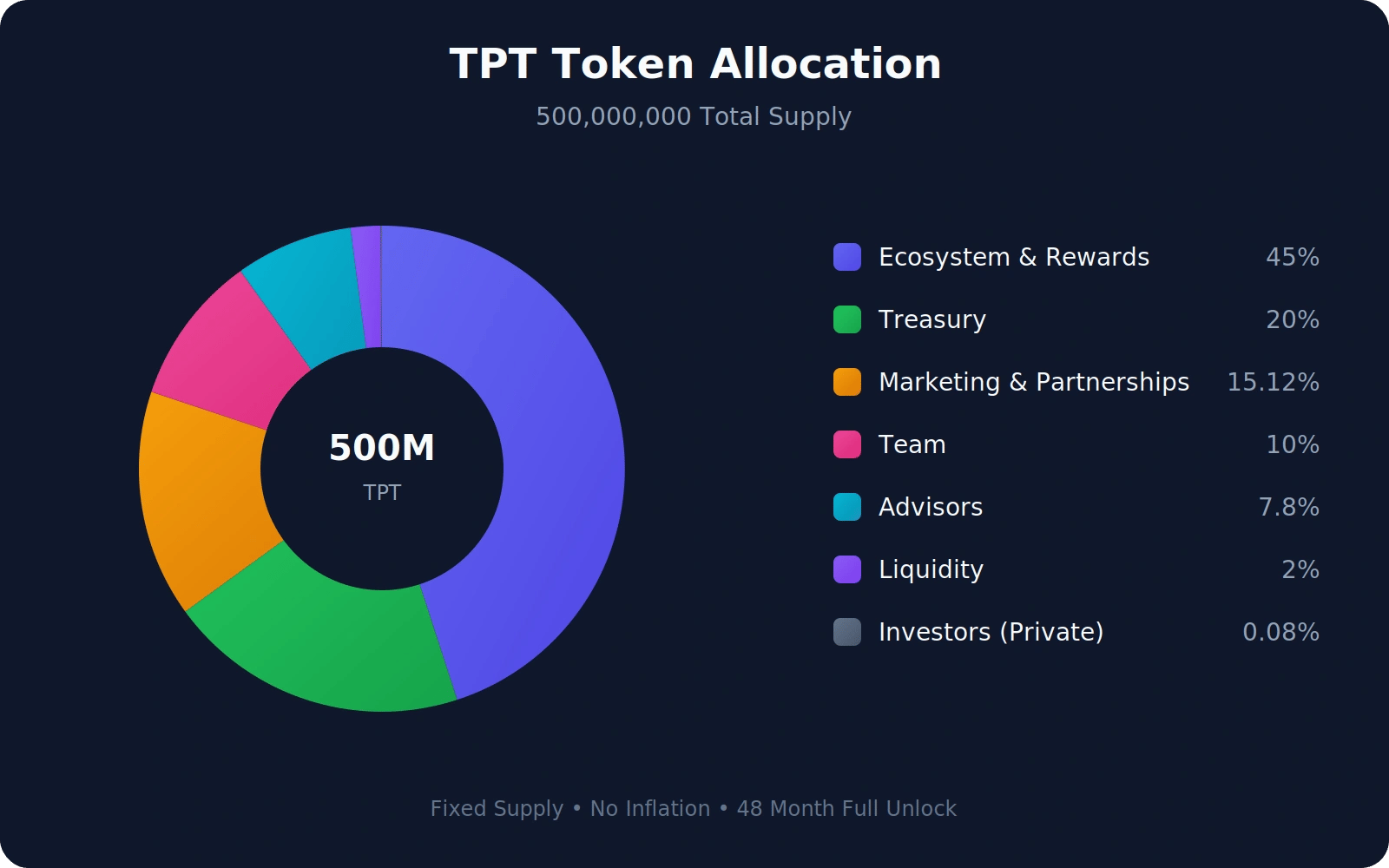
TPT has a fixed total supply of 500,000,000 tokens. The official distribution document lists the following allocations:[6][15]
- Ecosystem & Rewards: 45% / 225,000,000 tokens
- Treasury: 20% / 100,000,000 tokens
- Marketing & Partnerships: 15.12% / 75,600,000 tokens
- Team: 10% / 50,000,000 tokens
- Advisors: 7.8% / 39,000,000 tokens
- Liquidity: 2% / 10,000,000 tokens
- Private Investors: 0.08% / 400,000 tokens
The stated vesting schedule gives Ecosystem & Rewards 5% at TGE, followed by linear vesting over 48 months with no cliff. Treasury has 0% unlocked at TGE, a six-month cliff, then 36-month linear vesting. Marketing & Partnerships has 15% unlocked at TGE, followed by 24-month linear vesting with no cliff. Team has 0% unlocked at TGE, a 12-month cliff, then 36-month linear vesting. Advisors have 0% unlocked at TGE, a six-month cliff, then 24-month linear vesting. Liquidity and Private Investors are 100% unlocked at TGE.[15]
The official schedule provides projected circulation milestones but contains inconsistent TGE figures: its summary reports 22,690,000 tokens (4.54%), while its milestone table reports 32,990,000 (6.6%), and the stated TGE category amounts sum to 32,990,000. The discrepancy prevents a clear circulating-supply figure from being established from that schedule.[15]
See something wrong?

Official Website:
Social Profiles:
Explorers:
Founders:
Blockchains: