0% read
Last updated:
Lindsay Fraser
Lindsay Fraser is a public policy professional whose work has focused on technology, financial services, and government policy. She is Chief Policy Officer at the Blockchain Association and previously held policy roles at Uniswap Labs and Carta, as well as strategy and government-related positions in Washington, D.C. [1]
Education
Fraser attended Vanderbilt University, where she earned her BA in Political Science and Government. She later received her Master’s in Security Studies from Georgetown University. [2]
Career
Fraser began her professional career through internships in government, media, and international policy, including roles with Senator Bob Corker, MSNBC, the Carnegie Endowment for International Peace, and the U.S. Department of State. From 2019 to 2020, she worked at the Office of Management and Budget as a Graduate Student Trainee in the Office of Federal Financial Management before joining Pallas Advisors as an Analyst in 2020. Fraser joined Penta Group in 2022 as a Senior Associate in Strategy and moved into public policy at Carta in 2023, progressing from Public Policy Analyst to Public Policy Associate. She joined Uniswap Labs in October 2024, initially as a Senior Policy Associate and later as Senior U.S. Policy Lead, before becoming Chief Policy Officer at the Blockchain Association in December 2025. [3]
Interviews
CLARITY Act
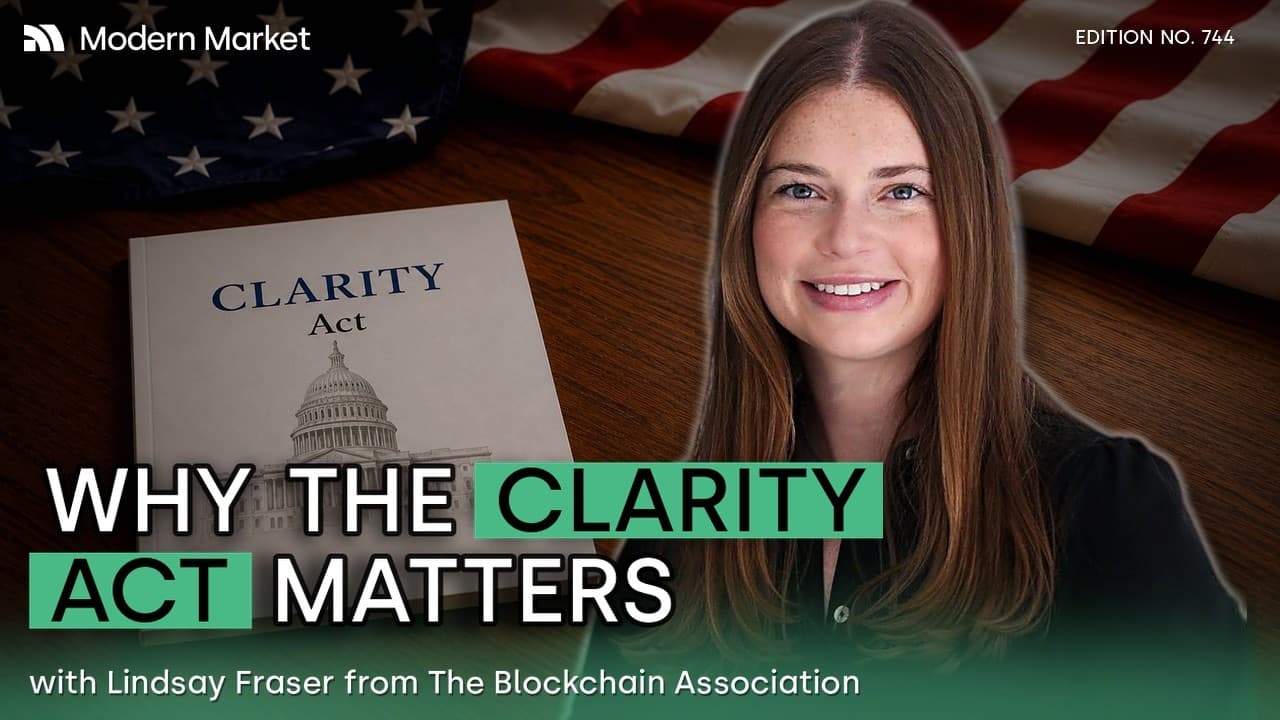
In a May 2026 interview on the Modern Market Show podcast, Fraser discussed her role as Chief Policy Officer at the Blockchain Association and the organization’s work on the Clarity Act and broader digital asset legislation. She outlined progress on bipartisan crypto legislation, including reconciling different bills, moving legislation through committee and Senate procedures, and ultimately sending it to the President, while noting the importance of timing ahead of the August recess and upcoming elections. Fraser also discussed policy debates around stablecoin rewards, AML/KYC requirements, technical definitions, conflicts of interest, DeFi regulation, and protections for blockchain developers, emphasizing the industry’s efforts to negotiate in good faith while preserving room for innovation. She also reflected on her transition into policy work, the rapid pace of legislative negotiations, and the significance of helping shape the U.S. regulatory framework for digital assets. [5]
Presentation
Blockchain Developers
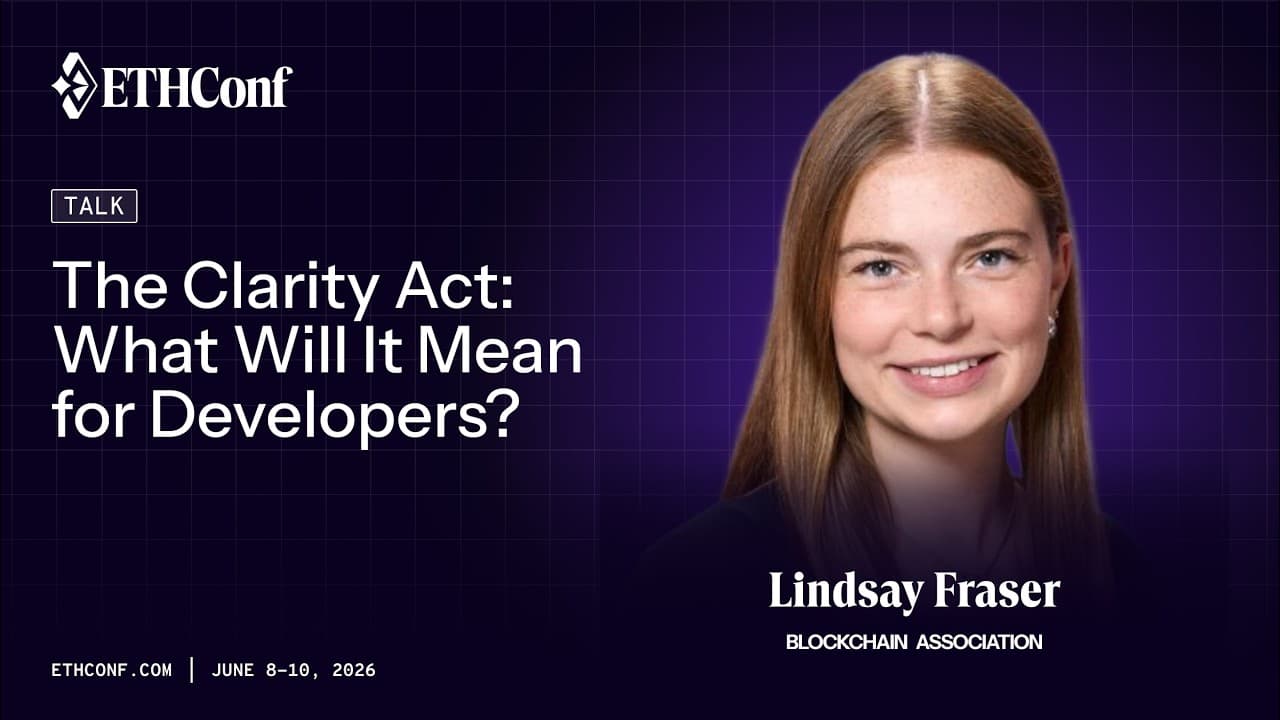
In a July 2026 presentation at ETHConf, Fraser discussed the Clarity Act and its implications for blockchain developers, particularly those building decentralized and non-custodial applications. She explained that the legislation sought to establish clearer rules for token classification, trading, and market structure while protecting software developers from being treated as financial intermediaries when they do not custody or control user funds. Fraser argued that regulatory uncertainty had contributed to reduced blockchain development in the U.S., overseas migration, and delayed innovation, highlighting provisions in the bill and the Blockchain Regulatory Certainty Act intended to provide greater protection for developers. She also reviewed the legislation’s progress through Congress, opposition from some law enforcement groups, and industry efforts to preserve developer protections as the bill advanced toward a Senate vote. Fraser concluded by encouraging industry participants to share their experiences and advocate for the provisions she viewed as important to the future of blockchain development in the U.S. [6]
Panels
Regulatory Clarity
In a July 2026 panel at the Hyperliquid Summit alongside Ji Kim of the Crypto Council for Innovation and Cody Carbone of the Digital Chamber, moderated by Jake Chervinsky of the Hyperliquid Policy Center, Fraser discussed the evolving U.S. regulatory framework for digital assets. The panel examined the Clarity Act, including its proposed division of jurisdiction between the SEC and CFTC, token classification, and compliance requirements, as well as the bill’s progress through the Senate and prospects for passage. The discussion also covered efforts by regulators to bring offshore perpetual markets onshore, the SEC’s increasing engagement with the industry, and the constraints created by agency resources and ongoing litigation. Looking ahead, the panelists identified legislation, regulatory rulemaking, agency coordination, tax policy, and developments in perpetual markets as key areas that would shape the U.S. digital asset industry over the following 6–12 months. [7]
See something wrong?

Average Rating
No ratings yet, be the first to rate!
How was your experience?
Give this wiki a quick rating to let us know!
Edited By
On August 11, 2026. 16:46 UTC
Edit summary:
Updated wiki content; events changed (5 -> 5 items)