0% read
Last updated:
Shaaran Lakshminarayanan
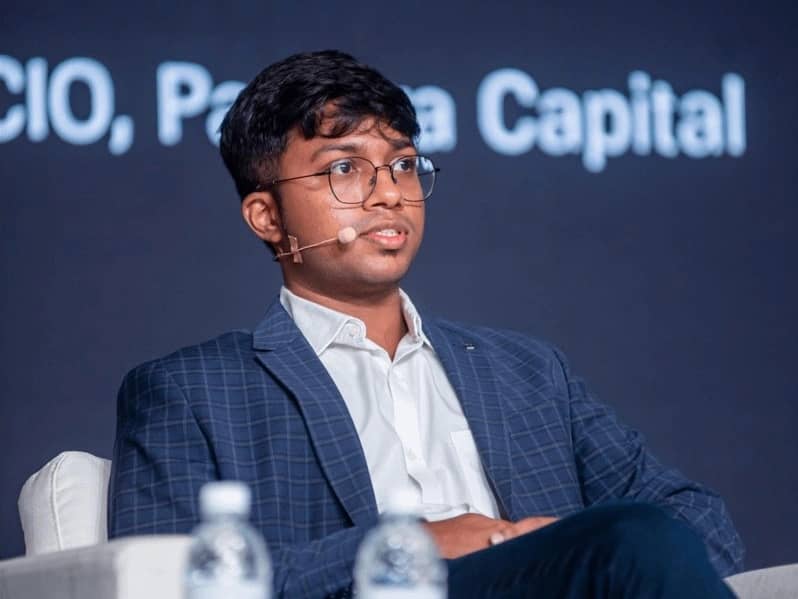
Shaaran Lakshminarayanan is the CEO of Multipli.fi, a real-yield protocol that offers institutional-grade yield products for crypto assets like Bitcoin and tokenized gold. [1] [2]
Early Life & Education
Shaaran Lakshminarayanan was born and raised in an environment that supported his early interest in technology and innovation. He studied Electronics and Instrumentation Engineering at the Vellore Institute of Technology, where he completed a Bachelor of Technology degree between 2017 and 2021. He later pursued Executive Leadership in Business Administration and Management at Harvard Business School.
Lakshminarayanan also participated in Stanford University's Scholar Initiative in Robotics and Artificial Intelligence as a faculty member. During his academic years, he worked in technology-related roles, including as a machine learning engineer and freelance developer, gaining professional experience in machine learning and software development. [2] [3]
Career
roboVITics
Shaaran Lakshminarayanan served as a Core Committee Member of roboVITics, the official robotics club of VIT, from October 2017 to August 2019 in Vellore, Tamil Nadu, India, which served as a basis for later work with blockchain.
Institution of Engineering and Technology
From October 2017 to September 2018, Shaaran worked as a Machine Learning Engineer at the Institution of Engineering and Technology (IET) in Vellore, Tamil Nadu, India.
GDG VIT
Shaaran served as a Senior Developer at GDG VIT from November 2017 to August 2019.
Hasura
From January 2018 to December 2019, Shaaran served as a Student Partner at Hasura.
Toshiba
Shaaran held freelance positions at Toshiba in 2018. He worked as a Freelance Developer from May to June 2018 and as a Freelance Software Developer in July 2018.
From August 2018 to December 2019, Shaaran worked at Google as a Machine Learning Facilitator.
MAJEES TECHNICAL SERVICES LLC
In December 2018, Shaaran worked as a Freelance Developer at MAJEES TECHNICAL SERVICES LLC in the Muscat Governorate, Oman.
Celebrify
Shaaran served as Chief Technology Officer at Celebrify from June 2019 to May 2020 in Bengaluru, Karnataka, India. The platform provided a service for booking personalized video messages from celebrities.
Krypto
From March 2020 to March 2024, Shaaran served as the founder of Krypto, a cryptocurrency-focused platform that combined cryptocurrency trading and peer-to-peer transfers with social media features. The platform also provided cryptocurrency-related content from industry experts.
TanX
Shaaran co-founded TanX, a decentralized exchange focused on cryptocurrency trading and liquidity services for institutional clients.
Multipli.fi
Shaaran has served as Chief Executive Officer of Multipli.fi since September 2024. The company operates in the cryptocurrency sector and develops yield-related products for digital assets, including tokenized delta-neutral hedge fund strategies. Its activities include applications involving stablecoins and Bitcoin.
Blockchain and DeFi
Shaaran has contributed to Ethereum's Solidity programming language and has worked on projects involving blockchain and decentralized finance. His work in the sector has included applications connecting financial strategies with decentralized finance and the use of Zero-Knowledge Proofs in decentralized exchange infrastructure, including Brine Fi.
His professional experience spans cryptocurrency, decentralized finance, software development, machine learning, and technology, including positions as a founder, chief executive officer, chief technology officer, developer, and machine learning professional. [1] [2] [3] [5] [7] [9] [6] [4]
Interviews
Identifying Opportunities in Crypto #01
On May 15, 2023, Shaaran Lakshminarayanan was interviewed by Kshitij Jayakrishnan of Elevation Capital as part of the Summit Series by Elevation. The discussion covered Lakshminarayanan's early involvement with cryptography and blockchain, the development of his earlier centralized exchange, and the transition toward a decentralized exchange model. According to Lakshminarayanan, the transition was influenced by concerns related to centralized custody and the risks associated with centralized exchanges.

Lakshminarayanan explained that tanX was designed to provide a trading experience similar to that of a centralized exchange while maintaining decentralized custody of user assets. He discussed the platform's approach to cross-chain trading, including the use of zero-knowledge technology and StarkWare infrastructure to support its trading system. At the time of the interview, the platform was operating on testnet and had processed more than 1.64 million orders and 400,000 trades.
The conversation also addressed the development of tanX's community and its infrastructure. Lakshminarayanan described a planned transition from a centrally hosted matching engine toward a more distributed architecture, with external operators expected to host additional instances over time. He also discussed a longer-term use of the infrastructure by other applications and services seeking to incorporate decentralized trading functionality.
In discussing his experience as a crypto founder, Lakshminarayanan identified community development, the selection of long-term venture capital partners, market timing, and addressing specific market needs as factors he considered relevant to developing crypto products. These points were presented as observations based on his experience building the platform and its earlier products. [8]
Money, Stablecoins and Tokenization #02
On November 21, 2025, Shaaran Lakshminarayanan appeared on the DROPS series of the When Shift Happens YouTube channel. The interview covered his early involvement in blockchain development, stablecoins, U.S. government debt, decentralized finance (DeFi), and the tokenization of real-world assets (RWAs).

Lakshminarayanan described blockchain as a technology that can provide alternative mechanisms for accessing and transferring financial assets. He also discussed the limited adoption of DeFi outside the cryptocurrency sector, attributing this in part to the complexity of existing applications and the industry's focus on speculative activity. In his view, stablecoins primarily function as digital representations of U.S. dollar value with applications across blockchain networks, rather than as instruments whose primary purpose is to distribute returns generated from U.S. Treasury securities.
The interview also addressed the relationship between stablecoins, U.S. government debt, and Treasury yields. Lakshminarayanan compared the financing structure of persistent U.S. fiscal deficits to a Ponzi scheme, based on his interpretation of the government's reliance on debt issuance and continued demand for Treasury securities. He connected this structure to interest rates, inflation, and the international use of the U.S. dollar. These statements represented his interpretation of U.S. fiscal and monetary dynamics rather than a formal characterization of the system.
Regarding real-world asset tokenization, Lakshminarayanan discussed the representation of assets such as gold, private equity, cash reserves, commodities, and sovereign wealth holdings on blockchain networks. He associated tokenization with changes in how these assets can be transferred, accessed, and used within blockchain-based financial markets.
The discussion also examined the relationship between tokenization and yield generation. Lakshminarayanan argued that an increase in the supply of tokenized assets without corresponding mechanisms for deploying those assets could reduce available returns. He described Multipli as infrastructure that uses tokenized assets as collateral within financial strategies involving DeFi protocols and external asset managers.
As an example, Lakshminarayanan discussed the tokenization of gold held in India. The proposed structure involves tokenizing gold through external providers, using the resulting tokens as collateral, and issuing stablecoins against the collateral. He explained that overcollateralization is used to account for fluctuations in the value of the underlying gold and to provide a margin in the event of liquidation.
Lakshminarayanan also compared the role of Multipli with that of exchange-traded funds (ETFs), noting that ETFs provide a standardized way of gaining exposure to underlying assets, while Multipli is structured around generating returns from assets held through blockchain-based mechanisms. [9]
See something wrong?