0% read
Spiko EU T-Bills Money Market Fund (EUTBL)
Spiko EU T-Bills Money Market Fund (EUTBL)
The Spiko EU T-Bills Money Market Fund (EUTBL) is a tokenized, regulated money market fund that provides on-chain exposure to a portfolio of short-term Eurozone Treasury Bills. EUTBL tokens legally represent shares in a fund that operates under the European Union's UCITS framework, offering investors a stable, low-risk, and yield-generating instrument denominated in Euros. Issued by the French financial technology firm Spiko, the fund is designed to bridge traditional finance (TradFi) with the digital asset ecosystem by offering a compliant, interest-bearing asset for individuals, corporations, and Web3 entities. [1] [2]
Overview
The Spiko EU T-Bills Money Market Fund is a short-term variable net asset value money market fund (short-term VNAV MMF) established as a sub-fund of the Spiko SICAV, an open-ended investment company domiciled in France. [3] The fund's primary objective is to preserve capital and provide stable returns by investing in high-quality, short-duration European government debt. It launched on May 15, 2024. [4] [1]
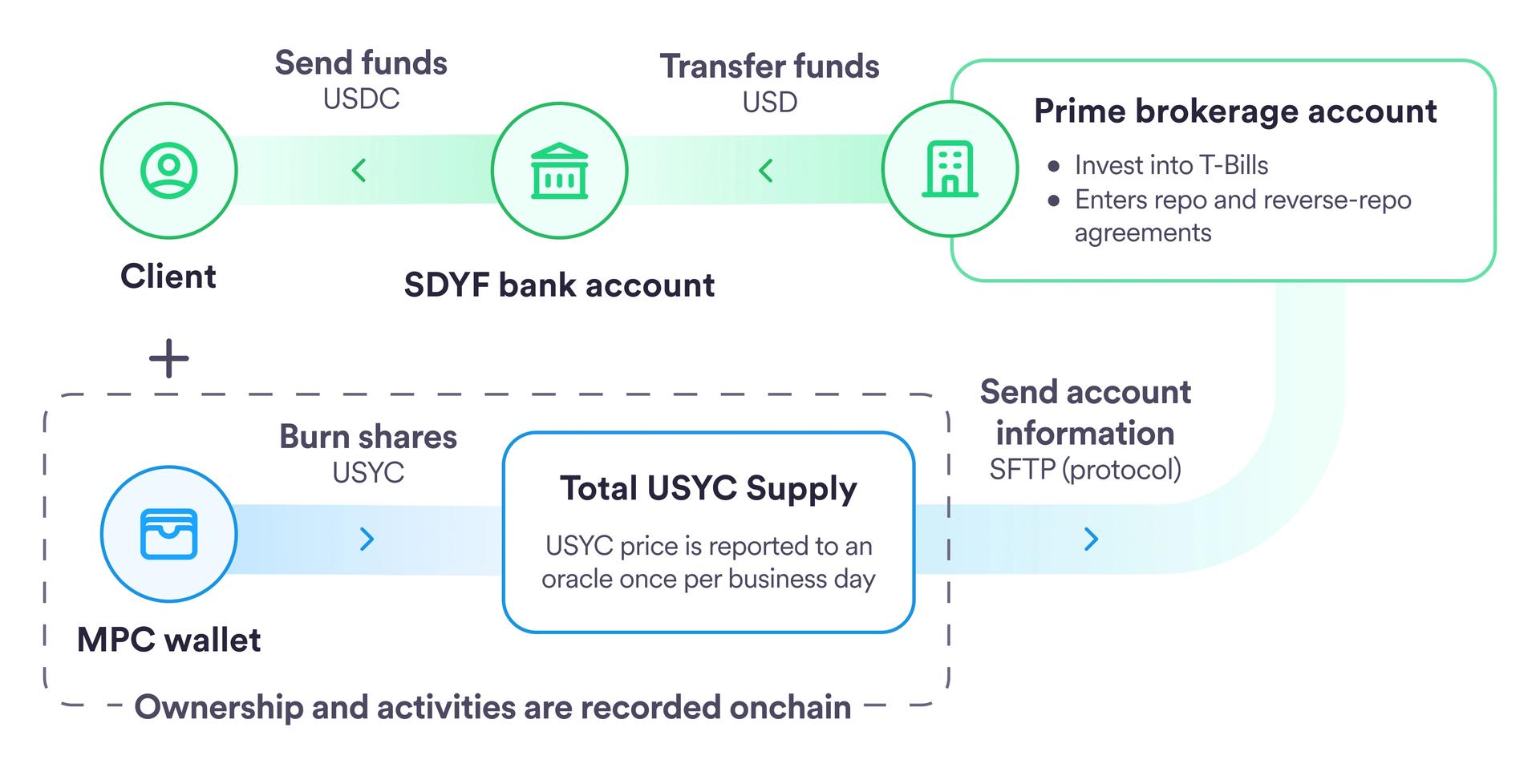
As a Real-World Asset (RWA), EUTBL tokenizes ownership of traditional financial instruments, making them accessible and programmable on public blockchains. A key innovation of the fund is its use of public distributed ledgers as the primary share registry, which allows for legally binding transfers of ownership to occur on-chain between approved investors 24/7. This structure bypasses the need for a traditional Central Securities Depository (CSD). The fund's income is accumulated, meaning gains are reinvested rather than distributed as dividends. This causes the Net Asset Value (NAV) of each EUTBL token to appreciate over time, reflecting the daily accrued interest. [3] [5]
Fund Structure and Investment Strategy
The fund's investment strategy is conservative, focusing on capital preservation and liquidity while generating yield. [4]
Investment Mandate
The fund's mandate requires it to invest 100% of its assets into a portfolio of high-quality, short-term debt instruments. The portfolio consists primarily of:
- Treasury Bills (T-Bills): Short-term debt issued by investment-grade or core Eurozone Member States, such as France. [4] [1]
- Repurchase Agreements (Repos): Transactions that are fully collateralized by the same qualifying T-Bills. [4]
- Cash: The fund may hold a portion of its assets in cash, which is capped at a maximum of 10% of total assets. [4]
Portfolio Management and Yield Generation
The fund is managed to maintain a very low-risk profile. The average maturity of the entire portfolio is kept under 60 days, and the maximum maturity for any single asset is less than six months. This strategy minimizes sensitivity to interest rate fluctuations. [4] [6]
Yield is generated from the interest paid by the T-Bills and repos in the portfolio. This interest accrues daily and is reinvested into the fund, causing the NAV per share (and thus the value of each EUTBL token) to gradually increase. The fund aims to deliver returns closely benchmarked to the Euro Short-Term Rate (€STR), net of fees. The fund's value is calculated each business day by an independent administrator, CACEIS, which marks the T-bill portfolio to market. As a value-accruing token, EUTBL's price is designed for stable, predictable growth rather than the volatility associated with speculative cryptocurrencies. [3] [1]
Fees
The fund structure includes several fees applied to its operations:
- Management Fee: 0.25% to 0.30% annually, deducted from the fund's assets on a daily pro-rata basis. [4] [1]
- Operating Expenses: A fee for other operational services is charged at 0.05%, with a maximum cap of 0.10%. [4]
- Subscription/Redemption Fees: There are no entry, exit, custody, or transaction fees for primary market subscriptions and redemptions. [3]
- Welcome Bonus: Spiko has offered promotional incentives, such as a 0.7% welcome bonus yield for new clients, valid for the first six months of investment. [1]
Issuer and Regulatory Framework
EUTBL is issued by Spiko and operates within a robust European regulatory framework supported by established financial institutions.
Issuer and Key Partners
- Issuer: Spiko Finance SAS, a French simplified joint-stock company with a share capital of €500,000, headquartered in Paris. The company, founded in 2023, has raised a $22 million Series A funding round. [3] [5]
- Asset Manager: Twenty First Capital, a regulated asset management firm, is responsible for managing the fund's investment portfolio. [2] [3]
- Custodian and Fund Administrator: CACEIS Bank, the asset servicing subsidiary of the Crédit Agricole Group, acts as the independent custodian, holding all client funds and securities. It also handles the fund's accounting. [1]
- Statutory Auditor: PricewaterhouseCoopers (PwC) conducts semi-annual or quarterly audits of the fund's accounts to ensure accuracy and compliance. [2] [4]
- Web3 Auditor: Trail of Bits performed a security audit on the smart contracts governing the tokenized fund shares. [2]
- Oracle Provider: Chainlink Labs provides the oracle service that publishes the fund's daily NAV on-chain. [2]
- Legal Advisor: Gide Loyrette Nouel advised on the legal structuring of the fund. [3]
In April 2025, Bpifrance, France’s public investment bank, invested a portion of its corporate treasury into the fund, signaling institutional adoption. [3]
Regulatory Compliance
The fund is structured for a high degree of regulatory oversight and investor protection.
- Fund Regulation: The fund is fully regulated under the EU's UCITS (Undertakings for Collective Investment in Transferable Securities) Directive (2009/65/EC) and the Money Market Fund (MMF) Regulation. It is approved and supervised by the French financial regulator, the Autorité des Marchés Financiers (AMF). [3] [4]
- Issuer Licensing: Spiko Finance is licensed as an investment firm by the French Prudential Control and Resolution Authority (ACPR) under number 19183 and registered as an intermediary with ORIAS under number 23008251. [1]
- Investor Protection: As a UCITS fund, its assets are segregated and held by the custodian (CACEIS), making them "bankruptcy remote" from Spiko. This means client assets are protected in the event of the issuer's insolvency. [1] [3]
- Legal Finality: French law recognizes the DLT-based ledger as the official securities register, meaning a confirmed on-chain transaction constitutes a legally binding transfer of ownership. [3]
Technology and Blockchain Integration
EUTBL employs a multi-chain, public-permissioned model to combine the transparency of public blockchains with regulatory compliance. [3]
Token Architecture
EUTBL is natively issued or represented across multiple blockchain networks. On Ethereum Virtual Machine (EVM) compatible chains, the token is based on the ERC-20 standard but includes extensions for greater functionality, such as ERC-1363 (pay-and-call) and ERC-2612 (gasless approvals). The smart contracts are designed to be upgradeable using a UUPS proxy pattern. [3]
Public-Permissioned Model
The fund operates on a "public-permissioned" or "allowlist" basis. While the token exists on public networks, only wallet addresses that have completed Spiko's Know Your Customer (KYC) and Anti-Money Laundering (AML) onboarding process can hold or receive EUTBL. This model prevents anonymous transfers and ensures compliance with financial regulations. [2] [3]
Cross-Chain Interoperability
Spiko manages cross-chain transfers through a centralized "burn-and-mint" mechanism. To move assets from one supported chain to another (e.g., from Polygon to Arbitrum), an investor submits a request to Spiko. Spiko then burns the tokens on the source chain and mints an equivalent number on the destination chain. This ensures the total supply of shares remains constant across all chains and avoids the security risks associated with third-party bridges. [3]
Tokenomics
The tokenomics of EUTBL are directly tied to the underlying fund's Assets Under Management (AUM). The total supply of EUTBL tokens is dynamic, increasing with new subscriptions and decreasing with redemptions. The fund has an ISIN (FR001400ODL1) and a Bloomberg Ticker (SPKEUMM). [4] [3]
Market Data and Growth
Based on data from mid-January 2026, the fund's key metrics were:
- Total Asset Value (TAV): $699,382,248
- Total Supply: 562,589,004.29 EUTBL
- Total Holders: 1,786
- Net Asset Value (NAV): $1.24
- 30-Day APY: 1.90%
The fund showed significant growth since its inception. By July 2025, its AUM had surpassed $250 million with over 1,100 on-chain holders. Some earlier data noted a high holder concentration, with the top 10 wallets controlling approximately 98% of the supply at a time when there were only 27 holders, indicating a potential centralization risk during the project's nascent stage. [3] [6]
Acquisition and Utilization
The EUTBL token is acquired through a primary market subscription process and can be used for various on-chain activities.
Primary Market Subscription and Redemption
- Eligibility: Investment is open to retail and professional investors but is restricted to non-U.S. persons and entities from non-sanctioned countries. [4] [2]
- Onboarding: Investors must create an account on the Spiko platform and complete the required KYC process. [1]
- Subscription: The minimum initial investment is €1,000. Subsequent deposits can be as low as €1. Subscriptions can be made daily by transferring EUR via bank transfer or by depositing EURC (Circle's Euro stablecoin). [4] [5]
- Redemption: Investors can redeem their tokens on any business day. The minimum withdrawal is €1. Payouts are processed in EUR to a bank account or as stablecoins to a crypto wallet. [4] [5]
Custody and Trading:
Investors can choose between a custodial wallet managed by Spiko or a self-managed, non-custodial wallet for holding their EUTBL tokens. While the tokens are available for trading on some decentralized exchanges (DEXs), all transfers—including peer-to-peer—can only occur between allowlisted wallets. This compliance feature prevents permissionless trading on public exchanges. [6] [3]
Use Cases
EUTBL is positioned as a foundational asset for various on-chain cash management and DeFi strategies.
- On-Chain Treasury Management: Web3 projects, DAOs, and startups use EUTBL to earn yield on their idle EUR or stablecoin reserves. [2]
- Stablecoin Reserves: The fund's regulated status and high-quality asset backing make it a suitable reserve asset for euro-denominated stablecoin issuers. [2]
- DeFi Collateral: EUTBL can be used as stable, yield-bearing collateral in compliant DeFi lending protocols or for securing OTC transactions. [6] [2]
- Payments: The token can facilitate on-chain payments where the underlying value continuously accrues interest. [5]
See something wrong?
Average Rating
No ratings yet, be the first to rate!
How was your experience?
Give this wiki a quick rating to let us know!
 eutbl
eutblUSD
Price
$1.20
0.01%
Market Cap
$924,506,488.00
0.24%
Diluted Market Cap
$924,506,488.00
0.24%
Volume
$0.00
0.00%
Edited By
On June 24, 2026. 17:45 UTC
Edit summary:
Expanded wiki content; updated category Cryptocurrencies -> Cryptoassets; changed events (3 -> 3)