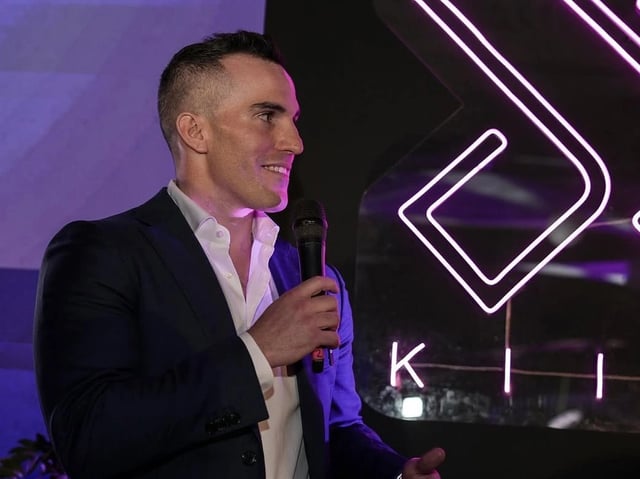
Reeve Collins
Reeve Collins is an American entrepreneur and co-founder of the stablecoin project Tether. He later co-founded BLOCKv, a platform for creating programmable NFTs, and Smart Media Technologies, a Web3 advertising and engagement platform serving major consumer brands.[3][2][9] Collins is also chairman and co-founder of STBL, a protocol associated with his "Stablecoin 2.0" thesis that separates payment tokens from yield-bearing claims on tokenized real-world assets, and he remains active in digital-asset-focused treasury and advisory roles, including SPAC and listed-vehicle initiatives and his position on Fineqia’s advisory board.[22][1][16][17]
Education
Reeve Collins graduated with a Marketing and Finance degree from Washington State University.[9]
Career
Prior to co-founding Smart Media Technologies,[2] Reeve co-founded and was the CEO of BLOCKv,[3] his second blockchain company. There, he raised $22 million in an ICO to deliver a platform for the creation of NFTs.[9]
At his first blockchain venture, he served as co-founder and first CEO of Tether, a blockchain-based stablecoin pegged 1:1 to the U.S. dollar and regarded as one of the earliest major fiat-backed stablecoins. Before working in blockchain, Collins founded several ventures, including Traffic Marketplace,[4] an online ad network that was acquired by Vivendi Universal;[5] he then created RedLever,[6] a branded entertainment studio acquired by Adconion Media Group.[7][9]
After that, he raised $70 million to launch a legal, real-money gambling site based in the US called Pala Interactive.[8] He also worked as one of the initial employees of Avenue A/Razorfish,[10] an internet advertising agency that expanded rapidly during the dot-com era.[9]
1997 - 2002
In 1997, Reeve Collins served as an original employee at Avenue A/Razorfish,[10] an internet advertising agency that went public during the dot-com boom and was later involved in a multibillion-dollar acquisition.[9][14][26][27]
In 2000, Collins co-founded Traffic Marketplace,[4] a business-to-audience online ad network integrated with multichannel digital marketing technologies.[9]
In 2002, Reeve Collins founded FusionDirect, a direct response television (DRTV) agency with a successful product line that grossed over $7 million in sales in its first year.[9]
2005 - 2012
In 2005, Reeve Collins co-founded FingerPrint Promotions, a platform that provides entertainment studios and businesses with specialty advertising, creative promotional products, apparel items, and custom goods where he served as the company's CEO until 2010.[9]
Collins founded Red Lever[6] in 2007, a creative production house specializing in high-quality, branded online content development and targeted distribution.[9]
In 2012, Reeve Collins co-founded Pala Interactive,[8] a full-service real-money, and social gaming technology provider and operator focused on establishing a material position in the U.S.-regulated online gaming market and served as the company's CEO until 2015.[9]
2013 - 2019
In 2013, Reeve Collins co-founded Tether, a blockchain-based stablecoin pegged 1:1 to the U.S. dollar and, according to Tether, backed by assets held in the platform’s reserve account, alongside Brock Pierce and Craig Sellars.[9][11]
Tether Operations Limited is the company operating the blockchain-enabled platform tether.to to facilitate the digital use of traditional currencies.[11] During his time at Tether, Collins oversaw the launch of the platform and was responsible for setting the company's strategic direction, leading product development and growth initiatives, and managing relationships with key stakeholders and partners. He also established a strong partnership between Tether and the banking industry, allowing users to deposit and withdraw fiat currency from the platform.
In 2015, Collins co-founded BLOCKv a platform for creating, minting, and distributing next-generation programmable NFTs. He served as the CEO of the company until December 2018.[9][13]
In 2019, Reeve Collins co-founded SmartMedia Technologies (SMT),[2] a Web3 platform that combines advertising technology with blockchain infrastructure to support digital campaigns and loyalty programs for global brands and agencies, including Accenture, PepsiCo, and Verizon.[9][12]
Tether
In 2013, Reeve Collins co-founded Tether, a blockchain-based stablecoin pegged 1:1 to the U.S. dollar that, according to Tether, is backed by assets held in the platform’s reserve account, alongside Brock Pierce and Craig Sellars.[9][11]
2020 - Present
From 2020 onward, Collins increasingly focused on stablecoin and real-world asset (RWA) innovation, positioning himself at the intersection of tokenized securities, digital dollars, and on-chain yield. This period culminated in the launch of the STBL protocol and associated Stablecoin 2.0 thesis, alongside roles in digital asset treasury vehicles and advisory positions with firms pursuing regulated crypto products and digital-asset-focused capital markets strategies.[22][23][17]
In public commentary from 2025 and 2026, Collins has outlined a broader thesis that banking services will increasingly function as a commodity-like utility delivered over shared digital infrastructure, with stablecoins and on-chain banking rails serving as the underlying “plumbing” for payments and financial applications.[28] He has described stablecoins as a bridge toward this upgraded financial “plumbing” and argued that jurisdictions with flexible, clearly defined virtual-asset regulations, such as the Cayman Islands, are positioned to attract issuers and infrastructure providers that build on these rails.[29] In 2026 television and media interviews, including on CNBC’s “Fast Money,” Collins has also stated that although he expects continued volatility in crypto asset prices, he believes stablecoins and tokenized, real-world-asset-based systems will see broader mainstream adoption over time.[30]
STBL and Stablecoin 2.0
In 2025, Collins embarked on a new venture to develop what he describes as "Stablecoin 2.0," a next-generation stablecoin architecture designed to be productive, transparent, and community-owned.[15] He is the chairman and co-founder of the project, STBL, a decentralized stablecoin protocol that moved from beta into mainnet deployment in 2025 alongside the launch of its governance token and listings on major exchanges such as Binance Alpha and Kraken.[22][20]
Collins's vision for this new phase of stablecoins is to correct what he sees as the shortcomings of the first generation ("Stablecoin 1.0"), such as Tether and USDC. He argues that while these early stablecoins successfully digitized the dollar and provided essential liquidity for the crypto ecosystem, their economic benefits were centralized, with the issuers retaining the yield on reserves rather than the users who rely on the tokens.[15][23] Collins frames Stablecoin 2.0 as a shift toward community-aligned models in which minters retain most of the value generated by underlying reserves, supported by on-chain transparency of collateral, user ownership of yield, and community-driven governance.[22]
“Stablecoins 1.0 enriched corporations. Stablecoins 2.0 empower communities.”[15]
The STBL protocol introduces a collaborative model built upon yield-bearing tokenized real-world assets (RWAs), such as tokenized U.S. Treasurys and money market funds, which are brought on-chain to back the stablecoin. When a permitted yield-bearing RWA is deposited and locked into the protocol, it is split into two components: USST, a dollar-pegged stablecoin that can circulate and be used in payments and DeFi, and YLD, a non-fungible token (NFT) that accrues the yield generated by the underlying asset.[22] The system is designed with two main participants: "Minters," who deposit tokenized RWAs as collateral to create USST and receive the YLD NFT, and "Users," who can hold and transact with USST similarly to other stablecoins.[15][24]
A core feature of the STBL protocol is the separation of the stablecoin from its underlying yield. Collins explains that if the first wave of stablecoins digitized the dollar, this second generation financializes it by splitting principal and income into two programmable streams. When a minter deposits collateral, the system generates USST, the non-yielding stablecoin pegged to the dollar, and YLD, a vault-controlling NFT that captures the interest from the underlying tokenized assets, allowing the two components to be held or traded separately.[22] This structure is designed so that minters, rather than a centralized issuer, capture the economic return on their collateral while creating a stable, liquid asset for the broader market. For regular users, holding USST provides the same utility as other digital dollars, while aligning with a protocol whose reserves and yield flows are transparently visible on-chain.[15][24]
The protocol’s design aims to keep USST slightly over-collateralized, with the system described as maintaining around 103% backing in money-market-style and treasury assets, coupled with incentive mechanisms such as mint fees and burn credits to help preserve the dollar peg in volatile markets.[22] By keeping the payment token non-yielding while directing income to the separate YLD NFT, STBL’s creators describe the model as aligned with emerging stablecoin regulatory frameworks, including the U.S. GENIUS Act, which focus on non-interest-bearing payment instruments.[22] Collins and his co-founders have also highlighted the use of zero-knowledge tools and whitelisting at the custodian or asset-issuer layer to balance regulatory compliance requirements with end-user privacy when transacting with USST.[25]
Governance of the protocol is decentralized through the STBL token, forming the third component of the system’s tri-token design alongside USST and YLD. Holders of STBL can vote on key parameters, including acceptable collateral types, risk parameters such as haircut levels, and system fees, as well as how protocol economics are distributed between token holders and other participants.[15] According to Collins, this community-led governance is intended to make the network more resilient and align its evolution with the interests of its users, transforming the stablecoin from a corporate product into a piece of public financial infrastructure.[22]
Token Launch
The native token of the ecosystem, STBL, had its token generation event on September 16, 2025.[21] The launch followed a funding round led by Wave Digital Assets, a digital asset manager that backed the project in its early stages.[21][19]
Upon its debut, the STBL token began trading on several major centralized cryptocurrency exchanges.[19][20] Trading activity around the launch led to rapid price appreciation, with CoinDesk reporting that the token’s fully diluted valuation rose from around $100 million at issuance to above $1 billion and briefly reached an all-time high of about $2.3 billion within 24 hours.[22] Coverage of the event also highlighted that STBL initially launched with a relatively low circulating supply compared with its total token supply, a structure that contributed to the intensity of early trading.[20]
The project's roadmap includes several phases following the token launch. These phases are planned to introduce a governance framework for token holders, build a bridge for USST to enable interoperability across multiple networks, and implement staking mechanisms to provide yield opportunities.[21]
Other Ventures and Roles
In May 2025, Collins, along with an affiliate of CC Capital, purchased sponsor interests in the SPAC M3-Brigade Acquisition V Corp. Collins was named chief executive officer of the company, which intends to seek a business combination with a target in the digital assets industry and plans to change its name to CCRC Digital Assets Corp.[16]
The following month, in June 2025, Collins was appointed to the advisory board of Fineqia International Inc., a Canadian-listed company specializing in crypto Exchange-Traded Products (ETPs). In this role, Collins provides his expertise to support Fineqia's mission of advancing regulated crypto ETPs across Europe.[17][18] Collins has also been associated with Reserve One, a public-market digital asset treasury vehicle aimed at giving investors exposure to a diversified portfolio of on-chain assets, reflecting his broader interest in bridging traditional capital markets with blockchain-based yield products.[23]
Collins is also a co-founder and chairman of WeFi, a company building self-custodial, on-chain banking infrastructure. In 2026, WeFi entered a partnership with Visa to connect its infrastructure to Visa’s payment network, enabling users to spend digital assets and stablecoins through Visa’s rails while retaining control of their private keys.[31]