Morpheus
Morpheus is a decentralized AI ecosystem designed to incentivize the first peer-to-peer network of personal general-purpose AIs, known as Smart Agents. These agents can execute Smart Contracts on behalf of users. The project aims to offer a permissionless and open-source alternative to centralized AI platforms, with a mission to democratize artificial intelligence.[9] The native MOR token is used to obtain the resources needed to interact with various Smart Agents.[1]
Morpheus aims to make Web3 more accessible by providing a neutral, ChatGPT-like chat interface. This interface enables users to easily buy or sell crypto, send stablecoins, access smart contracts, and utilize dapps and DeFi protocols.[6] The project's mainnet officially launched on November 19, 2024.[11]
On May 8th, 2024, the MOR token trading and claiming for capital providers and coders successfully went live on the Arbitrum network. Over 200,000 MOR tokens were claimed by early Morpheus adopters, and $10 million was traded on Decentralized exchange Uniswap through the ETH/MOR pair.[3]
Overview
Morpheus is a decentralized AI ecosystem designed to establish the first peer-to-peer network of personal AIs, known as Smart Agents. These Smart Agents enable users to seamlessly interact with their wallets, decentralized applications (DApps), and smart contracts using natural language, thereby making Web3 more accessible to everyone.[7] The project positions itself as a foundational "base layer zero" to facilitate the interaction of Smart Agents across the Web3 landscape.[12]
The Morpheus network is powered by the MOR token, which is designed to incentivize a diverse range of contributors: Capital providers adding liquidity, Coders enhancing the software, Compute providers offering computational power, and Community builders creating interfaces and tools. This token-driven model encourages a decentralized, competitive environment similar to the successful ecosystems of Bitcoin and Ethereum. By operating on decentralized public infrastructure, Morpheus offers a cost-effective alternative to centralized AI services. It avoids regulatory barriers that hinder centralized companies, enabling the Smart Agents to act on users' behalf within the Web3 context.[5]
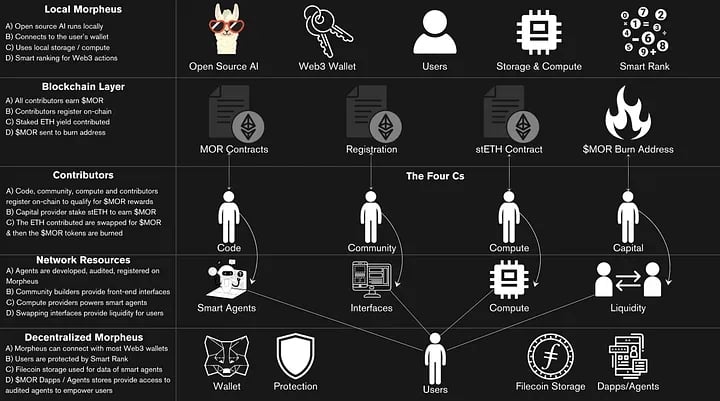
Morpheus acts as a Linux-like platform for developers, facilitating the rapid and free deployment of new agents and language models. Developers retain full ownership of their data, safeguarding it from leaks, hacks, and competitive threats. An evolving Agent Store, analogous to mobile app stores, is designed to reward developers for contributing to the platform and creating specialized agents, with popularity driving higher rewards.[12]
Users maintain ownership of their data, prompts, and history, ensuring privacy and security. Morpheus aims to be the premier solution for interoperability in the landscape of large language models (LLMs) and AI agents. With a user-friendly graphical interface and one-click installation via Electron, Morpheus is designed for accessibility, passing the "Friedl test" for ease of use by non-technical users.
Morpheus represents a significant leap in combining AI with blockchain technology. It transitions from reactive smart contracts to proactive AI-driven Smart Agents, enhancing sectors like service marketplaces and crypto gaming through complex AI-driven tasks. Morpheus supports chain-agnostic deployment, allowing developers to launch their DApps on any blockchain. The MOR token integrates with Wormhole and LayerZero OFT standards, ensuring flexibility and broad compatibility.[6]
Key Features
- Web3 Integration: Morpheus is inherently Web3 native, allowing users to engage in cryptocurrency transactions, utilize smart contracts, and access DApps and DeFi services. This surpasses the capabilities of current large language models (LLMs) that lack direct Web3 connectivity.
- Decentralization and Cost Efficiency: By operating on a decentralized public infrastructure, Morpheus avoids the regulatory and cost barriers faced by centralized entities. This approach offers a more affordable and flexible solution for AI deployment and usage.
- Developer-Friendly Platform: Morpheus serves as a Linux-like alternative for developers, enabling the quick and cost-free creation of new agents or LLMs. Developers retain full ownership and security of their data, ensuring protection from leaks, hacks, and competitive threats.
- User Sovereignty and Privacy: The platform emphasizes user control and data privacy through technologies like a Lite Client for local AI operations and the planned adoption of Fully Homomorphic Encryption (FHE) to protect user data.[9]
- Innovative Reward System: The platform incentivizes contributions across four key roles: Capital providers, Coders, Compute providers, and Community builders. A token-based system rewards participation and contribution to the Morpheus ecosystem, fostering a collaborative and competitive environment.
Morpheus aims to democratize AI and blockchain technology by providing a secure, efficient, and open-source ecosystem. It bridges the gap between traditional and blockchain technologies, enhancing the Web3 experience for developers and users alike.[5]
The four pillars of the Morpheus
The four pillars of the Morpheus network are Capital, Code, Compute, and Community. These ensure that the Morpheus network has everything to facilitate a growing ecosystem of Smart Agents.[7][12]
Capital providers support the Morpheus network by supplying stETH, generating yield, and contributing to Protocol-owned Liquidity (PoL). This mechanism ensures liquidity for the ecosystem, with capital providers being rewarded with MOR tokens proportional to their contributions.
Code Proof, Registration & Reward
Developers contribute code to the Morpheus Network, earning rewards based on the value of their contributions. This system encourages the development of specialized agents and tools, enhancing the platform's capabilities and user experience.
Compute Proof & Reward
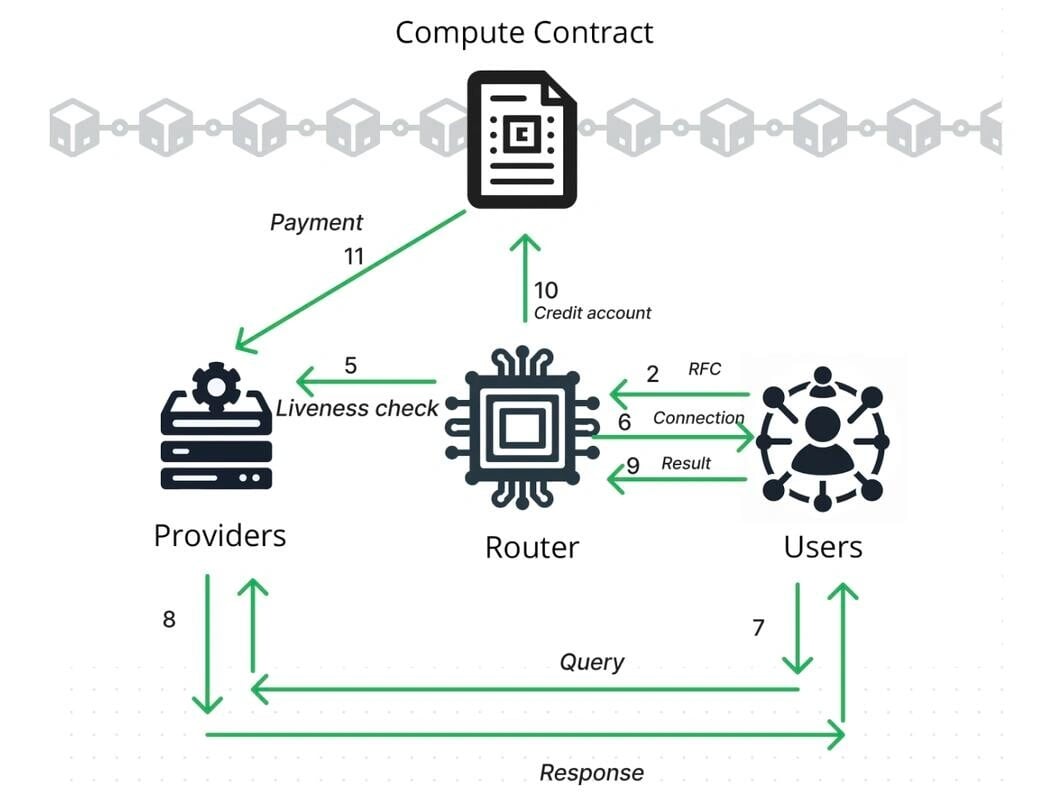
Compute providers supply the necessary resources for AI models, receiving compensation based on demand. This approach ensures efficient resource use and rewards providers for meeting the network's computational needs.
Community Builder Proof, Registration & Reward
Community builders develop user interfaces and developer tools, facilitating interaction with the Morpheus API. They are rewarded based on the fees generated by their contributions, promoting the development of a vibrant and supportive ecosystem.This proof and reward system incentivizes contributions across various roles, fostering a collaborative environment that enhances the overall Morpheus ecosystem.[8]
History
The Morpheus project was founded in 2023 with the publication of its foundational paper on September 2, 2023. A series of key milestones have marked its development since its inception.[11][9]
- February 8, 2024: The MOR token was launched on the Arbitrum mainnet through a fair launch, with no presale or early token sale.
- May 8, 2024: Trading and claiming for MOR tokens went live, and the vesting schedule for contributors was initiated.
- July 25, 2024: The project launched its testnet.
- September 11, 2024: Morpheus announced integration with the OKX Web3 wallet.
- November 19, 2024: The Morpheus mainnet was officially launched.
- December 19, 2025: The Morpheus Inference Marketplace, built on the Base blockchain, moved from open beta into full production.
- February 4, 2026: Morpheus was selected as one of 12 semifinalists for the CoinDesk PitchFest at the Consensus Hong Kong event.
- February 6, 2026: The Kimi K2.5 AI model, featuring a 256k context window for complex tasks, was made available on the Morpheus platform.
Throughout its development, the project has been showcased at events such as the AIBC Summit and the Blockchain Futurist Conference, and it won the AI Challenge at the All-In Canada Conference.[9][13]
MOR Token
$MOR is the utility token that supports the Morpheus decentralized AI ecosystem. With a total supply of 42 million tokens and no pre-mine or early token sale, $
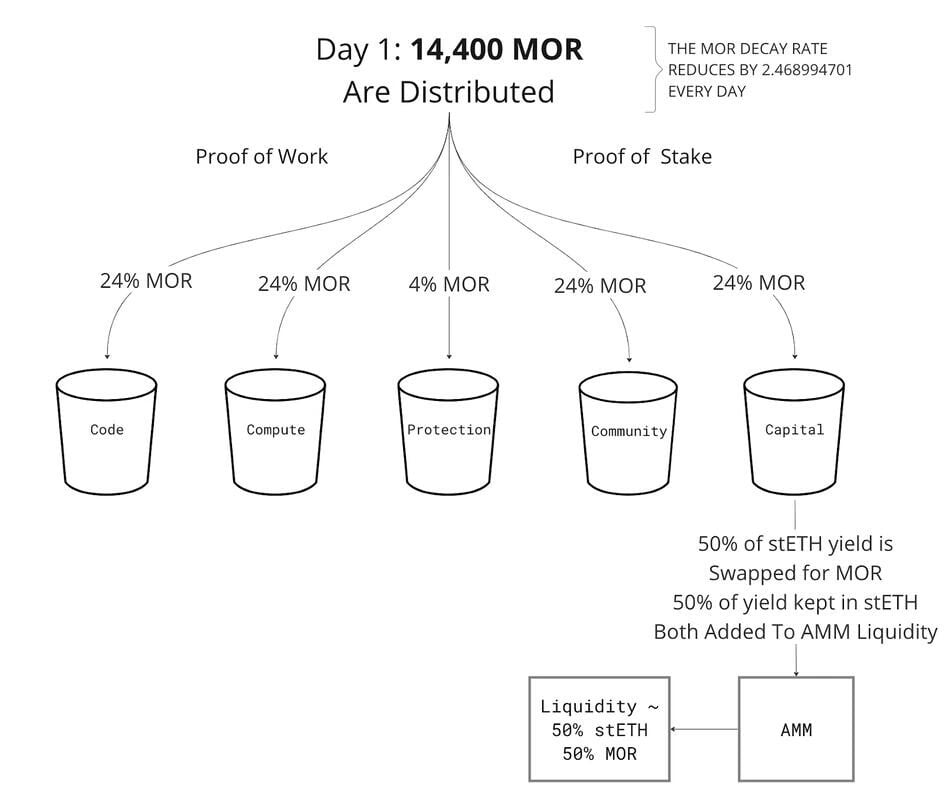
Morpheus launched the MOR token on the Arbitrum mainnet, starting with 14,400 MOR tokens created on the first day. The emissions follow a decreasing curve, reducing the daily emissions by 2.468994701 MOR each day until the rewards reach zero on day 5,833 (approximately 16 years). This structured distribution ensures that the total supply of MOR will reach 42 million tokens.[10]
MOR is available for trading on centralized exchanges like CoinEx and decentralized exchanges such as Uniswap V3 on the Arbitrum and Base blockchains.[11]
MOR Utility
The primary utility of the MOR token is to grant access to the Morpheus network's resources, including compute power for AI tasks. Its functions include:
- Access to Compute: MOR is used to pay for the computational resources required to run AI models and Smart Agents.
- Staking: Users can stake MOR tokens towards preferred frontends and smart agents. This directs community emissions to those entities and rewards stakers with their native tokens.
- Ecosystem Currency: MOR is designed to be the principal asset for AI projects launched within the Morpheus ecosystem, similar to how ETH functions for Ethereum.
- Settlements: All transactions and internal settlements within the Morpheus Network are conducted using MOR tokens.
Starting at 14,400 MOR per day, the reward decreases daily until it reaches zero on day 5,833, at which point the incentive model will transition from block rewards to transaction fees.[8][9]
Morpheus Technology
Morpheus's core architecture is a set of chain-agnostic smart contracts based on the Lumerin architecture, also known as the Morpheus Router Architecture. This enables the protocol to operate across multiple blockchains. Initially launched on Ethereum using the ERC-20 standard for the MOR token, the project has expanded to other layer 2 solutions like Arbitrum and Base to enhance adoption and functionality.[9][13]
User data security is a top priority, with the platform incorporating a Lite Client for local and private AI operations. Morpheus also plans to adopt Fully Homomorphic Encryption (FHE) for large language models (LLMs), providing enhanced protection for user data within the peer-to-peer network.[9]
Inference Marketplace
On December 19, 2025, Morpheus launched its Inference Marketplace into full production. Built on the Base blockchain, the marketplace is designed to provide a unified ecosystem for AI builders with lower costs for running AI models. Upon its production launch, the platform began offering models like Kimi K2.5, which features a 256k context window for advanced reasoning and complex tasks.[13]