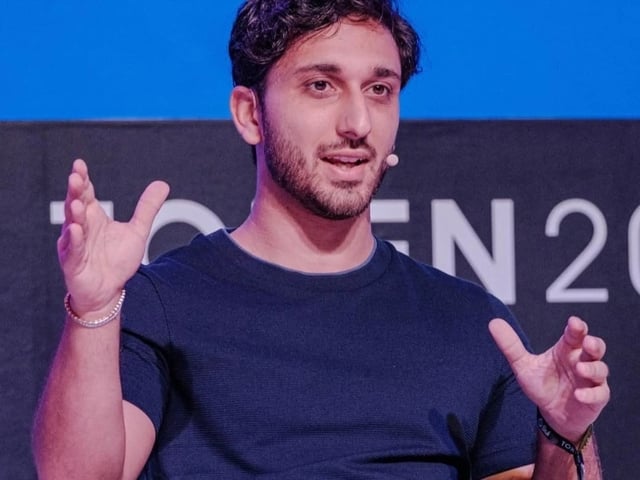
David A. Johnston is the co-founder and key contributor to Morpheus, a peer-to-peer network for powering autonomous "Smart Agents." [1] [2]
David A. Johnston attended Howard Community College from March 2004 to September 2004. During this period, his areas of study included decentralized information systems, biotechnology, investment, enterprise software, and renewable energy.
Johnston has cited a statement attributed to Mark Twain, “I never let school get in the way of my education,” to describe his perspective on learning. He has stated an interest in self directed education and learning through practical experience, characterizing first hand experience as a relevant component of his educational approach. [10]
Johnston's career has been centered on founding, funding, and developing decentralized technologies since the early days of the blockchain industry. He is based in Austin, Texas. [4]
In 2013, Johnston became heavily involved in the nascent Bitcoin and blockchain communities. That year, he co-founded BitAngels, which was the first angel investor network established specifically to fund Bitcoin and cryptocurrency-related startups. [2] [5]
Also in 2013, Johnston joined the board of the Mastercoin Foundation. The project conducted the first-ever token sale, later known as an Initial Coin Offering (ICO), raising 5,000 BTC to build a protocol layer on top of Bitcoin for creating custom assets and more complex smart contracts. Johnston served as the foundation's Executive Director until December 2014. The Mastercoin protocol was later rebranded as the Omni Layer and established a precedent for crypto project fundraising. [1] [4]
During this period, Johnston authored "The General Theory of Decentralized Applications" in 2013, a white paper in which he is credited with defining and coining the term "DApp" (Decentralized Application). This work provided a foundational framework for a new paradigm of application development on peer-to-peer networks that would become central to platforms like Ethereum. [1] [2]
Building on his early work, Johnston focused on venture capital. From 2014 to 2015, he was the Managing Director of the DApps Fund, a venture fund that invested in the emerging decentralized application ecosystem he had helped define. [2]
In 2014, Johnston co-founded Factom Inc. and served as its Chairman of the Board until 2017. [3] Factom was a blockchain-based protocol designed to provide data and record-keeping integrity for enterprises and government agencies. It allowed clients to secure data by hashing it and anchoring it to public blockchains, making it immutable and verifiable. The company secured a grant from the U.S. Department of Homeland Security but later faced financial difficulties, and its assets were acquired in 2020. [1]
Since 2016, Johnston has served as the Managing Director of Yeoman's Capital, a family office that invests in open-source software, Web3, and decentralized technologies. [4] His investment and advisory roles have also included being a General Partner at SpaceFund (2018-2023), a First GP Investor and LP at Multicoin Capital (2017-2023), and a board member at the security token platform Polymath (2017-2023). [3]
Johnston's primary focus shifted to the intersection of AI and blockchain in 2023. On September 8, 2023, he published an influential article on Medium titled "Morpheus - A Network for Powering Smart Agents," which served as the white paper and genesis for the Morpheus project. [1] [4]
Johnston is a co-founder, open-source contributor, and "Code Maintainer" for Morpheus. [6] [7] Morpheus is a decentralized, peer-to-peer network designed to power personal AIs, which Johnston terms "Smart Agents." The project's stated goal is to provide an open-source, permissionless, and community-owned alternative to the centralized AI models developed by large technology corporations. [4]
The Morpheus network began its "Fair Launch" on February 8, 2024. This model was designed with no pre-mined tokens, no venture capital allocation, and no special allocations for the founding team. Instead, its native token (MOR) is distributed to four key groups of contributors:
In interviews and writings, Johnston predicted that 2025 would be "the year of smart agents and decentralized AI," citing the convergence of mature blockchain infrastructure and the availability of powerful open-source large language models. [5]
Johnston is widely credited with coining the term "DApp" in his 2013 white paper, "The General Theory of Decentralized Applications." In this work, he established a framework and set of criteria for what constitutes a truly decentralized application, distinguishing them from traditional centralized software. The paper helped to formalize a key concept that guided development in the early blockchain space and became a cornerstone of the Web3 ecosystem. [1] [6]
In 2023, Johnston authored the framework for "Smart Agents" as part of the Morpheus white paper. [7] He defines a Smart Agent as an autonomous AI that acts on a user's behalf by connecting a large language model (the "brain") to a user's Web3 wallet (the "hands"). This connection allows the agent to execute economic actions, interact with smart contracts, and manage digital assets autonomously. [5]
Johnston envisions Smart Agents as the next evolution of the user interface, following the command line, GUI, web page, and mobile app. He has stated that these agents will be the "‘App Store moment’ for Web3," simplifying the user experience and onboarding billions of new users to cryptocurrency by making complex on-chain actions as easy as using a search engine. [1] He believes every person will eventually have a personal "Super Agent" that will serve as their primary interface to a future "Agentic Economy." [8]
Johnston identifies as a "Freedom Accelerating Decentralist (d/acc)," a philosophy that advocates for using decentralized technology to enhance individual liberty and reduce reliance on centralized institutions. [2] [9] His writings and public statements often reflect a strong belief in open-source principles, privacy, and censorship resistance. He has expressed criticism of the U.S. Federal Reserve system and government regulation in the technology sector, stating in 2018 that the U.S. regulatory environment would prevent Silicon Valley from becoming the dominant crypto ecosystem. [8]
A core tenet of his philosophy is that artificial intelligence is too powerful to be controlled by a few large corporations or governments. He argues for a decentralized approach to ensure open access, user data sovereignty, and freedom from censorship. He has stated that for billions of people in the developing world, decentralized AI will not be an alternative but the only viable option due to the cost and restrictions of centralized systems. [4] [5]
This vision is further articulated in his February 2026 article, "Surfing The Singularity," where he advocates for individuals to use open-source tools like Morpheus to build their own "AI surfboard" and maintain personal agency, rather than becoming "serfs to AI overlords." [8] His participation in events like the Solarpunk Summit, where he led a workshop on setting up personal AIs, aligns with an optimistic view of technology's role in creating a more equitable and human-centric future. [9]
In an interview published on December 6, 2024, on the YouTube channel of the Filecoin Foundation, David Johnston discussed decentralized artificial intelligence in an episode of DWeb Decoded, hosted by Aaron Stanley.
During the conversation, Johnston described the Morpheus Project as an initiative designed to apply principles commonly associated with early cryptocurrency systems, including open source development, permissionless participation and distributed coordination, to artificial intelligence infrastructure. According to his explanation, decentralized AI is positioned as an alternative to models in which AI development and deployment are concentrated within a limited number of large technology companies.
Johnston characterized Morpheus as an infrastructure layer rather than a centralized platform or operating entity. He stated that the project functions as a decentralized routing and marketplace system that facilitates interactions between compute providers, developers and end users, without directly managing GPU hardware or deploying applications. In his account, this structure is comparable to the role played by Ethereum in providing a general purpose execution environment for smart contracts while leaving application development to independent participants.
The interview also covered Johnston’s description of “smart agents”, which he defined as AI systems associated with cryptographic wallets and capable of interacting with smart contracts. He explained that, within this framework, smart agents are intended to act on user instructions expressed through natural language, while authorization and execution remain subject to cryptographic confirmation.
Throughout the discussion, Johnston presented decentralized AI as an approach in which control over AI systems is associated with individual users rather than centralized institutions. He described Morpheus as part of a broader ecosystem that integrates open source AI models, distributed compute resources and token based coordination mechanisms. He also noted that the architecture and use cases discussed remain under development and subject to ongoing experimentation. [11]
An interview published on February 6, 2025, on the Filecoin Foundation’s YouTube channel (DWeb Decoded), features David Johnston discussing topics related to decentralized AI agents and distributed computing within Web3 contexts.
Recorded in Davos during the World Economic Forum 2025, the conversation addresses the Morpheus project and its role in enabling software agents designed to operate autonomously. Johnston described these agents as programs capable of interacting with decentralized applications, application programming interfaces, and financial protocols to perform predefined tasks, including transaction execution and workflow coordination.
The interview also covered the structural components of the Morpheus platform. According to Johnston, the system provides development tools, access to decentralized compute resources, and token-based incentives for agent builders. He stated that a portion of the project’s token supply is allocated to developers who deploy agents, and that compute routing mechanisms are used to direct workloads to GPU providers based on pricing and performance criteria rather than centralized infrastructure.
Another topic discussed was the concept referred to by Johnston as “brain power,” introduced as a comparative measure between human cognitive activity and AI processing capacity. He referenced estimated token processing rates and GPU performance metrics to contextualize projected growth in AI compute availability, noting expectations that aggregate AI processing capacity could exceed aggregate human cognitive output within the same timeframe.
The interview further addressed the intended ownership and control model for AI agents. Johnston stated that agents are designed to operate under user-defined parameters, with data management relying on decentralized storage, encryption, and open-source software components. These design choices were presented as mechanisms to distribute control over agent behavior and data usage.
The discussion concluded with references to ongoing development efforts. Johnston indicated that Morpheus operates across multiple blockchain networks and that additional integrations, including decentralized storage systems, are under development. He characterized 2025 as a period in which decentralized compute, storage, and agent frameworks are expected to become more closely interconnected within the broader Web3 ecosystem. [12]