Magic Eden
Magic Eden is a digital marketplace that originated on the Solana network for the purpose of selling, purchasing, and creating non-fungible tokens (NFTs). While it began with a focus on Solana, the platform expanded to become a multi-chain marketplace supporting blockchains such as Bitcoin, Ethereum, and Polygon. In March 2026, the company announced a major strategic pivot, scaling back its NFT marketplace operations to focus on the iGaming sector.[1][6]
Compare Cryptoassets
Select an asset to compare its price and other stats against Magic Eden.
Ecosystem map
Explore the wikis Magic Eden is connected to and their relationships on the map.
Overview
Magic Eden was founded with the goal of simplifying the NFT minting process and lowering transaction fees compared to other platforms, particularly those on the Ethereum network. Initially, it offered 0% listing fees and a 2% transaction fee, which helped lower the barrier to entry for NFT creators and collectors on the Solana network. The platform's utility token for transactions on its native chain is the Solana (SOL) token.[1]
Over time, Magic Eden grew to become the largest marketplace on Solana and expanded to support multiple blockchains, including Bitcoin (Ordinals and Runes), Ethereum, Base, Polygon, Avalanche, and others. Its product offerings grew to include an NFT marketplace, a mobile app, token swaps, a Launchpad for new collections, and various tools for creators.[1]
In March 2026, CEO and co-founder Jack Lu announced a significant strategic shift for the company. Citing that 80% of the company's costs were associated with products generating only 20% of its revenue, Magic Eden decided to scale back its multi-chain NFT marketplace ambitions. The company announced it would be "doubling down" on its on-chain casino and sportsbook platform, Dicey, while refocusing its NFT efforts primarily on its "Solana roots" and NFT packs.[6]
2026 Strategic Pivot to iGaming
On March 2, 2026, Magic Eden announced it was pivoting its primary business focus from being a multi-chain NFT marketplace to concentrating on its online casino and sportsbook platform, Dicey. This move involved significantly scaling back its Ethereum and Bitcoin NFT operations to refocus on its most profitable products and long-term growth in crypto entertainment.[6]
As part of the transition, the company announced the following key changes:
- Service Discontinuation: Support for Ethereum Virtual Machine (EVM) and Bitcoin-based (Runes and Ordinals) marketplaces was scheduled to end on March 9, 2026. The Bitcoin API was set to be shut down on March 27, 2026, and the company's crypto wallet was to be discontinued on April 1, 2026.
- New Focus on Dicey: The company's new primary focus became Dicey, an on-chain casino platform that had seen significant wagering volume during its beta phase.
- Future of NFTs: Following the pivot, Magic Eden's NFT offerings would "exclusively" focus on NFT packs, which are bundles of random NFTs from various collections, with a renewed emphasis on its original Solana ecosystem.[6]
Historic Marketplace Features
Prior to its 2026 pivot, Magic Eden was a full-featured NFT marketplace. Users could connect a compatible crypto wallet, such as Phantom or Solflare, to the platform to begin buying and selling NFTs. The process involved funding the wallet with the appropriate cryptocurrency (e.g., SOL for Solana NFTs) and then browsing collections on the marketplace. The platform supported options to "Buy now" at a listed price or to make an offer to the seller.[4][3]
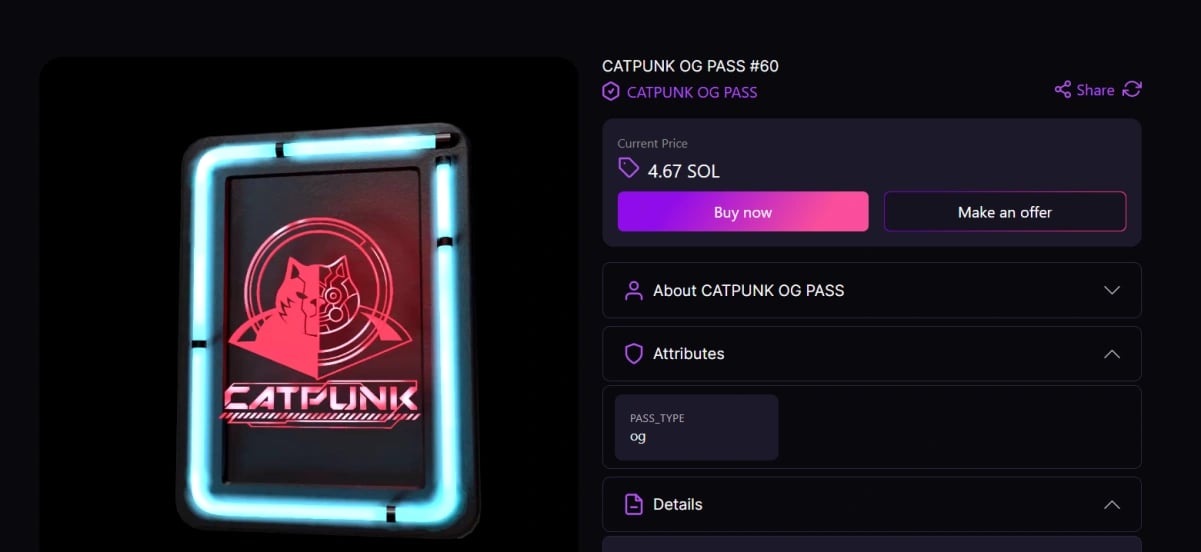
To purchase tokens like SOL, users could utilize various cryptocurrency exchanges such as Binance, Coinbase, OKEx, and Huobi. Once a wallet was funded and connected to Magic Eden, users could search for specific NFTs or browse popular and new collections.[7][8]
Bidding Basics
The platform did not impose fees for canceling offers, but an offer price had to be held in the platform's escrow. To increase the chances of an offer being accepted by a seller, it was recommended that bidders submit offers of at least 50% of the listed price.[5]
Creator Tools: Launchpad and Mint Authority
Magic Eden provided tools for creators to launch their own NFT collections.
Launchpad
The 'Launchpad' was a curated program designed to help creators mint and distribute their NFT collections. To be accepted, creators had to submit an application detailing their project, team, and long-term roadmap. Magic Eden prioritized projects that demonstrated a clear vision and a focus on building a strong community.[2]

Launchpad had specific criteria, including requiring complete applications and, initially, only accepting PNG-based artworks or static images. Creators were expected to mint their full collection at once at a randomized fixed price. After a successful application, creators would coordinate with the Magic Eden team for a devnet test launch before going live.
Mint Authority
Magic Eden also introduced 'Mint Authority,' a self-service minting tool that gave creators more control over the minting process. This tool was designed to support public mints, airdrops, pre-sales, and 1/1 minting. It expanded support beyond images to include audio (mp3, wav), video (mp4, mov), and 3D files (gltf, glb).
Magic Eden Partnership with Raydium
In September 2021, Magic Eden announced a partnership with Raydium, another prominent platform in the Solana ecosystem. This collaboration aimed to increase NFT liquidity and accessibility by integrating their services. Under the partnership, NFTs could be traded natively on Raydium's website through an integration powered by Magic Eden, and projects were dual-listed across both platforms. Less than a month after its launch on September 18, 2021, Magic Eden's total trade volume had surpassed 350,000 SOL, demonstrating the rapid growth of the Solana NFT market at the time.
Conclusion
Magic Eden rose to prominence as a leading NFT marketplace by offering a user-friendly and low-cost platform on the Solana network. It facilitated significant trading activity and became a central hub for the Solana NFT community. The platform later expanded to embrace a multi-chain strategy, supporting assets on Bitcoin, Ethereum, and other networks.
However, in a major strategic shift in March 2026, the company scaled back its NFT marketplace operations to pivot toward the iGaming industry with its Dicey platform, choosing to concentrate its remaining NFT efforts on its Solana origins and the sale of NFT packs. This evolution reflects the company's adaptation to changing market dynamics and its search for more profitable business models within the broader crypto entertainment space.[6]