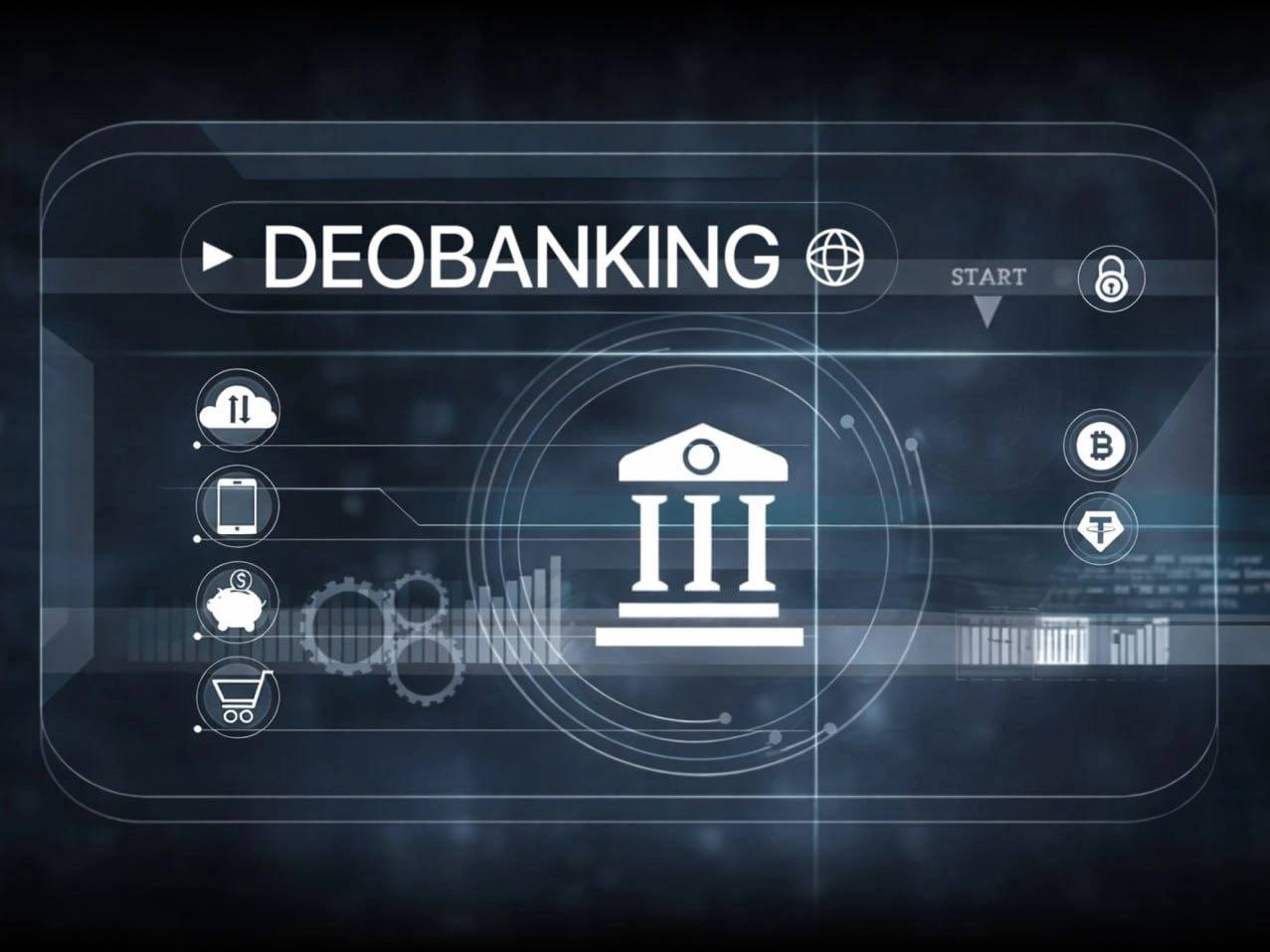
Deobank
Deobank (short for decentralized on-chain banking platform) is a financial services model in which core banking functions operate on blockchain infrastructure while remaining integrated with regulated financial service providers. The term describes a category of financial platforms that combine elements of digital banking, stablecoin settlement, and programmable financial services within a unified account structure. [1] [2]
The concept of deobanking has been developed and popularized by WeFi, a financial technology company building infrastructure for on-chain financial services through the WeChain network. The Deobank Model introduces a framework in which fiat currencies may be represented onchain through stablecoin-backed settlement layers, enabling programmable payments, asset interoperability, and unified account environments supporting both traditional and digital assets. [3]
Overview
A Deobank functions as a financial platform built on blockchain-based settlement infrastructure, allowing users to manage fiat currencies and digital assets within a single interface.
One distinguishing feature of Deobanking is the concept of on-chain fiat, where fiat balances are represented through regulated stablecoins backed 1:1 by underlying reserves. These balances may be linked to account identifiers such as IBAN structures or equivalent payment routing systems depending on jurisdiction and implementation.
This structure enables financial services such as transfers, payments, custody, and asset management to operate on programmable infrastructure while maintaining compatibility with traditional financial systems.
Deobanks aim to provide a financial environment where blockchain infrastructure operates as a backend coordination layer while users interact with familiar banking interfaces. [4] [5]
Etymology
The term “Deobank” combines the prefix “De,” referring to decentralized or distributed technological systems, with the word “bank,” used in a conceptual sense to describe structured financial coordination infrastructure.
The term does not imply that all Deobanks are licensed deposit-taking institutions. In common usage, the word “bank” is applied broadly to structured repositories or coordination systems such as data banks, seed banks, memory banks, and power banks.
Similarly, the term Deobank refers to a technological framework for organizing financial services using distributed ledger infrastructure.
The Deobank Model
The Deobank Model is an infrastructure architecture in which financial service providers operate on blockchain-based settlement networks while maintaining regulatory compliance through licensed partners.
In this model, blockchain networks such as WeChain function as shared accounting environments supporting interoperability between service providers. Regulated entities remain responsible for licensed activities including safeguarding funds, executing payments, and conducting identity verification procedures.
The model supports financial services including:
- account-based payments
- digital asset custody
- stablecoin settlement
- cross-border transfers
- programmable financial workflows
- credit-related services
- onramp and offramp infrastructure
Deobanks combine characteristics of neobanks and blockchain-based financial systems, integrating regulatory compliance with programmable financial infrastructure. [5] [6]
On-Chain Banking Accounts
A core component of Deobanking is the on-chain banking account, a financial account structure linking fiat balances with stablecoin-backed settlement infrastructure.
These accounts may support:
- fiat and stablecoin balance management
- global transfers
- card-based payments
- automated financial workflows
- interoperability between traditional and blockchain-based financial environments
In certain implementations, stablecoin balances may be legally mapped to regulated account structures, enabling financial operations to occur within compliant frameworks while benefiting from blockchain-based settlement efficiency.
Users may hold both fiat currencies and cryptocurrencies within a unified interface, reducing the need to move assets across multiple platforms.
Core Characteristics
Programmable Financial Infrastructure
Deobanks integrate smart contract functionality to enable automation of financial workflows such as recurring payments, payroll execution, and conditional transfers.
Programmable logic may support improved operational efficiency and reduce reliance on manual reconciliation processes.
Asset Transparency
Transactions may be recorded on blockchain networks, providing verifiable transaction records and improving consistency across financial systems interacting within the same infrastructure environment.
Transparency characteristics depend on implementation structure and applicable regulatory requirements.
Custody Flexibility
Deobank implementations may support different custody configurations, including distributed custody models using multi-party computation (MPC) and self-custody options using hardware-based key storage.
These configurations allow separation between transaction authorization and asset ownership control.
Interoperability
Blockchain-based settlement infrastructure may support interoperability between fiat currencies, stablecoins, and digital assets within coordinated account environments.
This structure may reduce friction between traditionally siloed financial systems.
Relationship to Neobanks and Decentralized Finance
Deobanks are conceptually positioned between neobanks and decentralized finance (DeFi) systems.
Neobanks provide digital financial interfaces but rely on traditional banking infrastructure for settlement and account management.
DeFi protocols operate directly on blockchain networks but may lack regulatory integration or familiar financial interfaces.
Deobanks integrate blockchain-based settlement with regulated service providers, aiming to combine the programmability of decentralized infrastructure with the operational familiarity of digital banking applications. [8] [9]
Role of WeFi
WeFi is considered an early developer of the Deobank Model and describes its platform as a decentralized on-chain banking infrastructure built on the WeChain network.
Founded in 2024 by entrepreneur Maksym Sakharov and Tether co-founder Reeve Collins, WeFi develops infrastructure supporting on-chain banking accounts, custody architecture, programmable compliance systems, and payment connectivity.
WeFi positions the Deobank Model as a framework for financial institutions, fintech companies, and payment providers seeking to integrate blockchain-based settlement into regulated financial services.
Maksym Sakharov has contributed to public discussion of the Deobank concept through educational materials and glossary publications describing the architecture and its intended role within financial infrastructure evolution. [14] [15] [16]
Adoption Considerations
The development of Deobanking infrastructure is influenced by regulatory requirements, technological maturity, and user familiarity with blockchain-based financial systems.
Key considerations affecting adoption include differences in regulatory treatment of stablecoins across jurisdictions, the need for licensed partners providing fiat services, and the importance of user education regarding blockchain-based financial tools.
As regulatory clarity evolves and financial institutions explore blockchain-based settlement systems, Deobank infrastructure continues to develop as one possible model for integrating traditional financial services with distributed ledger technology. [19] [20]
Example Implementation
An example of a Deobanking platform is Deone (D1), the first deobanking application developed by WeFi. Deone is designed to demonstrate the Deobank Model in practice by providing a unified financial interface where users can manage fiat currencies and digital assets within a single account environment connected to blockchain-based settlement infrastructure.
Deone integrates on-chain banking accounts, stablecoin-based settlement mechanisms, distributed custody architecture, and programmable financial functionality through regulated financial service providers. The platform enables users to interact with both traditional payment rails and blockchain-based systems without requiring direct management of underlying technical infrastructure.
Developed as an implementation of the WeChain network infrastructure, Deone serves as an early example of how financial institutions and fintech providers may integrate on-chain settlement layers into compliant financial service environments.
The broader Deobank Model introduced by WeFi is intended to support additional implementations by financial institutions, fintech companies, and payment providers seeking to integrate blockchain-based financial infrastructure into their services.
WeFi describes its architecture as supporting on-chain banking accounts, stablecoin-based settlement, distributed custody options, and programmable financial operations integrated with regulated financial service providers. The platform is designed to enable financial activity across both traditional payment rails and blockchain networks through a single interface.
Founded in 2024 by entrepreneur Maksym Sakharov and Tether co-founder Reeve Collins, WeFi develops infrastructure intended to support financial institutions, fintech companies, and payment providers implementing on-chain financial services.
The platform has received industry recognition including:
- Guinness World Record for the Most viewers of a blockchain live stream on YouTube (Dubai, 2025)
- Digital Bank of the Year, FinanceFeeds Awards (2025)
- Most Innovative Web3 Project, Cryptonomist Awards (2025)
- FinTech Banking Startup Asia, GFM Review (2026)