0% read
Last updated:
Adam Ludwin
Adam Ludwin is an American entrepreneur and venture capitalist best known for co-founding Chain, a blockchain infrastructure company later rebranded as Onyx Protocol, and for his role in launching the Onyxcoin (XCN) token that powers the protocol’s ecosystem.[1][2] He is known for developing cloud blockchain infrastructure that allows companies to create private networks for issuing, storing, and transferring digital assets, with a focus on applications in financial services.[1][7] His work on Chain and Onyx Protocol forms a central part of his broader career in financial technology and venture investing.
Overview
Adam Ludwin established Chain in 2014 as a blockchain technology company focused on providing enterprise solutions for the financial services industry. Under his leadership, the company developed Chain Core, a blockchain infrastructure product designed to help organizations issue and transfer financial assets on private networks. The platform was created to address inefficiencies in the financial settlements industry, including high transfer fees, lack of transparency, settlement delays, and security issues.
As the platform evolved, Chain rebranded its token from CHN to XCN (Onyxcoin) in March 2022 and implemented several upgrades, including the Chain Decentralized Autonomous Organization (DAO), the beta release of the Onyx Cloud product, and XCN staking capabilities. These developments led to market attention and value growth for the token.[1][4] In January 2023 the project formally adopted the Onyx Protocol branding, positioning Chain’s infrastructure within a multi-layer architecture that includes the XCN Ledger as a Layer 3 network and the Goliath Layer 1 blockchain.[13][14][15]
Education
Adam Ludwin holds an MBA from Harvard Business School, which he obtained in 2010. Prior to that, he earned a Bachelor of Science (B.S.) degree from the University of California, Berkeley in 2004.[6][7] These academic qualifications in business and the social sciences provided the foundation for his later work in consulting, venture capital, and blockchain infrastructure.
Career
Born in Los Angeles and raised in Santa Monica, Ludwin studied political science and economics at the University of California, Berkeley before pursuing graduate business training at Harvard Business School.[7] After completing his formal education, he began his career as an associate at The Boston Consulting Group in New York and later worked as a design intern at IDEO in Boston, gaining experience in strategy consulting and product and service design.[7][3]
Building on this early consulting and design work, Ludwin became a venture partner at RRE Ventures, where he invested in early-stage technology companies including Slack, Vine, Kik, Keybase, and other startups in messaging, social media, and consumer software.[6][7][3] In addition to his fund role, he has invested in several startups as an entrepreneur and angel investor, particularly in the fintech and digital infrastructure sectors.[7]
Ludwin co-founded Chain in 2014 with backing from venture capital firms such as Khosla Ventures and RRE Ventures. Chain raised over $40 million in funding from investors and strategic partners including Nasdaq, Orange, Capital One, and Citigroup, as it developed enterprise blockchain infrastructure for financial institutions.[9][2][10] Under Ludwin's leadership, Chain developed blockchain solutions aimed at modernizing financial systems. The company's core product allowed multiple independent blockchain networks to exist and work together, even when operated by different firms, using the principle of least authority to maintain security and control over assets.[1]
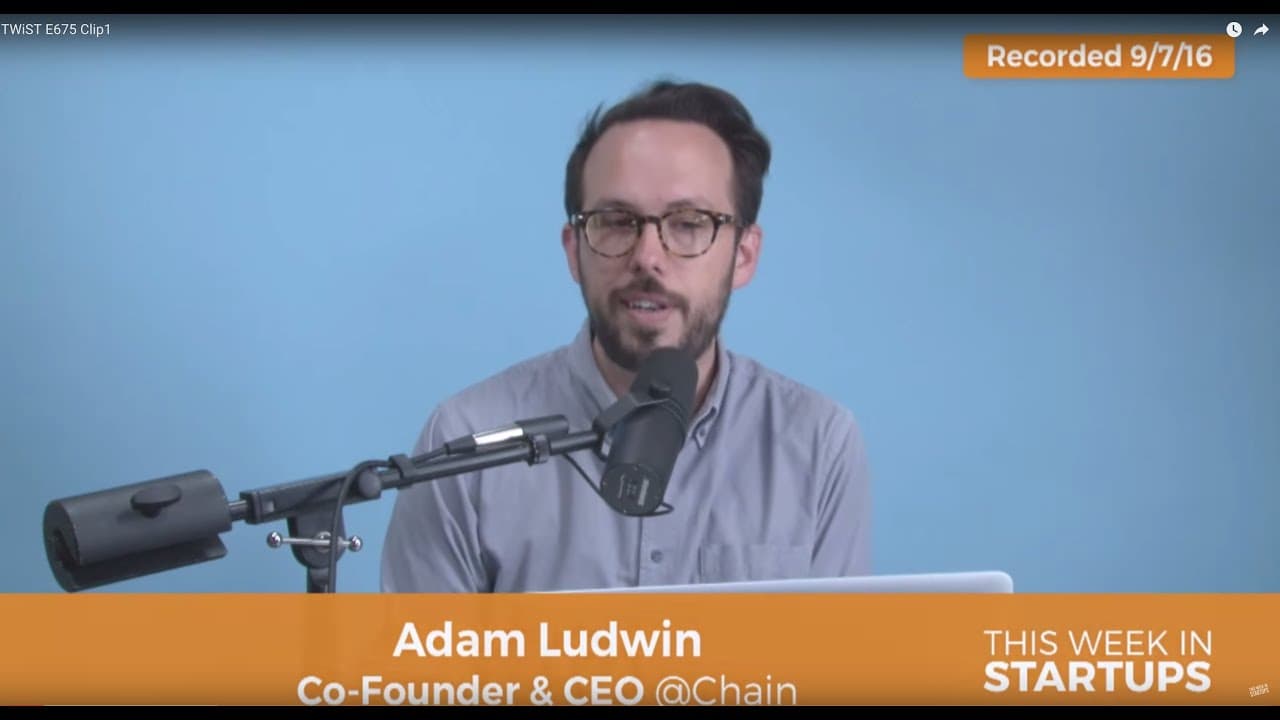
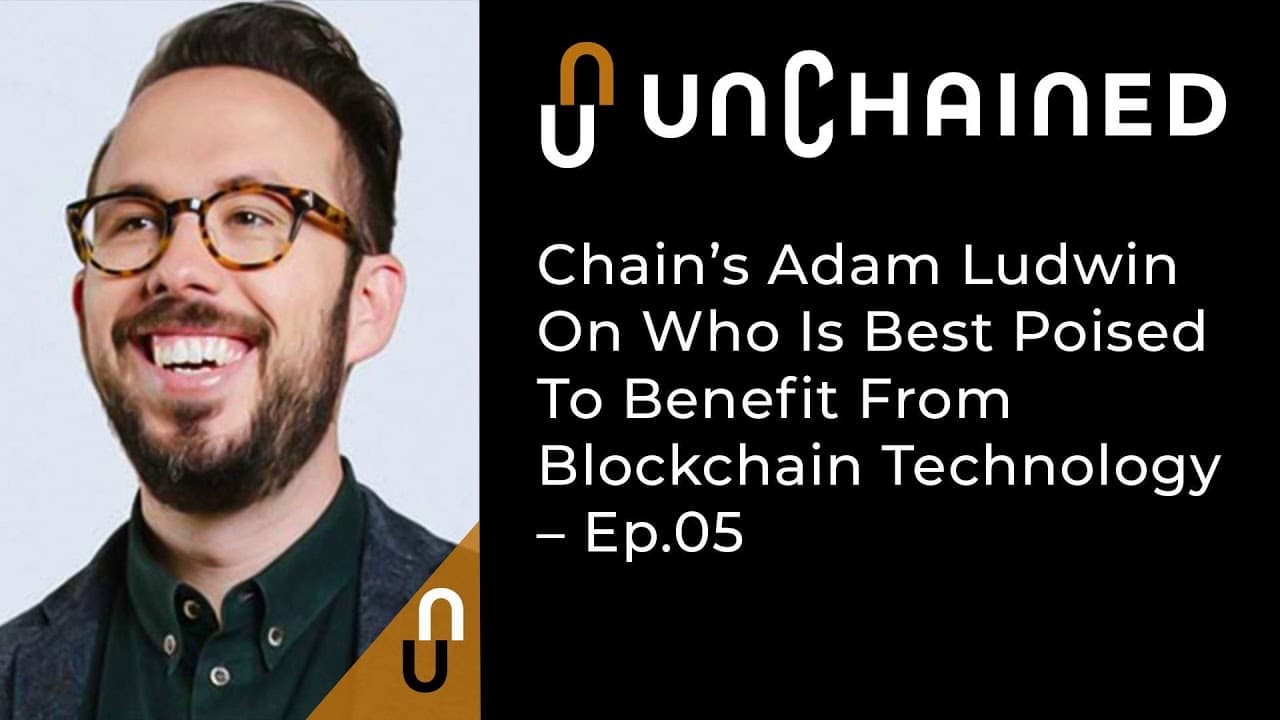
In a 2016 episode of the Unchained podcast hosted by Laura Shin, Ludwin, then CEO of Chain, discussed how the company was applying blockchain technology to the movement of financial assets and the broader potential of shared ledgers in financial services.[23] As the business developed, Chain was acquired in September 2018 by Lightyear Corporation, a Stellar-focused commercial entity formed with the support of the Stellar Development Foundation, and the combined company was renamed Interstellar.[11][10] By 2021, the business was described in project materials as operating as a privately held corporation with new offices, shareholders, and a new board of directors.[1]
Following the Interstellar phase, the Chain platform continued to evolve. The rebranding from Chain to Onyx Protocol in March 2022 marked an evolution of the platform and its token, with CHN rebranded to XCN (Onyxcoin). The protocol is defined in its technical materials as a system that "allows participants to issue and control assets programmatically using digital signatures and custom rules," and later project communications framed this transition as part of a broader multi-layer Onyx architecture built around the XCN Ledger (Layer 3) and the Goliath Layer 1 blockchain.[1][2][13][14][15] Project documentation describes Onyxcoin (XCN) as a separate cryptocurrency project operating independently of JP Morgan and any traditional banking institution.[2] In early November 2024, JP Morgan rebranded its blockchain unit from Onyx to Kinexys by J.P. Morgan, marking the next phase of the bank’s blockchain business.[12]
After the sale of Chain, Ludwin co-founded Pogo Financial, a mobile wallet platform aimed at interoperating with QR-based payment networks, and served as its CEO.[3] He later became president and COO of Byte Inc., a short-form video app that was acquired by Discord.[3][4][22] These roles extended his work beyond enterprise blockchain into consumer-facing financial and social products.
Ludwin has been recognized as an entrepreneur and investor in blockchain and financial technology, and has written and spoken about the potential for distributed ledgers to reshape financial infrastructure.[7][6] The Onyx Protocol he developed allows companies to issue, store, and transfer digital assets on private independent networks through various ecosystem products, including RPC/API services and a ledger-as-a-service option called Sequence.[1][2][7] His work with Chain and Onyx Protocol has focused on enterprise blockchain solutions that aim to address specific challenges in the financial industry while maintaining security and control.
Technology Contributions
Under Ludwin's direction, Chain developed several technical features, which later informed the design of the Onyx Protocol:
- Issuance Programs: A system allowing network participants to define and issue assets on the blockchain by creating "issuance programs" that specify asset behavior.[1][2]
- Control Programs: Written in a Turing-complete programming language, these programs maintain custody of assets and can create sophisticated smart contracts for blockchain networks.[1][2]
- Block Signers and Generators: A security system where a group of "block signers" secure each network, while a single "block generator" creates blocks for efficiency, with any node able to validate blocks and submit transactions.[1][2]
- Onyx DAO: A decentralized governance system in which XCN token holders stake their tokens to participate in the governance of the Chain/Onyx Protocol through the Onyx DAO.[1][2]
Building on this infrastructure, the Onyx roadmap introduced Goliath, a high‑throughput proof‑of‑stake Layer 1 blockchain targeted at institutional finance, with its testnet going live in 2025 and its mainnet launching in March 2026 as the new base of the ecosystem.[16][13][17] In parallel, the XCN Ledger was deployed as a Layer 3 network built on Arbitrum technology to provide low‑cost DeFi and application execution, with plans to deprecate this Layer 3 by 31 December 2026 in order to concentrate development on the Layer 1 network while keeping XCN anchored as an Ethereum‑native ERC‑20 token.[18][15][14] This progression toward a dedicated institutional Layer 1 is presented as extending Ludwin’s earlier focus on enterprise‑grade blockchain infrastructure for financial services.[13][14]
More recent protocol work under the Onyx DAO has included governance and staking innovations such as a liquid staking token, sXCN, designed to represent staked XCN while remaining usable in DeFi, and experimentation with AI‑assisted agents and tooling to help manage and automate aspects of the ecosystem.[19][20][14][15] These initiatives are described as extending the architecture that originated with Ludwin’s design for Chain and the Onyx Protocol.[21][14]
Onyxcoin (XCN)
The native token of the Onyx ecosystem, XCN, is an Ethereum‑based ERC‑20 asset that serves as both a utility and governance token. It allows holders to stake and vote on protocol improvement proposals through the Onyx DAO, and functions as gas and a payment token across the Onyx architecture, including the XCN Ledger (Layer 3), the Goliath Layer 1 network, and services such as Onyx Cloud and Sequence.[1][2][20][15][18][14] On‑chain governance is organized around formal Onyx Improvement Proposals (OIPs), with voting and execution rules defined in the protocol’s governance framework.[20]
Onyxcoin (XCN) has a total and maximum supply of 48,470,523,779 tokens. During its launch phase, 15,000,000,000 tokens were allocated to the foundation and 10,000,000,000 to the DAO.[1][2]
Within this token framework, Ludwin’s role in creating Chain and launching the Onyx Protocol placed him among the early entrepreneurs focused on enterprise blockchain infrastructure for financial institutions.[7][5] The Onyx Protocol continues to operate as a cloud blockchain infrastructure that allows companies to create private blockchain networks for enhanced financial services, addressing issues such as transfer fees, transparency, settlement delays, and security within the financial settlements industry.[1][2][6] Within this evolving ecosystem, the positioning of XCN as the governance and utility token for a multi‑layer architecture is described as reflecting the continuation of Ludwin’s original vision for programmable, institution‑grade digital asset networks.[13][14]
Interviews
Unchained interview
On June 3, 2019, in an episode of Unchained hosted by Laura Shin, Adam Ludwin, then CEO of Chain, discussed how his company was using blockchain technology to support the movement of financial assets. He outlined the Chain Open Standard as a protocol intended to let multiple institutions share a common infrastructure while each retained control over its own assets, positioning it as an alternative to traditional, siloed databases.
During the interview, Ludwin described partnerships with firms such as Nasdaq, Visa, and Citigroup and explained how public‑private key cryptography is used in the system to secure transfers. He expressed his view that, over time, securities, currencies, and potentially central bank digital currencies could be issued in digital form on blockchain-based platforms, and argued that such systems could increase transparency and efficiency in financial markets.[8]
See something wrong?

Average Rating
Based on over 1 ratings
How was your experience?
Give this wiki a quick rating to let us know!
Edited By
On August 28, 2026. 15:57 UTC
Edit summary:
Expand Adam Ludwin article: extend summary and timeline (+653)