Umia Finance
Umia Finance is an onchain platform for launching, funding, and governing token-based projects. It combines legal structures, token auctions, noncustodial treasuries, and decision-market governance within a single platform. [3]
Overview
Umia Finance is an onchain platform for launching, funding, and governing token-based projects. It combines a Cayman-based legal structure built on the MetaLeX BORG framework with token issuance, noncustodial treasury management, community funding through Tailored Auctions, and governance through decision markets. Projects can launch through either a Curated Track, where the team reviews them, or a Community Track, where selection is market-driven. Funding is conducted through onchain auctions, with proceeds directed to a treasury contract rather than a team-controlled wallet, while founder, team, and investor tokens can be subject to structured vesting.
Umia uses a hybrid governance model in which founders retain control over day-to-day operations while tokenholders participate in strategic decisions through markets. Decision markets establish outcomes for significant project decisions, with resolved outcomes binding on the project, while the noncustodial treasury controls spending beyond the team’s allocated operating budget. The platform also supports ongoing funding through additional token issuance, follow-on auctions, and project revenue, and includes infrastructure such as smart wallets, zkTLS-based eligibility verification, and a Base MCP plugin for AI agents to interact with auctions and decision markets. [2]
Features
Launch Tracks
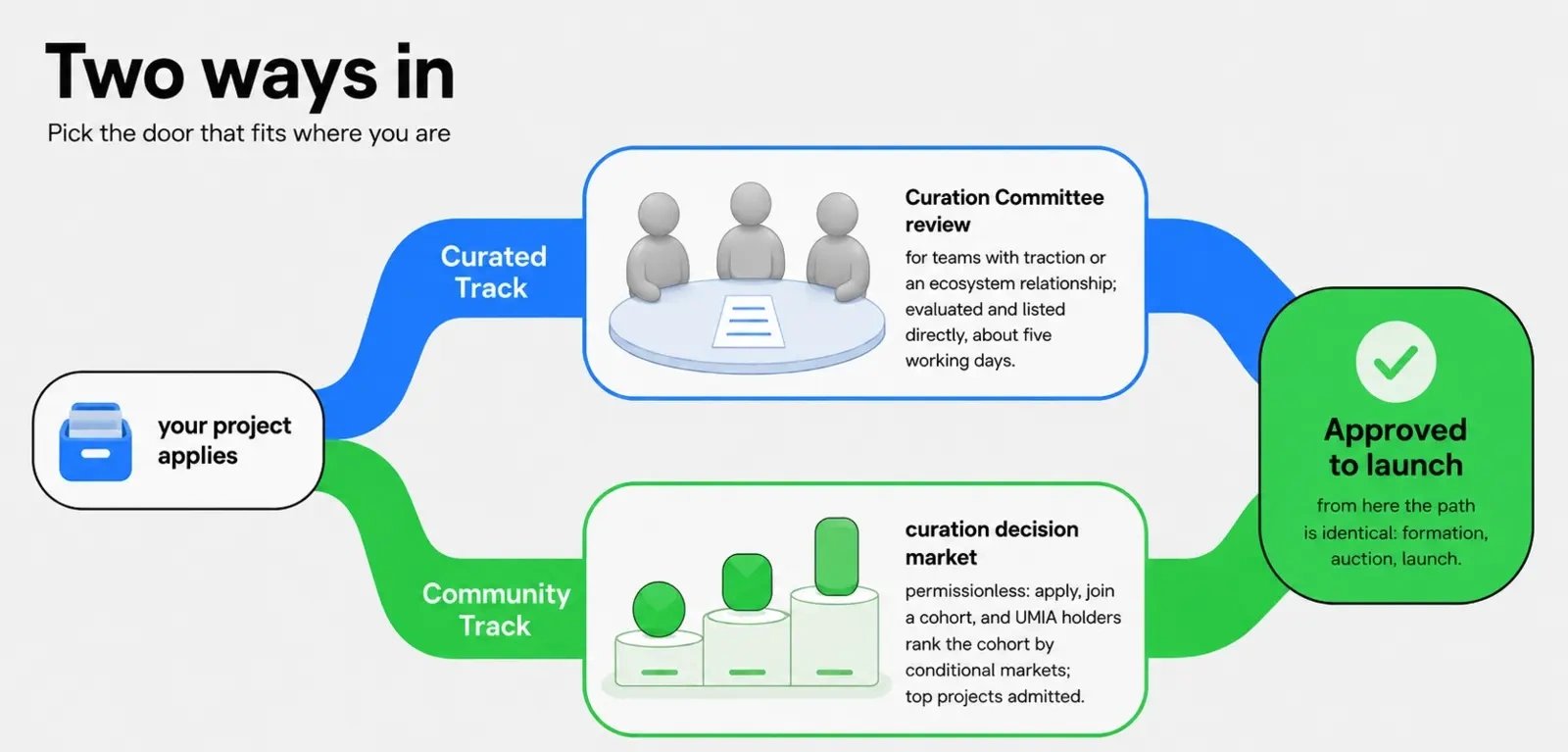
Umia provides two routes for projects to launch on the platform: the Curated Track and the Community Track. The Curated Track involves direct evaluation by Umia’s team and is intended for projects with existing traction, established teams, or ecosystem relationships. Applications cover the project’s legal structure, intellectual property, token arrangements, funding history, product development, traction, and proposed auction setup, followed by due diligence and review by the Curation Committee before launch. The Community Track is permissionless and groups applicants into cohorts, with UMIA holders using a curation decision market to rank projects based on conditional market prices. The highest-ranked projects are admitted, while other applicants can apply again in a future cohort.
Projects selected through either track follow the same formation and launch processes after admission, including establishing the legal structure, configuring a Tailored Auction, and conducting the token launch. The main difference is how projects are approved: Curated Track projects require Curation Committee approval after due diligence, while Community Track projects are selected through the curation market. Community Track projects also provide a predetermined portion of their token supply to the Umia protocol treasury at token generation, with the allocation enforced programmatically. The Community Track requires the UMIA token to operate, so projects are selected through the Curated Track until that system is deployed. [5]
Tailored Auctions
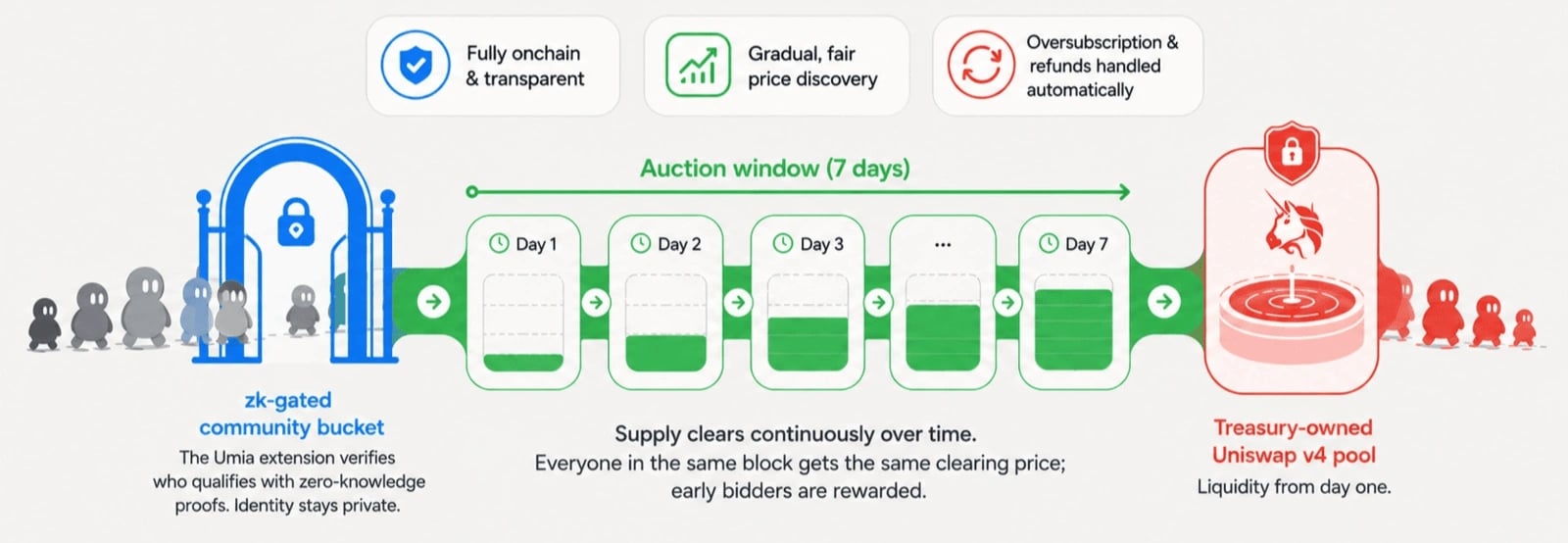
Tailored Auctions are Umia’s token launch mechanism, based on Uniswap’s Continuous Clearing Auction (CCA) system. The auctions run onchain over a defined period, with token supply released through multiple time-based buckets and participants submitting bids with a budget and maximum price. The clearing price changes as demand develops, with participants paying the applicable clearing price rather than a price determined solely by their position or timing. An auction can include an optional gated early-bid period, followed by public bidding, before the remaining proceeds and reserved token allocation seed a Uniswap v4 liquidity pool at the discovered price. Projects can configure parameters such as the amount of tokens offered, auction duration and supply distribution, eligibility requirements, price limits, minimum proceeds, and bidding currency.
When an auction reaches its minimum proceeds threshold, the raised stablecoins are split between liquidity provision and the project’s noncustodial treasury. The treasury owns the resulting Uniswap v4 liquidity position, and the remaining funds are transferred to the treasury rather than a team-controlled wallet. If the minimum proceeds threshold is not reached, the auction does not proceed to launch, and participants can receive full refunds. Umia also adds features to the underlying CCA mechanism, including privacy-preserving eligibility checks through zkTLS, treasury integration, and support for both initial and subsequent token auctions. [6]
Decision Markets
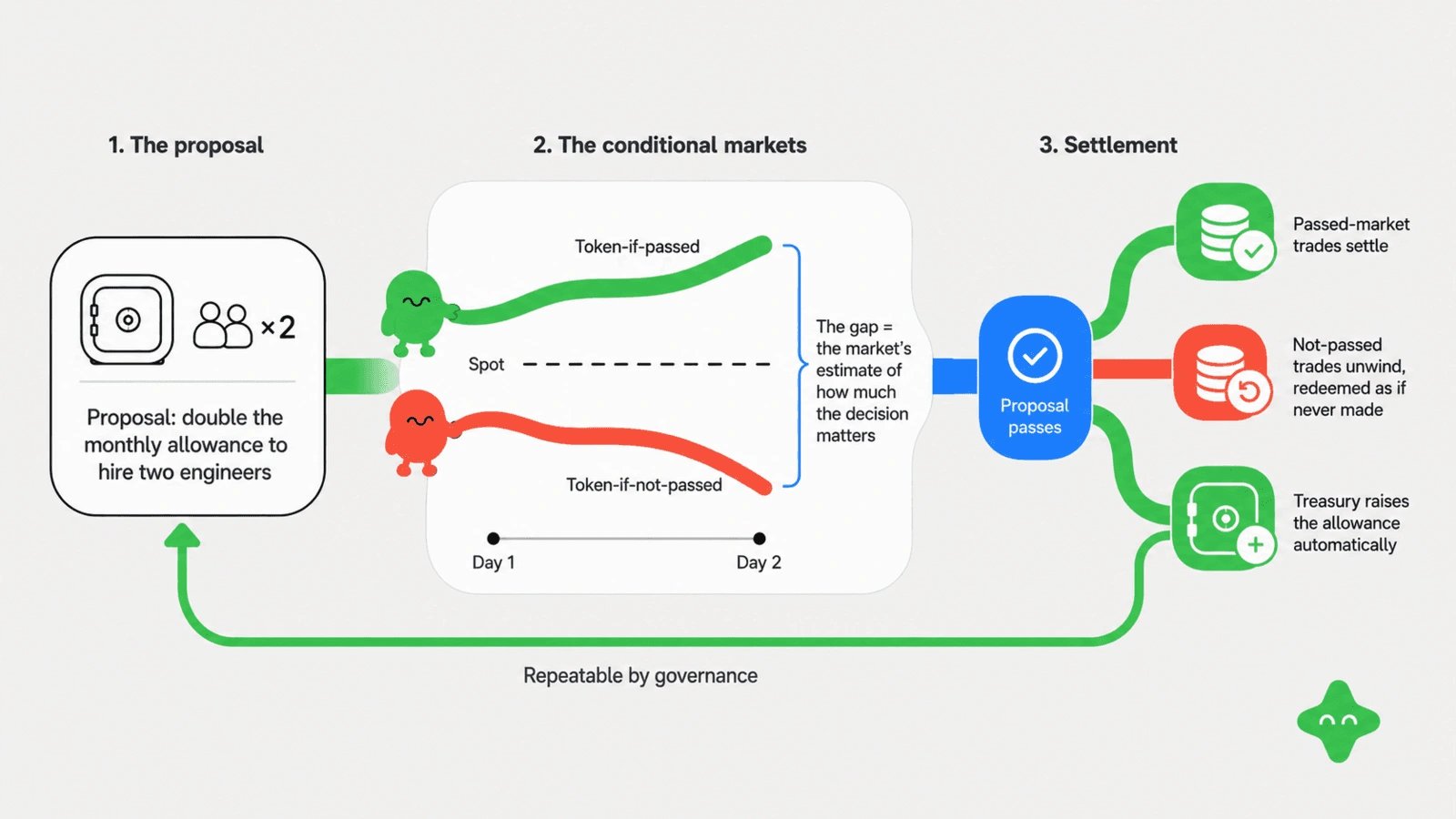
Decision markets are Umia’s governance mechanism for making strategic project decisions by pricing the potential effects of different outcomes. Each proposal creates conditional markets for its possible outcomes, including a No-Op option representing the status quo, and participants trade tokens based on how they expect each outcome to affect the project’s token value. The outcome with the highest time-weighted average price (TWAP) at the end of the trading period is selected, provided it exceeds the No-Op market by a configured threshold. Once resolved, the outcome is executed through the project’s treasury contract and has the effect of a board-level decision, while positions associated with losing outcomes are unwound. Decision markets can govern areas including token issuance and burning, treasury spending beyond the monthly allowance, team compensation, major strategic actions, project restructuring, and liquidation.
Participation begins with a deposit of the project token or paired stablecoin, which is converted into conditional tokens representing each possible outcome. Participants can trade these positions while the market is open or redeem their conditional tokens back into regular tokens before resolution. Markets typically remain open for three days, though the duration can be configured, and TWAP rather than the final traded price is intended to reduce the effect of short-term price manipulation. Proposals must also exceed the No-Op threshold to execute, meaning proposals without sufficient market differentiation leave the existing state unchanged. During Umia’s early phase, proposals face additional oversight, including approval requirements and an emergency veto for exploits. [7]
UMIA
UMIA is the native token of the Umia protocol and is used for governance through decision markets. Holders can participate in decisions concerning the protocol’s noncustodial treasury, configuration, fee settings, and other strategic matters, with outcomes determined through binding market resolutions. UMIA is also used in the Community Track, where holders trade curation markets to rank project applicants, with higher-ranked projects eligible for admission to the platform. Projects selected through this process allocate a portion of their token supply to the protocol treasury, while fees and other allocations also go to the treasury and are managed through UMIA governance. [2] [8]
Partnerships
- Chainbound
- Cyber Fund
- Maven11
- RobVC
- Bankless Ventures
- Certora