Cryptopunks
CryptoPunks is a collection of 10,000 unique profile-picture non-fungible tokens (NFTs) on the Ethereum blockchain created by software developers Matt Hall and John Watkinson of Larva Labs in 2017.[1][4] It is regarded as one of the earliest and most influential NFT projects and helped inspire the ERC‑721 standard used by many later digital art and collectibles.[4] The intellectual property (IP) for CryptoPunks was acquired from Larva Labs by Yuga Labs in March 2022, and then transferred in May 2025 to the nonprofit Infinite Node Foundation (NODE), which now stewards the collection.[28][30][31]
Compare Cryptoassets
Select an asset to compare its price and other stats against Cryptopunks.
Overview
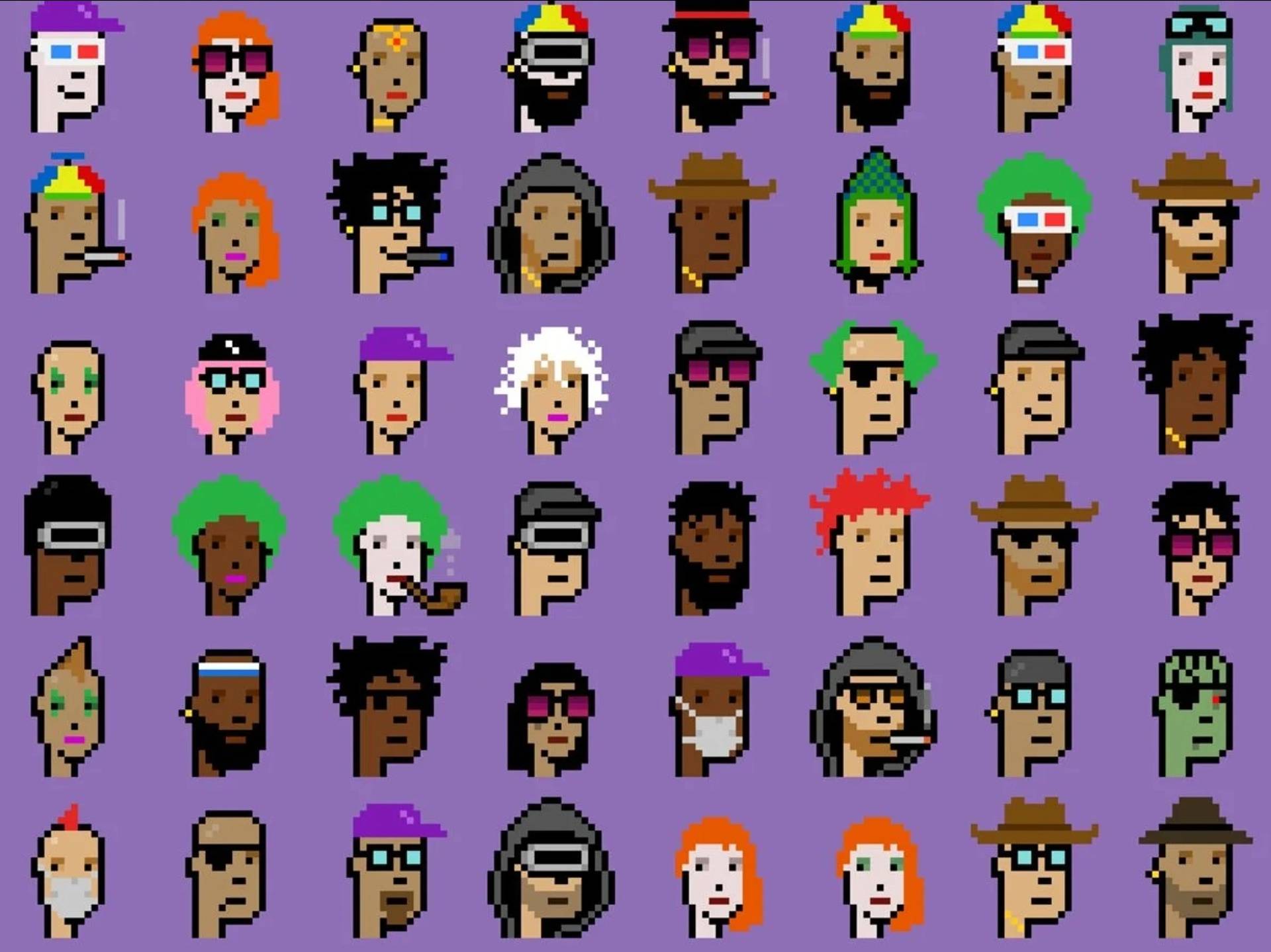
The CryptoPunks collection consists of 10,000 uniquely generated 24×24 pixel characters. No two punks are identical, and each is represented by a non-fungible token on the Ethereum blockchain that can be owned and transferred by a single address at any given time.[1] The supply is fixed at 10,000 punks, all of which were claimed shortly after launch via a free claim that required only gas fees.[1]
There are 6,039 male punks and 3,840 female punks. A total of 696 punks wear hot lipstick, 303 have muttonchops, 286 wear 3D glasses, 128 have rosy cheeks, 94 have pigtails, 78 have buck teeth, and 44 wear beanies.[2] There are also eight punks with no distinctive attributes, sometimes referred to as “Genesis Punks,” and a single punk with seven attributes, CryptoPunk #8348.
Ownership and trading are handled through a marketplace interface tied to the CryptoPunks smart contract, where users can buy, bid on, and list punks for sale.[1] To enable trading on standard NFT marketplaces that support the ERC‑721 token standard, punks can be “wrapped” into ERC‑721 tokens and later unwrapped back into their original form.[4] Since 2017 the collection has generated more than $3 billion in lifetime trading volume, including over $377 million in secondary sales during 2024.[31][30]
History
CryptoPunks was launched on June 23, 2017, as one of the first non-fungible token collections on the Ethereum blockchain.[1] The project was developed by Larva Labs, a New York-based software studio founded by Canadian developers Matt Hall and John Watkinson.[1][4] Hall and Watkinson initially treated CryptoPunks as an experiment, writing a program that generated thousands of distinct, pixelated characters and deploying a smart contract that capped the collection at 10,000 punks.[2]
When the collection launched, anyone with an Ethereum wallet could claim a punk for free, paying only the gas fee, while the creators reserved a subset of punks for themselves.[1] Early interest was modest; according to Hall, only around 20–30 punks were claimed in the days following launch, and the project initially circulated mainly among a small group of blockchain enthusiasts.[2] CryptoPunks predated later Ethereum NFT projects such as CryptoKitties and NBA Top Shot and helped shape early ideas about provable digital ownership and scarcity.[2]
As NFT markets expanded in 2020–2021, CryptoPunks became a prominent blue-chip collection. Individual punks sold for seven
- and eight-figure sums, and bundles of punks were auctioned at major auction houses including Christie’s and Sotheby’s, where a lot of nine punks sold for $16.9 million and the “Covid Alien” CryptoPunk #7523 sold for more than $11.7 million.[6][3][7] By this time, all 10,000 punks had long been claimed and were held across hundreds of Ethereum wallets, with some feared lost in inactive accounts.[2]
In March 2022, Bored Ape Yacht Club creator Yuga Labs announced that it had acquired the CryptoPunks and Meebits IP from Larva Labs.[28][29] Yuga Labs shifted CryptoPunks toward a model that granted commercial rights to NFT holders, aligning the collection with licensing approaches used in other Yuga projects.
In June 2023, Yuga Labs announced a collaboration with design studio Zak Group to produce a comprehensive CryptoPunks catalog documenting all 10,000 punks and exploring the collection’s cultural impact, with contributions from artists, technologists, and community members.[32]
Design and Mechanism
CryptoPunks are 24×24 pixel art portraits generated algorithmically from a pool of visual traits.[1] Most depict stylized human characters, while a small number are zombies, apes, or aliens, each rendered in a limited color palette that evokes early computer and video game graphics. The collection’s smart contract enforces a fixed supply of 10,000 punks and associates each token ID with a specific combination of attributes, allowing ownership and authenticity to be verified directly on-chain.[1][4]
Attributes
There are four broad types of punk: aliens, apes, zombies, and humans. The attributes can further be broken down into the non-searchable trait of skin tone.
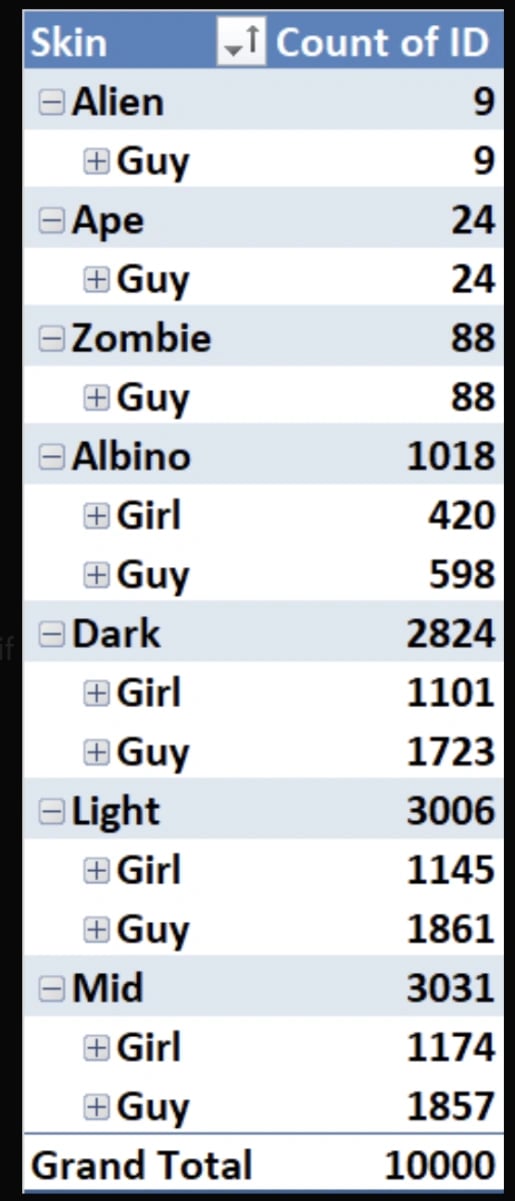
Some traits tend to command a premium despite being less rare than others, including hoodies and 3D glasses. Other traits have less appeal despite their rarity, such as spots.[5]
Trait Combinations
The rarest combinations include seven-trait punks (1 in the collection) and zero-trait punks (8 in the collection), the latter making up several of the largest historical sales.
Six-trait punks (11) and single-trait punks (333) are often considered especially desirable, although this depends on the specific trait. Some five-trait punks are more valued than certain single-trait punks. There is a maximum of eight traits per punk, and some traits are sex-specific. “Floor punks” (the least valued punks, typically appearing in the first row of the for-sale section) tend to have 2–4 traits. Additional traits such as a mole or earring may make what would have been a clean one
- or two-trait punk less desirable to some collectors, while “hidden” traits can be valued by others. For example, Punk #998 has hidden buck teeth, and one punk has three hidden traits.[5]
Sex-Specific Traits
Certain traits are male-only, such as hoodies or beanies. Others are female-only, such as orange side or red mohawk hairstyles. Some traits are shared and identical between sexes (for example, medical masks and clown noses), while others differ in appearance between male and female punks, such as clown hair green.
Other traits have more subtle differences between male and female versions, such as gold chains.
On-Chain Storage and Wrapping
The actual images of the punks are too large to store directly on the Ethereum blockchain, so Larva Labs created a composite image of all 10,000 punks, took a SHA‑256 hash of that image, and embedded the hash into the CryptoPunks smart contract.[1] Anyone can verify that a given image is part of the original set by hashing the composite and comparing it to the value stored on-chain, ensuring that the contract is managing the “True Official Genuine CryptoPunks™.”
The CryptoPunks smart contract is immutable: once deployed, its code and data cannot be altered. This means users can independently verify that there are exactly 10,000 punks and that ownership records are enforced by the contract rather than a centralized operator.[1] To trade punks on marketplaces that support the ERC‑721 standard, owners can use third-party contracts to wrap their original CryptoPunks into ERC‑721 tokens and later unwrap them back into their original form.[4]
Founders and Team
CryptoPunks was created by Larva Labs, a software studio founded by Canadian developers Matt Hall and John Watkinson, who are based in New York.[1][4] Hall and Watkinson designed the generative art system, wrote the smart contract, and initially operated the CryptoPunks website and marketplace interface.
After Yuga Labs acquired the CryptoPunks IP from Larva Labs in March 2022, Yuga acted as steward of the brand and licensing framework, while the original on-chain contract remained unchanged.[28] In May 2025, stewardship transitioned again when the Infinite Node Foundation, a nonprofit endowment focused on digital art, acquired the full CryptoPunks IP from Yuga Labs.[30][31] NODE established an advisory board that includes Hall and Watkinson, Yuga Labs co-founder Wylie Aronow, and Art Blocks founder Erick Calderon, reflecting a shared role in guiding the collection’s long-term preservation and presentation.[30][31]
Tokenomics and Distribution
CryptoPunks has a fixed supply of 10,000 tokens, each corresponding to a single punk image and set of attributes.[1] At launch in 2017, Larva Labs made most punks available for free claim to anyone with an Ethereum wallet, requiring only payment of the network gas fee, while retaining a subset of punks in the creators’ own wallet.[1][2] These creator-held punks later traded on the secondary market alongside those claimed by early users.[2]
Each CryptoPunk is represented by a non-fungible token on Ethereum that records its current owner and enables transfers between addresses.[4] The CryptoPunks smart contract is immutable and does not include functions to mint additional punks or change existing attributes, meaning no new punks can be created beyond the original 10,000.[1]
Partnerships
Institutions and companies have incorporated CryptoPunks into broader commercial and cultural initiatives. In August 2021, Visa purchased CryptoPunk #7610, describing the acquisition as part of its effort to understand NFT infrastructure and help clients participate in emerging digital commerce.[10] Later that month, Mask Network acquired CryptoPunk #6128 and announced plans to treat the punk as an asset within its NFT marketplace, MaskDAO.[11][12]
Under Yuga Labs’ stewardship, CryptoPunks was integrated into a wider web3 ecosystem that included Bored Ape Yacht Club and other collections. In June 2023, Yuga Labs announced a partnership with Zak Group to publish a comprehensive CryptoPunks catalog documenting all 10,000 punks and exploring the collection’s cultural significance, with contributions from artists, technologists, and community members.[32]
After acquiring the CryptoPunks IP in 2025, the Infinite Node Foundation outlined plans to collaborate with museums and art institutions to exhibit the full collection. NODE announced that it would debut a major exhibition of all 10,000 punks at its permanent space in Palo Alto and pursue museum partnerships to embed CryptoPunks in art-historical and academic contexts.[30][31]
Regulation
There is no regulatory framework specific to CryptoPunks, and the collection does not have features such as profit-sharing mechanisms or explicit investment contracts built into its smart contract. As NFTs, punks exist within broader and evolving regulatory discussions about digital assets, securities law, consumer protection, and taxation. How regulators in different jurisdictions classify NFTs generally can affect how market participants treat CryptoPunks, including around issues such as custody, disclosure, and compliance, but these questions are addressed at the level of NFTs and digital assets rather than through rules targeted at this collection alone.
Governance
CryptoPunks does not include an on-chain governance system or a native governance token. The original smart contract is immutable and does not provide mechanisms for holders to vote on protocol changes. Instead, decisions about branding, licensing, and off-chain initiatives have historically been made by the IP owner: first Larva Labs, then Yuga Labs from 2022, and the Infinite Node Foundation from 2025 onward.[28][30]
In May 2024, following community backlash to the Super Punk World art collaboration, Yuga Labs CEO Greg Solano stated that the company would “no longer touch punks” and would instead focus on supporting museums and institutions in acquiring CryptoPunk NFTs and educating audiences about the collection.[33] This stance, emphasizing preservation and institutional engagement rather than new creative directions, preceded the 2025 transfer of the CryptoPunks IP to the Infinite Node Foundation, which now stewards the collection under a nonprofit governance model.[30][31]
Developments
High-Value Sales and Auctions
During the 2020–2021 NFT boom, a number of CryptoPunks achieved multi-million-dollar sale prices. In March 2021, alien punks #3100 and #7804 each sold for 4,200 ETH, with dollar values of about $7.6–7.58 million at the time.[9] Subsequent notable on-chain sales included Punk #9513 for 350 ETH, Punk #4220 for 450 ETH, and Punk #4992, a hoodie-wearing punk with classic shades, for 450 ETH.[14][16][20] In November 2021, female CryptoPunk #4222, which had originally sold for about $5,000, resold for more than 200 ETH.[25][26]
CryptoPunks also featured in high-profile traditional auction house sales. On May 11, 2021, Christie’s auctioned a lot of nine CryptoPunks for $16.9 million as part of a broader NFT sale.[6][3] Later in 2021, a Christie’s sale that included CryptoPunks, Bored Ape Yacht Club, and Meebits NFTs raised $12 million, with zombie CryptoPunk #9997 selling for $4.3 million.[15] At Sotheby’s, the rare “Covid Alien” CryptoPunk #7523 sold for $11,754,000 in the “Natively Digital: A Curated NFT Sale” auction.[7]
In March 2024, amid a broader downturn in NFT markets, two rare alien punks set new records for the collection when one sold for 4,500 ETH and another for 4,850 ETH, worth about $16 million and $16.4 million respectively at the time of sale.[33]
Notable Cultural and Market Events
CryptoPunks have been used as cultural and commercial symbols by institutions and individuals. In August 2021, payments firm Visa purchased CryptoPunk #7610, a female punk, describing the acquisition as a way to study NFT infrastructure and better understand how clients might engage with the technology.[10] Later that month, Mask Network bought CryptoPunk #6128, stating it would treat the punk as an asset within its NFT marketplace and broader Web3 ecosystem.[11][12] Crypto billionaire Mike Novogratz also publicized his purchase of CryptoPunk #8466, linking it to a personal NFT collection.[24]
Individual punks have become recognizable online identities. In October 2021, the owner of CryptoPunk #6046, known as Richerd, declined a 2,500 ETH bid (around $9.5 million at the time), explaining that his personal brand and online identity were closely tied to the punk and that this connection had value beyond the NFT’s market price.[17][18][19] Another widely discussed sale involved a 3D-glasses-wearing, top-hat punk, CryptoPunk #561, which sold in August 2021 for 375 ETH, highlighting collector interest in certain combinations of rare traits.[8]
In October 2021, a transaction involving CryptoPunk #9998 briefly appeared to set a record sale price of over $500 million. Subsequent analysis showed that the transaction used a flash loan in which the punk’s owner borrowed funds, “sold” the punk between their own addresses, and repaid the loan in a single transaction, making it a non-economic sale rather than a conventional purchase.[22][23]