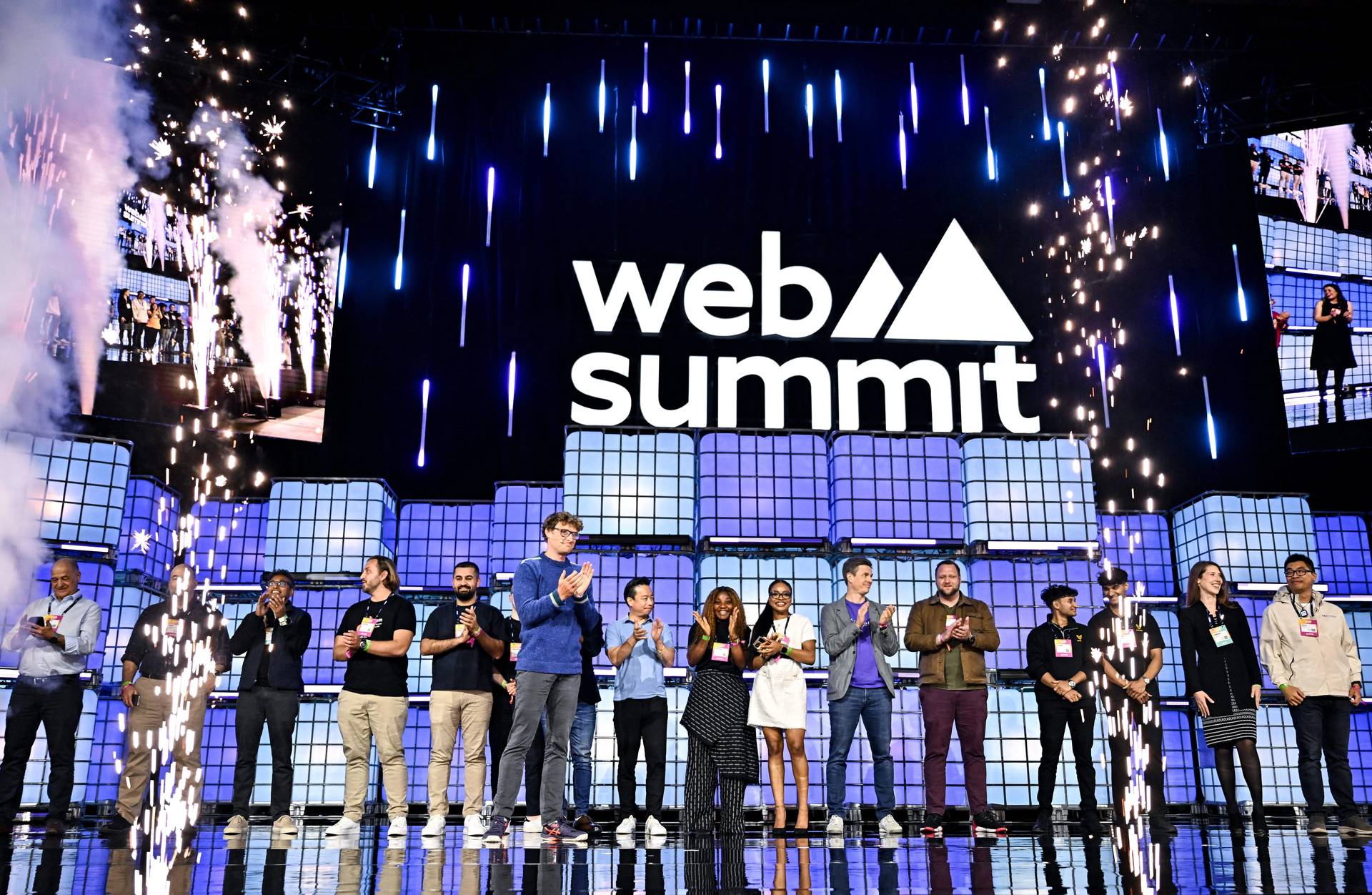
Web Summit
Web Summit is a technology conference series founded in Dublin in 2009 by Paddy Cosgrave, David Kelly, and Daire Hickey to bring together the business and technology communities.[1] Its first event, then called the Dublin Web Summit, was a technology conference attended by 150 people.[2] The series’ flagship conference is held in Lisbon, with additional editions organized in other regions.[3][4] Web Summit Lisbon 2026 is scheduled for November 9–12, 2026, at the MEO Arena and FIL.[36]
The conference brings together startups, investors, speakers, media, businesses, and public figures. Its programming includes keynote addresses, panel discussions, startup showcases, investor meetings, exhibitions, and networking events.[3][4]
历史
Dublin and the Move to Lisbon
The first Dublin Web Summit took place in October 2009, with 150 attendees.[1] Following disputes with the Irish government, the organizers announced in 2015 that the event would move from Dublin to Lisbon; it was held in Portugal from 2016.[1][5]
In October 2018, Web Summit founder Paddy Cosgrave announced an agreement for the conference to remain in Lisbon for a further ten years. Reuters reported that Portugal’s government would pay €11 million annually to expand the venue and that organizers and officials anticipated attendance could eventually rise from 70,000 to 100,000.[6] A Portuguese Council of Ministers resolution dated November 8, 2018, approved a related agreement covering 2019 through 2028. It authorized state commitments of up to €80 million, with annual payments beginning at €8 million and later amounts adjusted for inflation; Turismo de Portugal and IAPMEI were assigned equal shares of the state funding.[5] The resolution described the conference as a way to support Portuguese startups and promote the country as a destination for investment, innovation, and tourism.[5]
Company and Founder Disputes
In 2018, Web Summit contributed $2 million to establish the Amaranthine Fund I investment fund; David Kelly and Patrick Murphy were listed as managers.[1] Daire Hickey resigned as a Web Summit director in August 2019, and Kelly resigned in March 2021. In May 2021, Kelly and Murphy established Semble Fund II, a successor to Amaranthine Fund I, without Web Summit’s involvement.[1]
In October 2021, Cosgrave sued Kelly, alleging that Kelly had breached his duties as a director of Manders Terrace, the company behind Web Summit, and caused it a $10 million loss. Cosgrave also brought a separate action in the United States alleging that Kelly and Murphy had used Web Summit resources for the fund and benefited from its association with the conference.[1] Kelly filed a shareholder-oppression case against Manders Terrace in November 2021, followed by a separate case from Hickey.[1] The civil trial began in March 2025 and was settled after about a week. The settlement provided for Cosgrave to acquire Kelly’s 12% stake and Hickey’s 7% stake; both stakes were redeemed in April 2025, leaving Cosgrave with 100% control. The settlement price and terms were not publicly disclosed. On April 29, 2025, the High Court struck out all five interrelated actions, with no order on legal costs.[37][38][39]
Web Summit’s 2024 accounts, reported in November 2025, showed group turnover of €79.2 million, up 32% year over year, and a return to profit.[39]
2023 Leadership Crisis
On October 13, 2023, Cosgrave posted criticism of Israel’s actions in Gaza following the Hamas attacks. His remarks prompted criticism from technology executives and announcements that companies and individuals would withdraw from Web Summit events.[7][1] Cosgrave later said Web Summit was “devastated” by the killings and issued an apology.[7]
Sponsors began withdrawing from the Lisbon conference on October 19. Intel and Siemens were among the first, followed by Amazon and Google; other companies reported as withdrawing included Meta and Stripe. Several speakers also canceled their participation.[1][7] Cosgrave resigned as chief executive on October 21, saying his comments had “become a distraction.” At the time, he also left the board; the company, which had about 300 staff and 6,000 volunteers and contractors, was being run by an executive committee.[1][7]
Katherine Maher was appointed to run Web Summit on October 30, 2023. The Lisbon conference went ahead in November, and the company confirmed that its Qatar event, then scheduled for February 2024, would also proceed.[1][7] Maher announced on January 24, 2024, that she would leave after the Qatar event to take a role with PBS in the United States; Cosgrave returned as chief executive on April 8, 2024.[1]
2027 Editions
Web Summit Qatar
Web Summit Qatar is scheduled for January 31–February 3, 2027, in Doha. Its event page describes it as a gathering of technology and business leaders and as the largest gathering of international startups in the Middle East.[9]
Web Summit Vancouver
Web Summit Vancouver is scheduled for May 25–28, 2027.[10]
Web Summit Rio
Web Summit Rio is scheduled for June 14–17, 2027, in Rio de Janeiro.[11]
Past Editions
2026
Doha, Qatar
Web Summit Qatar in Doha drew 30,274 participants from 127 countries and 1,637 startups. The edition included more than 77 memoranda of understanding; at its opening, Qatar announced QAI, a national AI company, and an additional $2 billion for the Qatar Investment Authority’s Fund of Funds program.[17][12]
Vancouver, Canada
Web Summit Vancouver welcomed 20,235 attendees and recorded its largest-ever investor turnout for a North American edition.[18]
Rio de Janeiro, Brazil
Web Summit Rio had a record 40,287 attendees and 1,572 startups.[19]
2025
Lisbon, Portugal
Web Summit Lisbon welcomed 71,386 attendees from 157 countries, including a record 1,857 investors and 2,725 startups from 108 countries. AI and machine learning were the largest startup category, and 40% of startups were women-founded.[20]
Rio de Janeiro, Brazil
Web Summit Rio welcomed 34,552 attendees and 1,397 startups.[13]
Doha, Qatar
Web Summit Qatar in Doha welcomed 25,747 attendees.[14]
Vancouver, Canada
Web Summit Vancouver debuted with 1,108 startups from 117 countries, succeeding Collision in Toronto as Web Summit’s North American event and marking the relocation and rebranding of the North American edition.[15][8]
2024
Lisbon, Portugal
Web Summit Lisbon set an attendance record with 71,528 attendees.[21]
Rio de Janeiro, Brazil
The second Web Summit Rio drew 34,397 attendees and featured 1,066 startups, 518 speakers, and a 45% share of women-founded startups.[22]
Doha, Qatar
The inaugural Web Summit Qatar in Doha brought together 15,453 attendees from 118 countries and 1,043 startups; the event included 24 memoranda of understanding.[23]
Toronto, Canada (Collision)
Collision held its final Toronto edition that year as a separate event.[8]
2023
Lisbon, Portugal
Web Summit Lisbon drew 70,236 attendees from 153 countries and a record 2,608 startups. Women made up 43% of attendees, and the program used 16 stages and more than 25 content tracks.[24]
Rio de Janeiro, Brazil
The inaugural Web Summit Rio brought together 21,367 attendees from 91 countries and 974 startups, with 400 speakers and 14 content tracks.[25]
Toronto, Canada (Collision)
Collision was held in Toronto as a separate event, not branded Web Summit.[8]
2022
Lisbon, Portugal
Web Summit Lisbon reached full capacity with 71,033 attendees from 160 countries, 2,296 startups, and 1,081 investors. The program included 1,050 speakers over 26 tracks and 17 stages, with new Book Summit, Verified, Crypto, and Security Summit stages. On opening night, Olena Zelenska addressed technology during Russia’s invasion of Ukraine.[2]
Toronto, Canada (Collision)
Collision also took place in Toronto as a separate event, not branded Web Summit.[8]
2021
Lisbon, Portugal
Web Summit Lisbon marked the conference’s return to in-person format after the online-only 2020 edition. It drew 42,751 attendees from 128 countries, and women made up 50.5% of participants. The event had 748 speakers, 1,519 startups, and 872 investors. Frances Haugen’s keynote called for Mark Zuckerberg’s resignation.[26]
2020
Online Edition
Web Summit moved fully online and attracted 104,328 attendees from 168 countries, with 2,007 startups. The event used Web Summit’s own digital platform and offered talks, roundtables, masterclasses, Q&As, and app-based speed networking.[16][27]
2019
Lisbon, Portugal
Web Summit Lisbon drew 70,469 attendees from 163 countries and hosted 2,150 startups. It featured 1,206 speakers across 22 stages, and women made up 46.3% of participants.[28]
Toronto, Canada (Collision)
Collision was also held in Toronto as a distinct event.[8]
2018
Lisbon, Portugal
Web Summit Lisbon welcomed 69,304 attendees from 159 countries, with more than 1,200 speakers across 24 stages. The event app enabled attendees to schedule talks and message one another for networking.[29]
2017
Lisbon, Portugal
Web Summit Lisbon drew about 59,000 attendees from 170 countries, with over 2,100 startups and 1,400 investors. Its program covered 26 conference tracks. The organizer designated the event carbon neutral for the first time, with plans to offset emissions, including attendee travel, through a Portuguese pine plantation of 95,000 saplings.[30][40][41]
2016
Lisbon, Portugal
The first Lisbon edition drew 53,056 attendees from 166 countries and included 1,490 startups. The move established Lisbon as the conference’s new flagship location.[30][41]
2015
Dublin, Ireland
The final Dublin edition drew more than 30,000 attendees and featured about 1,000 speakers, including Michael Dell and Slack chief executive Stewart Butterfield. The organizers announced that the conference would move to Lisbon in 2016.[31]
2014
Dublin, Ireland
Dublin attracted more than 22,000 people and over 600 speakers. The conference included 2,150 startups, 800 investors, and 10 themed summits, such as Builder, Enterprise, and Food Summit.[32]
2013
Dublin, Ireland
Dublin drew a record 9,834 attendees, with 872 early-stage startups and more than 350 speakers. The event shifted toward a multi-day festival format, with workshops, pitches, and keynotes. It closed with a conversation between Elon Musk and Irish prime minister Enda Kenny.[33]
2012
Dublin, Ireland
The Dublin meeting at the RDS drew about 4,000 visitors and included more than 200 speakers. Technology companies including YouTube, Skype, Google, HP, and Microsoft were represented, and startups attended to meet investors.[34]
2011
Dublin, Ireland
Dublin drew about 1,500 attendees. The social program included informal founder meetups to support networking, including a pub crawl hosted by Bono.[35]
2010
Dublin, Ireland
The Dublin Web Summit drew about 400 people and featured Jack Dorsey, Niklas Zennström, and Chad Hurley. Its program included shared meals and deliberately arranged seating to foster connections among attendees.[35]
2009
Dublin, Ireland
The initial gathering in Dublin attracted about 150 people. It began as a small, informal event in a Dublin hotel before developing into the larger annual conference.[35]
Doha, Qatar
Web Summit Qatar in Doha drew 30,274 participants from 127 countries and 1,637 startups. The edition included more than 77 memoranda of understanding; at its opening, Qatar announced QAI, a national AI company, and an additional $2 billion for the Qatar Investment Authority’s Fund of Funds program.[17][12]
Vancouver, Canada
Web Summit Vancouver welcomed 20,235 attendees and recorded its largest-ever investor turnout for a North American edition.[18]
Rio de Janeiro, Brazil
Web Summit Rio had a record 40,287 attendees and 1,572 startups.[19]