0% read
Last updated:
Superform
Superform is a decentralized finance protocol that provides infrastructure for cross-chain asset management, programmable vaults, and automated yield strategies. Its ecosystem includes Superform Core for composable transaction execution, SuperVaults for managing yield-generating assets, SuperformOS for configuring and monitoring vault strategies, and SuperAssets and SuperStocks for accessing onchain savings and tokenized equity products. [3]
Overview
Superform is a decentralized finance protocol composed of Superform Core and Superform Periphery. Superform Core consists of non-upgradeable smart contracts that combine multiple onchain actions into a single cryptographically verifiable signature, with ERC-7579 smart accounts and modular Hooks handling execution for actions such as bridging, swapping, lending, and depositing across multiple blockchains. Superform Periphery includes SuperVaults, permissionlessly deployable vaults that execute strategies through Hooks and use validator attestations to verify price-per-share values, and SuperAssets, omnichain savings tokens such as SuperUSD and SuperETH that allocate assets across multiple vaults and support rebalancing between them. The protocol is designed to simplify cross-chain transactions, establish verifiable vault pricing and fee rules, and coordinate liquidity and yield across blockchain networks, with SuperAssets directing yield from multiple chains back to Ethereum mainnet. [1] [2]
Features
Superform Core
Superform Core is a suite of persistent, non-upgradeable smart contracts that enables composable transaction execution across multiple blockchains through ERC-7579 smart accounts and Merkle-proof verification. Its architecture consists of an execution layer, which processes sequences of actions through SuperExecutor and SuperDestinationExecutor; a validation layer, which verifies authorization for batched operations using SuperValidator and SuperDestinationValidator; and an accounting layer, which uses SuperLedger and YieldSourceOracles to track asset cost basis and calculate performance fees across supported vault standards and yield sources. Additional infrastructure includes bridge adapters for cross-chain messaging, SuperNativePaymaster for sponsoring gas fees with ERC-20 tokens, and SuperBundler for processing batched UserOperations.
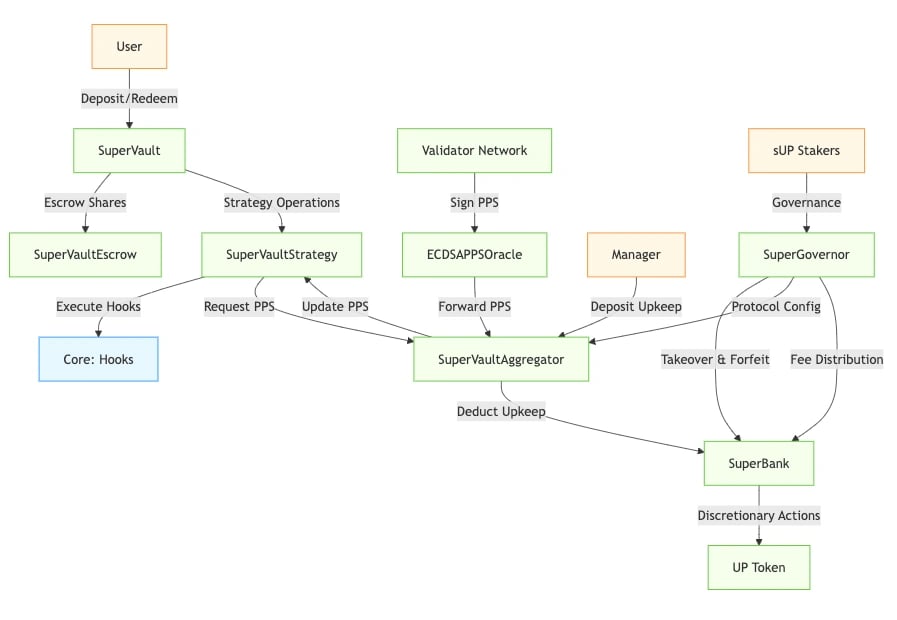
The protocol uses Hooks, which are modular, permissionless contracts that perform individual actions such as bridging, swapping, and lending. Hooks can be combined into sequences to execute more complex strategies across multiple chains, with transient storage used to pass temporary data between actions without permanent storage writes. Transactions are atomic, meaning that a failure in any Hook causes the entire transaction to revert. The execution process begins with a frontend selecting the Hooks and their transaction data, after which SuperBundler organizes the operations by chain and creates a Merkle tree. The smart account then delegates authorization checks to SuperValidator, which verifies the relevant Merkle proofs before SuperExecutor runs the Hooks and updates SuperLedger. [5]
SuperVaults
SuperVaults are ERC-7540 tokenized vaults that allow operators to manage yield strategies while keeping depositor assets in smart contracts. They support standard deposits and asynchronous redemptions, with automated workers handling asset allocation, rebalancing, swaps, reward claims, and withdrawal requests. Operators execute strategies through approved Hooks, while onchain Merkle proofs restrict keepers to authorized actions. Validators verify price-per-share (PPS) updates using signed attestations, which require two-thirds weighted consensus before acceptance onchain. Additional safeguards include role-based permissions, slippage and accounting checks, timelocks for selected parameter changes, and emergency pause and withdrawal mechanisms. SuperVaults support yield sources such as ERC-4626 vaults and Pendle Principal Tokens, while SuperBundler enables cross-chain deposits. A transparency dashboard allows depositors to monitor vault allocations, validator signatures, and performance. [7]
SuperformOS
SuperformOS is an operating platform for launching and managing programmable DeFi vaults, combining strategy configuration, automated execution, pricing verification, and operational monitoring. It allows curators to create ERC-7540 vaults, configure eligible yield sources, fees, roles, and oracles, and define strategy rules for actions such as deposits, withdrawals, swaps, bridging, and rebalancing. A Strategy Engine evaluates these rules against onchain vault conditions and publishes execution intents, while an order management system coordinates the execution process. Merkle proofs restrict operations to authorized actions, and validator-attested pricing safeguards against stale or abnormal values, and emergency controls support risk management. SuperformOS also records intent history, transaction results, errors, and configuration changes to make strategy operations auditable. Superform can distribute vaults through its web and mobile applications, APIs, and partner platforms, providing infrastructure for funds, issuers, fintech companies, and other curators to create and operate vault products. [8]
SuperStocks
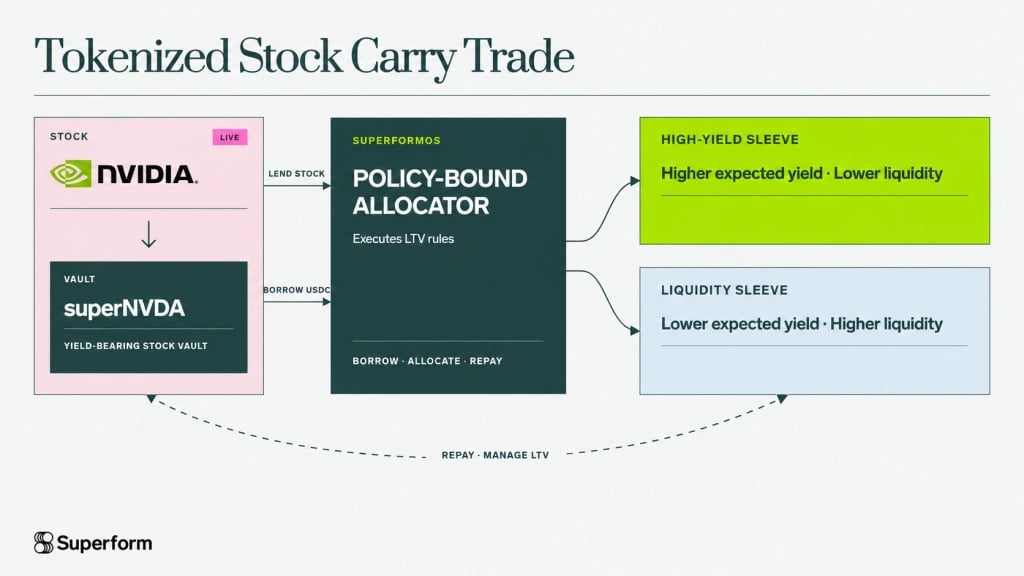
SuperStocks are tokenized stock-based products built on Superform’s programmable vault infrastructure, designed to generate yield from tokenized equities through automated lending strategies. The products operate on SuperformOS, which manages strategy rules, execution, monitoring, accounting, and redemptions. Under the Earn Stocks strategy, eligible users deposit Coinbase tokenized stocks, which are used as collateral on Aave V4’s Coinbase Stock Hub on Base to borrow USDC. The borrowed USDC is then supplied to approved lending markets, initially the Clearstar cbAssets Vault on Morpho, when expected returns exceed borrowing costs, fees, operating expenses, liquidity requirements, and predefined risk thresholds. Individual SuperStocks may authorize additional lending venues through SuperformOS. The system manages loan-to-value ratios, debt repayment, and position unwinding according to its programmed rules, while charging a 20% performance fee, with revenue routed through SuperBank and potentially converted into $UP through governance-approved operations. [9]
UP
The UP token is the governance and coordination token of the Superform ecosystem, supporting protocol decision-making, validator participation, and staking-related incentives. Token holders can vote on protocol integrations, fee distribution, and liquidity incentives for SuperVaults. Validators stake UP as collateral to participate in the network’s pricing and verification processes. Staking UP may also provide access to a share of protocol revenue from transaction and management fees, as well as boosted annual percentage yields (APYs) on eligible savings products. [11]
Tokenomics
UP has a total supply of 1B tokens and has the following distribution: [10]
- Community & Ecosystem: 40.14%
- Core Team & Advisors: 24.56%
- Strategic Partners: 22.2%
- Public Sale: 3.72%
- Airdrop: 3.6%
- Liquidity: 2.98%
- Strategic Echo Sale: 2.8%
Partnerships
- Polychain
- CMT Digital
- Maven11
- VanEck
- Circle Ventures
See something wrong?
Official Website:
Social Profiles:
Founders: