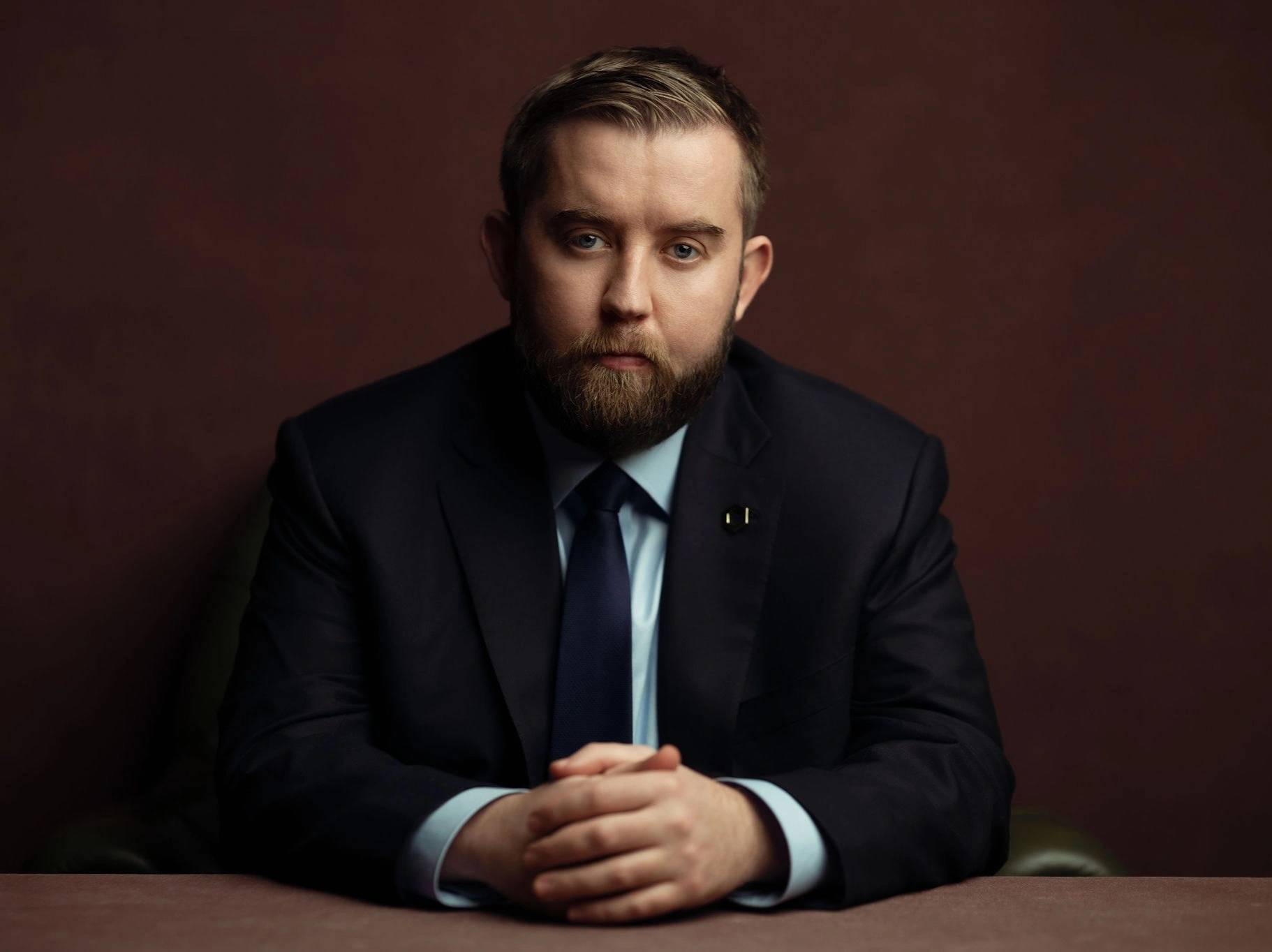
Sergey Nazarov
Sergey Nazarov is the Co-Founder of Chainlink, a decentralized oracle network that enables smart contracts to securely access off-chain data feeds, web APIs, and other resources. Before joining the crypto space in 2011, he worked in various peer-to-peer marketplaces and investment teams such as FirstMark Capital.[1] In February 2026, he was appointed to the U.S. Commodity Futures Trading Commission's (CFTC) Innovation Advisory Committee.[2][10]
Education
He graduated from New York University with a bachelor's in Philosophy and Management, and worked as a Teaching Fellow in the Stern School of Business for Professor Lawrence Leninhan’s Technology Entrepreneurship course.[3]
Career
In 2010, Nazarov was a Teaching Fellow at NYU Stern School of Business, where he aided professor Lawrence Lenihan, CEO of FirstMark Capital, in his technology entrepreneurship course. He contributed by assisting in the creation of the curriculum, giving presentations on effective networking, and working one-on-one with teams on their technology startups. [3]
He was an intern in residence and then an associate at FirstMark Capital, where he was responsible for presenting potential investments to the partnership for consideration and participating in board meetings at portfolio companies, such as SecondMarket, to assist the firm in adding value.[3]
Nazarov has experience in the venture capital and startup fields, as he has experience as a General Partner at QED Capital, co-founder, and CEO at CryptaMail and Secure Asset Exchange.[3]
He is also the Co-Founder of SmartContract, a company where connections between smart contracts and external data are made.[3]
- Co-Founder at Chainlink Labs (2020 - Present)
- Co-Founder at SmartContract (September 2014 - Present)
- Co-Founder and CEO at Secure Asset Exchange (May 2014 - January 2016)
- Co-Founder and CEO at CryptaMail (May 2014 - July 2014)
- General Partner at QED Capital (February 2011 - April 2014)
- Co-Founder and CEO at ExistLocal Inc (March 2009 - February 2011)
- Intern in Residence and Associate at FirstMark Capital (April 2009 - November 2010)
- Teaching Fellow at NYU Stern School of Business (January 2010 - May 2010)
Chainlink
In 2017, he co-founded Chainlink with Steve Ellis, and co-authored the protocol's white paper. Chainlink is a blockchain protocol that takes the role of a bridge between blockchain and off-chain data, as it acts as an oracle.
The Chainlink network was initially intended to be a centralized system for verifying information but has evolved into a decentralized network that works with smart contracts to facilitate secure transactions by utilizing external data sources and APIs.[5] In late 2025, Nazarov commented on a strategic partnership between Japan's SBI Group and Chainlink, calling it a signal of a "shift toward production-level blockchain use in high-value financial transactions." The collaboration focuses on leveraging Chainlink's Cross-Chain Interoperability Protocol (CCIP) and Proof of Reserve for tokenized assets and regulated stablecoins, aiming to build the necessary infrastructure for institutional DeFi adoption.[8]
We make open source software that provides security to an oracle mechanism, and provides the economic framework through which the usage of that oracle mechanism has crypto-economic guarantees. We extend that software to multiple environments, many different blockchains, many different data providers, and many different payment providers, providing a large collection of inputs and outputs.
Nazarov proposes that the infrastructure created by Chainlink could potentially deliver significant value to society as a whole, possibly evolving into a "public good" comparable to a federal postal service or an interstate system. [6]
I think the pinnacle, the absolute fucking pinnacle of success for somebody building this type of infrastructure is that they build something that becomes a public good that is important to how society functions properly.
CFTC Appointment
In February 2026, Nazarov was appointed to the U.S. Commodity Futures Trading Commission's (CFTC) Innovation Advisory Committee (IAC). The committee's purpose is to advise the CFTC on how emerging technologies like blockchain and artificial intelligence are impacting derivatives and commodity markets. As one of 35 members, Nazarov's role involves providing insights on topics such as asset tokenization, cryptocurrency derivatives, 24/7 trading, and prediction markets to assist the commission in developing adaptive regulations and maintaining financial oversight.[10][11]
Investments
In April 2022, he invested in Reputation DAO’s €4.4M seed round alongside Koji Capital, Framework Ventures, Digital Asset Capital Management, Richard Galvin, and AirTree Ventures. [1][2]
Personal Life
His family immigrated to New York in the 1990s, where he later studied at New York University obtaining a bachelor’s degree in philosophy and management. Sergey Nazarov was introduced to computers at a young age by his engineer parents. He began using a keyboard when he was around five years old and was reading programming manuals in middle school. During his childhood, he enjoyed building with Lego, disassembling old televisions to understand how they worked and playing real-time strategy video games.
Blockchain
In the early 2010s, Nazarov ran a business in which he rented GPUs to mine bitcoin for a three-month period. He was able to recoup the rentals costs within the first week, earning a profit for the remainder of the contract. Gradually, he became interested in blockchain.[2]
"What excites me most is fundamentally changing the way the world works to improve society in two key ways. Firstly, the booms and busts we see with financial markets are based on information asymmetries that benefit the very few who can exploit them. Often, the rest of society is left to foot the bill. This is not right and has to change. Secondly, millions of users across emerging markets still lack basic economic agreements about bank accounts, insurance, global trade and many other contract systems that users in developed markets often take for granted. Hybrid smart contract applications can take the rest of the world from zero to one, regardless of their local system’s failings. This is perhaps the most worthwhile goal in all of contract theory."[4]
Nazarov views the consequences of FTX's downfall as a positive opportunity rather than a negative setback. According to him, the more conventional finance struggles, the greater the chance for blockchain technology to succeed in realizing the potential of DeFi. [7]
Nazarov believes that the downfall of FTX is due to a lack of transparency that has historically plagued traditional finance. He has stated that blockchain technology is not the issue, but rather the solution to this problem. [7]
I think there’s also a confusion where the misuse of blockchain technology, such as in the case of FTX, gives people a sense that the technology isn’t ready. The technology in many ways is ten times to a hundred times better than what you have in the traditional financial system, which is why the traditional financial system is quickly adopting it.
By February 2026, Nazarov observed that the crypto industry had entered a new, more mature phase. He noted that the current market cycle demonstrated improved risk management, lacking major failures like the FTX collapse in the previous cycle. He asserted that the system's ability to withstand price and liquidity downturns makes it more reliable for attracting institutional capital.[9]
Looking to the future, Nazarov has made several predictions about the growth of decentralized finance (DeFi). In November 2025, he estimated that DeFi was about 30% of the way toward global mainstream adoption. He forecasted this could reach 50% with clear regulatory guidelines from the U.S. and 70% once institutions have compliant methods to deploy capital. He projected that DeFi could achieve full mainstream integration, with capital on par with traditional finance, by 2030.[8]
A key component of this growth, according to Nazarov, is the tokenization of real-world assets (RWAs). He predicts that the on-chain RWA segment will eventually surpass the crypto market in total value and will serve as the primary catalyst for making blockchain technology mainstream. He has observed that the migration of real-world assets to the blockchain is accelerating, driven by a demand for 24/7 markets and transparent collateral management. To support this, he emphasized the importance of interoperability and systems like the "Chainlink Runtime Environment" for synchronizing processes between blockchains, off-chain systems, and AI.[9]