Subscribe to wiki
Share wiki
Bookmark
Pandora
The Agent Tokenization Platform (ATP):Build autonomous agents with the Agent Development Kit (ADK)
0%
Pandora
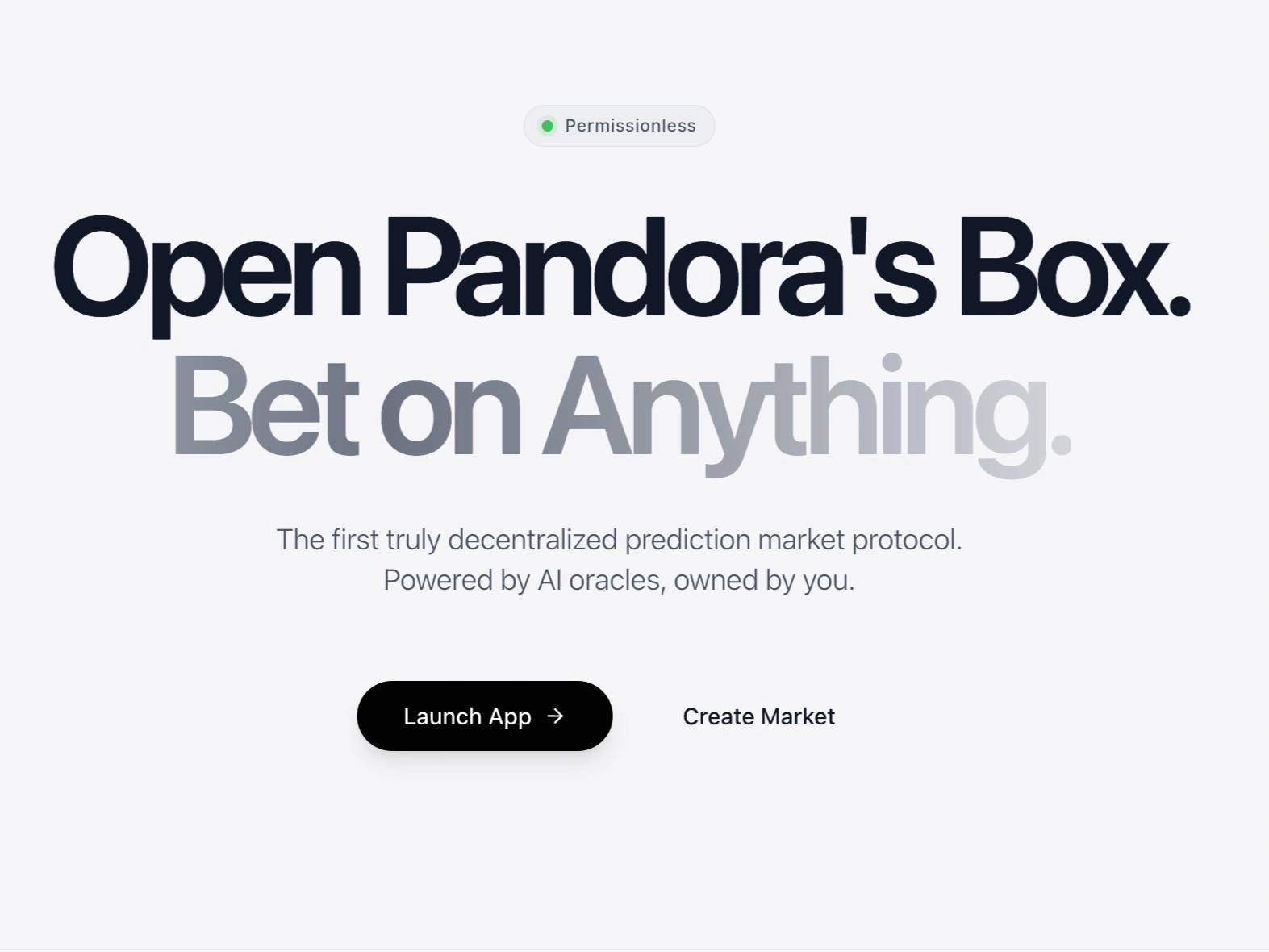
Pandora is a decentralized prediction market protocol built on the Ethereum blockchain. The platform allows users to create markets and trade on the outcomes of any real-world event.
It is distinguished by its use of an artificial intelligence (AI)-powered oracle system for resolving market outcomes and a dual-engine architecture that supports both parimutuel and Automated Market Maker (AMM) trading models. [1] [2]
Overview
Pandora launched on the Ethereum mainnet on February 23, 2026. The protocol was developed by an AI-focused team known as Hey Anon, led by Daniele Sestagalli. The stated mission of the project is to provide a transparent and decentralized alternative to what the creators describe as the "prediction market duopoly," criticizing incumbent platforms for operating with opaque, "black box" market-making practices. [2] [5]
The core of the platform is its permissionless nature, which allows any user to create a prediction market on topics ranging from global politics to internet culture. All market mechanics are designed to be fully on-chain, ensuring public verifiability. Market resolution is handled by the Pandora Oracle, a system that relies on a consensus of multiple proprietary AI agents.
In cases where the AI cannot reach a consensus, the decision is escalated to a vote by stakers of the $ANON token. The platform's long-term vision is to become a "home for trading agents," enabling both human and autonomous AI to interact with the protocol. Future plans include allowing AI agents to autonomously assess markets, optimize strategies, and deploy new markets, with a scoring mechanism to rate agents based on performance and integrity. [1] [2] [5]
As of March 3, 2026, shortly after its launch, the platform had recorded a total trading volume of $167,900 across 246 created markets, with 1,107 total trades executed. [1]
History
Pandora was officially launched on the Ethereum network on February 23, 2026. The launch was announced by its development entity, Hey Anon, through a press release. The initial announcement highlighted the platform's AI-driven oracle and its aim to bring greater transparency to the prediction market sector. [1] [2]
Technology and Features
Pandora integrates several key technologies to operate its decentralized prediction market, focusing on a transparent on-chain architecture, flexible trading models, and an AI-based resolution system. [2]
Core Architecture
The protocol is built on the Ethereum Layer 1 blockchain. A core design principle is transparency, with all market mechanics, trades, and fund management executed via publicly verifiable smart contracts. The protocol operates on a non-custodial basis, which means users retain full control and custody of their own funds without depositing them into a centrally controlled entity. [1] [2]
The protocol’s technical foundation consists of several key smart contracts. A PredictionOracle contract manages the creation and resolution of "Polls"—the underlying questions with defined rules and resolution sources. A MarketFactory contract then creates tradeable "Markets" (either AMM or Pari-Mutuel) that are linked to these polls. The system also uses a 5-minute time window, or "Epoch," for managing deadlines. [6]
While the protocol is described as non-custodial, the available source materials do not mention if the smart contracts have undergone any third-party security audits. [1]
Dual-Engine Trading Model
Pandora employs a "dual-engine architecture" that supports two different types of trading mechanics, allowing market creators to choose the model best suited for their prediction. [1]
Parimutuel Model (Pool Betting)
This model is designed for binary (Yes/No) outcome markets. In a parimutuel system, all bets are placed into a pool. The odds are dynamic and change as more bets are placed on one outcome versus the other. After the event is resolved, the total pool (minus protocol fees) is distributed among those who bet on the correct outcome. This model can enable high-leverage betting opportunities. [1] [6]
Automated Market Maker (AMM) Model (Continuous Trading)
This model, also referred to as V2, is used for markets that may have multiple possible outcomes and facilitates continuous trading. It utilizes a Uniswap-style AMM pricing model for YES/NO outcome tokens to provide instant liquidity, allowing traders to buy or sell outcome shares at any time without needing a direct counterparty. This facilitates ongoing price discovery up until the market's resolution. [1] [6]
Pandora Oracle and Market Resolution
A key feature of the protocol is its unique oracle system, a smart contract named PredictionOracle, for resolving market outcomes. Instead of relying on a centralized entity or a traditional, human-based oracle network, Pandora uses a proprietary, AI-driven process. [1] [6]
The resolution process follows two main steps:
- AI Consensus: Multiple "advanced AI agents" analyze information related to the market's event to determine the correct outcome. These agents work to reach a consensus on the final result. The specific AI models used, whether proprietary or based on existing large language models, are not detailed in the source materials. [1] [2]
- Escalation to
$ANONStakers: If the AI agents are unable to reach a consensus, the resolution task is escalated to the stakers of the$ANONtoken. These token holders then vote to determine the final, correct outcome. [2]
This system was designed to minimize human interference, reduce the potential for manual resolution errors, and increase the overall decentralization of the platform. [2]
Platform Functionalities
Pandora offers several user-facing features to support its trading environment.
- Permissionless Market Creation: Any user can create a prediction market on any verifiable, real-world event without requiring approval from a central authority. [1]
- Provide Liquidity: Users can provide liquidity to markets and earn a share of the fees generated from trading activity. [6]
- Parlay Betting: Users can combine multiple, separate predictions into a single wager known as a parlay. For the bet to win, all individual predictions within the parlay must be correct. A successful parlay results in a compounded, exponential payout. [1]
- Liquidity Architecture: The protocol's design is optimized for high-frequency trading with low protocol fees. The liquidity model, particularly the AMM, is engineered to allow users to enter or exit positions at any time. [1]
- Social & Research Tools: The platform integrates additional tools to enhance the user experience, including a site-wide live chat function for community discussion and real-time "whale alerts" that notify users of large trades or positions being opened. [2] [5]
Hey Anon and the $ANON Token
Hey Anon
Hey Anon is the development team and decentralized finance (DeFi) protocol behind Pandora. The group is led by Daniele Sestagalli. Hey Anon focuses on applying AI to simplify complex activities within the DeFi space, using a combination of natural language interfaces and machine intelligence for tasks like portfolio management and the execution of automated strategies. [4] [3]
Pandora represents one of its flagship products, applying its AI focus to the prediction market sector. [2]
$ANON Token
The $ANON token is the native asset associated with the Hey Anon ecosystem and serves a critical function within the Pandora protocol. Its primary utility is related to governance and security of the oracle system. Stakers of the $ANON token act as the final arbiters for market resolution.
They are called upon to vote on an outcome if and only if Pandora's primary AI oracle system fails to reach a consensus. The provided source material does not specify other tokenomics, such as supply, distribution, or other potential use cases. [2]
See something wrong?
The Agent Tokenization Platform (ATP):Build autonomous agents with the Agent Development Kit (ADK)