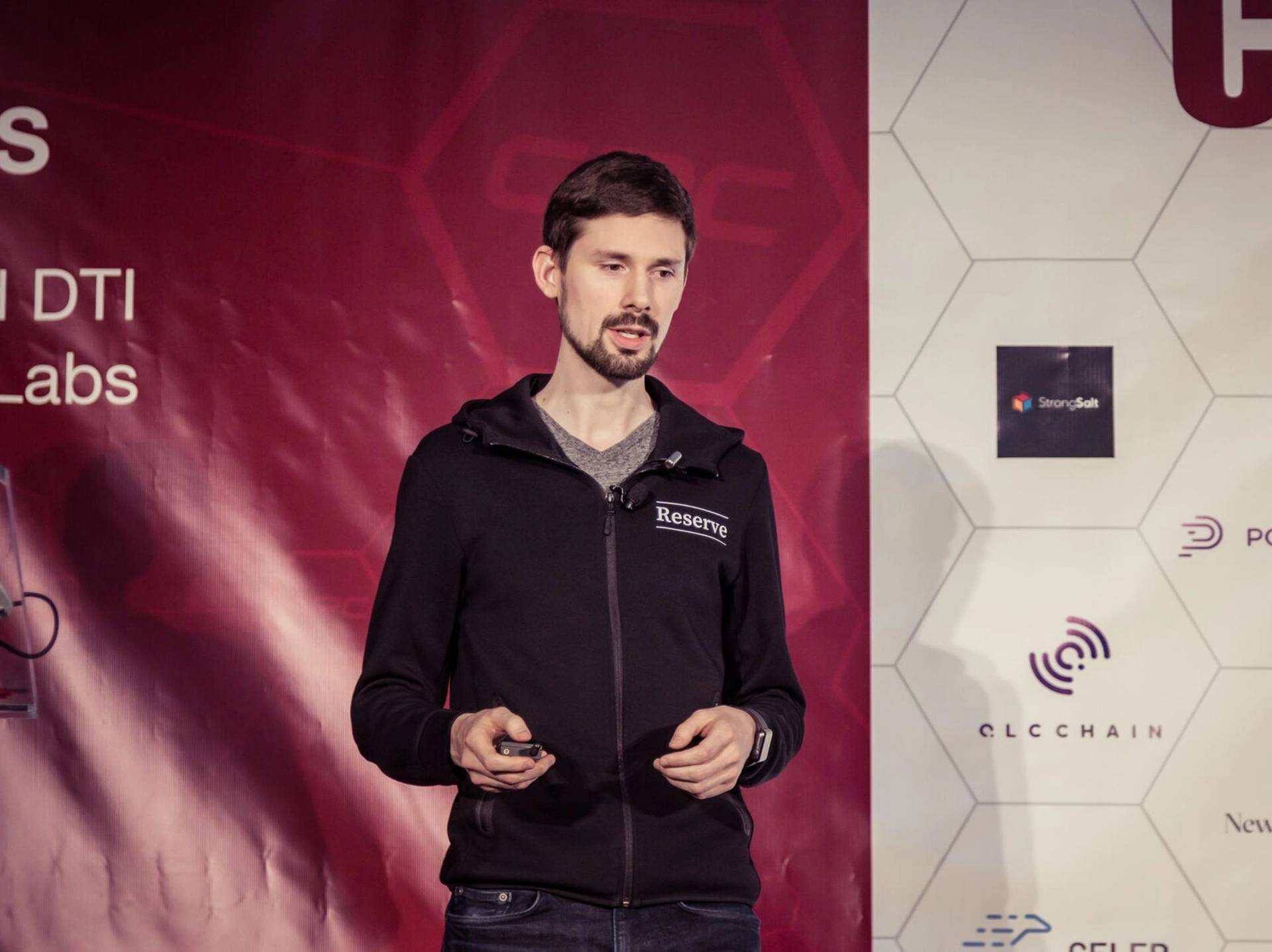
Nevin Freeman is the CEO and co-founder of the Reserve Protocol and has been involved in its strategic and conceptual development since its early stages. His work focuses on asset-backed digital currencies, decentralized governance, and the design of onchain financial systems aimed at long-term stability. [6]
Freeman graduated from Portland State University with a Bachelor’s in Transportation Engineering in 2009. [1]
In 2009, Freeman co-founded RIABiz, an industry-insider publication, where he served as the CTO until 2011. After leaving, he co-founded MetaMed Research, Inc., a personalized medical research company, where he was the CIO for a year. In January 2016, he co-founded Paradigm Academy, an education institution and company builder. The following year, he co-founded Reserve alongside Matt Elder. In January 2024, Reserve launched two new companies, ABC Labs and Confusion Capital, to aid in the Reserve ecosystem and protocol development. Freeman now serves as the president of Confusion Capital. [2]
In an October 2025 interview on the Decypher Podcast, Freeman discussed the challenges of tokenizing regulated financial assets, the early role of stablecoins in regulatory gaps, and the motivation to develop a more stable, asset-backed form of digital money. He cited Bitcoin as a key inspiration while noting its volatility, and described diversification across global assets as a way to reduce risk and improve stability. Freeman contrasted the relatively small scale of crypto index products with that of traditional equity indices, framing this gap as a potential area for growth, and explained how decentralized finance infrastructure enabled more efficient index products through on-chain liquidity, direct ownership, and reduced reliance on custodians. He also addressed the gradual tokenization of financial assets, regulatory constraints, and the need for collaborative regulatory frameworks, while outlining a long-term vision for a decentralized asset management platform supporting tokenized assets and a globally accepted reserve currency, noting that market behavior often developed in unexpected ways and required ongoing adaptation. [7]
In September 2023, Freeman described the origins of the Reserve Protocol by outlining the project’s roots in a small founding team influenced by the effective altruism movement and focused on pursuing high-impact solutions. He explained that the team approached problems with an ambitious mindset, driven by interests spanning global issues such as artificial intelligence, mental health, animal welfare, and environmental challenges, alongside the goal of generating financial resources for future initiatives. Freeman recounted his early exposure to Bitcoin and the conclusion that it was unsuitable as a stable currency, which led the team to explore alternative digital currency models. This exploration focused on addressing hyperinflation, leading to the development of applications that enabled access to U.S. dollar–backed cryptocurrencies in affected regions, particularly Latin America. He also emphasized the role of a growing, globally distributed team. He highlighted the contribution of individuals such as Gabo, whose prior experience with a Venezuelan state-backed cryptocurrency informed Reserve’s regional strategy. [8]
In July 2025, Freeman, Billy Sanders, and Andrew Worth presented the Digital Securities Initiative at Monetarium, describing it as a collaborative effort by Confusion Capital to explore new secondary-market structures for tokenized securities in decentralized finance. They discussed how existing regulatory frameworks focused primarily on centralized crypto entities left DeFi largely unaddressed, and contrasted this with traditional finance, where institutions oversee custody, identity, and transaction monitoring. The presenters outlined a proposed decentralized compliance framework involving regulated roles such as identity keepers, transaction monitors, and transaction filters, intended to reduce fragmentation caused by repeated token-specific KYC processes through a unified certification approach. They described a model for embedding regulation directly on-chain within a defined regulated zone, supported by zero-knowledge proofs to preserve user privacy while enabling compliant transaction filtering. They explained how monitoring entities could report suspicious activity using pseudonymous identifiers. The presentation concluded with plans to develop and test prototypes in collaboration with industry participants under regulatory innovation exemptions. [9]
In an October 2024 presentation at Monetarium, Freeman examined long-term volatility challenges faced by asset-backed protocols and discussed the potential role of RSR staking as a stabilizing mechanism. He questioned whether bundling stable assets alone was sufficient for monetary stability, referencing historical market drawdowns. He proposed a structured hedging approach that would allow participants to exchange volatility for greater stability in the currency’s backing. Freeman reframed the concept of default around changes in purchasing power rather than nominal price movements, introducing consumer baskets to assess real value. He outlined a staking model in which RSR could be locked for varying durations with rewards allocated through a dynamic table once asset values exceeded defined thresholds. He described how RSR could be seized and converted into bond-like instruments to cover deficits during market downturns. He concluded by considering whether predefined trading or hedging strategies could manage volatility more effectively than reactive approaches during periods of asset distress. [10]