0% read
Last updated:
Gijs op de Weegh
Gijs op de Weegh is the founder and CEO of the European stablecoin provider StablR. He is also a co-founder of the global payments processor Payvision, a company that became the subject of significant controversy related to financial crime. [1] [2]
Education
Gijs op de Weegh studied law at Rijksuniversiteit Groningen from 1995 to 1996 before attending the University of Amsterdam, where he earned a Master's degree in Law in 2001. [1] He also studied Business and Managerial Economics at Vrije Universiteit Amsterdam. [3]
Career
Op de Weegh's career spans over two decades in the global payments and financial technology industries, marked by the founding of two significant companies: Payvision and StablR.
In 2002, op de Weegh co-founded Payvision, an Amsterdam-based payment service provider. [2] [4] He served in senior leadership roles for over 18 years, including founder, CEO, and Chief Operating Officer (COO), leading the company's growth. [1] [5] During his tenure, Payvision expanded to employ over 300 people and process a turnover exceeding €4 billion. [2] In 2015, he founded Acapture, a data-driven payment platform, as a subsidiary of Payvision. [1]
In 2018, the Dutch banking group ING acquired a 75% stake in Payvision for €260 million, before acquiring the remaining 25% for a total valuation of €360 million. Op de Weegh remained CEO of Payvision following the acquisition until his departure in October 2020. [1] [4]
Between December 2008 and January 2017, op de Weegh was also a partner at The Paypers, a news and analysis source for the global payments industry. [1]
Op de Weegh founded StablR in Malta in late 2022, with the company officially established in January 2023. [3] [1] As Founder and CEO, he leads a team that includes Corné van der Meijden (Chief Risk & Operations Officer), Julia Frendo (Chief Financial Officer), and Robin Nijkamp (Chief Technology Officer). [6] The company was created to issue fully reserved, fiat-backed stablecoins compliant with the European Union's Markets in Crypto-Assets (MiCA) regulation. [7]
Under op de Weegh’s leadership, StablR has launched a Euro-pegged stablecoin (EURR) and a US Dollar-pegged stablecoin (USDR). The company aims to enhance transparency by using Chainlink's Proof of Reserve (PoR) system, which provides on-chain verification of the fiat reserves backing its tokens. [3]
StablR has achieved several key milestones since its founding:
- Funding: In November 2023, the company closed a €3.3 million seed funding round led by Maven 11 and Deribit. In December 2024, StablR secured a strategic investment of an undisclosed amount from Tether, the issuer of the USDT stablecoin. This was followed by another strategic investment from cryptocurrency exchange Kraken in July 2025. [8] [1] [9]
- Licensing: In July 2024, StablR announced it had acquired an Electronic Money Institution (EMI) license from the Malta Financial Services Authority (MFSA), a critical step for issuing e-money tokens under MiCA. [7] [1]
- Growth and Adoption: By October 2025, StablR's stablecoins had facilitated over 3 billion in transaction volume and were listed on over 50 exchanges, including Kraken, Bitfinex, Bybit, and HTX. [10] [9]
- Partnerships: StablR has formed partnerships to integrate its stablecoins with various platforms, including Zengo wallet, UZX exchange, the Concordium blockchain network, and the payment service Oobit. [11]
Other Activities
Op de Weegh is an active participant in industry discussions, contributing opinion articles to publications like Blockworks and appearing on podcasts and webinars to discuss stablecoins and regulation. [2] [10] He has also served as a member of the advisory board for Dutch Blockchain Week since April 2024. [1] His professional social media handle on X (formerly Twitter) is . [12]
Controversies
Controversies surrounding Gijs op de Weegh are primarily related to his tenure as a senior executive at Payvision and the subsequent scrutiny of transparency in his professional biography.
Payvision Scandal
After its acquisition by ING and op de Weegh's departure, Payvision became the subject of a major financial scandal. Investigative reports from outlets such as FinTelegram and Ratex42 alleged that during op de Weegh's leadership, Payvision acted as a key payment processor for high-risk clients, including cybercrime networks and fraudulent investment schemes. [4] [5]
The allegations state that Payvision knowingly processed hundreds of millions of euros from fraudulent broker and gambling platforms run by convicted fraudsters like Gal Barak and the late Uwe Lenhoff. One report alleged that by 2018, Payvision had processed over €52.2 million in stolen funds. FinTelegram specifically claimed that "Gijs op de Weegh signed the contracts with merchants involved in fraudulent schemes." [5] [4]
The revelations reportedly led ING to incur significant losses and announce the closure of Payvision in October 2021, approximately one year after op de Weegh had stepped down as CEO. [4]
Public Stances and Commentary
Op de Weegh has publicly commented on the stablecoin industry and cryptocurrency regulation, particularly the EU's MiCA framework.
- On MiCA Regulation: In an August 2024 article, he argued that MiCA could "hand Tether unforeseen advantages" and that the regulation's strict requirements, such as prohibiting yield on stablecoins and mandating reserves be held in European credit institutions, could put the European stablecoin market at a competitive disadvantage. He described the European focus on euro-linked stablecoins as a "defensive position" in a market dominated by the US dollar. [2] [10]
- On Stablecoin Use Cases: He has highlighted stablecoins as a tool for financial inclusion, contrasting the low interest rates in traditional European banking (around 0.5%) with higher yields available in Decentralized Finance (DeFi) of 5-7.5%. He has also criticized the high fees of traditional cross-border remittances, which can reach 20%, stating that stablecoins can reduce these costs to around 2%. [10]
- On Transparency: Regarding the integration of Chainlink Proof of Reserve, he stated, "In the realm of stablecoins, where maintaining a 1:1 peg is crucial, the ability to offer trustworthy proof of reserves is critical for widespread adoption." [3]
- On Investment in StablR: Following the investment from Tether in December 2024, op de Weegh said, "From the outset, StablR has been laser-focused on delivering unmatched compliance, liquidity, and flexibility for institutions, and merchants. With the support of these new investors, that's exactly what we're delivering. This is a new era for stablecoins and StablR is very much at the helm." [1]
Interviews
Stablecoins and Euro Payments #01
In an interview aired on the Off-Chain Podcast, premiered on August 8, 2024, Gijs op de Weegh discussed topics related to payment infrastructure, stablecoins, and regulatory developments in Europe. The discussion took place in the context of his role as founder and CEO of Stablr and focused on structural aspects of digital payments rather than promotional objectives.
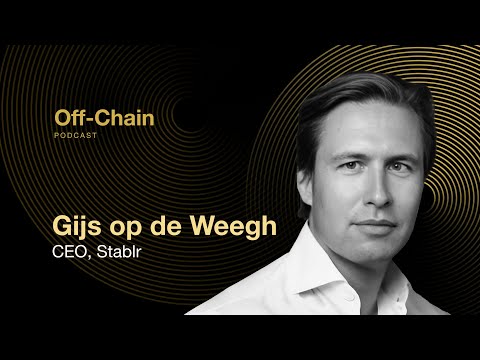
Op de Weegh referenced his professional background in payments and banking and described how this experience influenced his assessment of early cryptocurrencies as payment instruments. He attributed limitations in their use for payments to price volatility and settlement characteristics. Within this context, he presented stablecoins as a category of crypto assets designed to address these constraints, particularly in payment processing, liquidity management, and fiat to crypto conversion mechanisms.
The interview also addressed the interaction between traditional financial institutions and blockchain systems. Op de Weegh stated that banks generally prioritize permissioned blockchain models in order to maintain operational control, while permissionless networks allow broader participation. He associated regulatory complexity and compliance requirements with slower adoption of blockchain based systems within established banking structures.
A significant portion of the discussion focused on the European Union’s Markets in Crypto-Assets regulation, known as MiCA. Op de Weegh described MiCA as a framework intended to define legal requirements for crypto assets, including stablecoins, by establishing rules related to backing, redemption, and issuance by regulated entities. He noted that the regulation aims to provide legal clarity within the European market, while challenges related to cross border interoperability remain under discussion.
Euro denominated stablecoins were discussed in relation to their role within markets where US dollar based stablecoins are more prevalent. Op de Weegh indicated that Euro backed instruments are intended to support settlement processes, exchange liquidity, and continuous transaction availability outside standard banking hours. In contrast, he described central bank digital currencies as instruments primarily designed for retail payment use, operating under direct central bank control.
The interview presented op de Weegh’s assessment of stablecoins as components of payment and financial infrastructure, particularly within regulated environments, without extending beyond the scope of the topics addressed during the discussion. [13]
Quiet Market Conditions in Cryptocurrency #02
In an interview published on the Wirex YouTube channel on September 29, 2025, Gijs op de Weegh discussed how periods of low volatility and reduced media attention in cryptocurrency markets can be interpreted within a broader development cycle. He stated that a quiet market should not automatically be associated with decline, but rather viewed as one phase in the ongoing evolution of the sector.

According to op de Weegh, cryptocurrency markets tend to move through distinct stages, including speculative phases and periods of consolidation. He indicated that lower levels of hype often coincide with increased attention to infrastructure development, regulatory compliance, and practical implementation. Within this context, he identified stablecoins as a functional link between traditional financial systems and blockchain based networks, particularly in Europe, where regulatory frameworks such as MiCAR shape their issuance and use.
He also described differences in investor behavior across market participants. In his account, venture capital investors generally operate with longer time horizons, while retail investors are more likely to pursue short term returns. Op de Weegh noted that slower market conditions may lead to increased focus on operational planning, user requirements, and assessment of economic viability. He presented these periods as part of the process through which crypto related technologies, including stablecoin based payment and transfer mechanisms, continue to be developed and integrated into existing financial structures. [14]
See something wrong?