0% read
Last updated:
Flapping Airplanes
Flapping Airplanes is an artificial intelligence (AI) research laboratory focused on solving the data efficiency problem in AI.[1][2] The company, which is headquartered in San Francisco, California, publicly launched on January 28, 2026, with $180 million in funding.[2] Its stated mission is to develop models that can achieve human-level cognitive abilities without needing to be trained on massive datasets.[1]
Overview
Flapping Airplanes operates as a foundational AI research lab. Though it was operating in stealth mode for an unknown period, it gained public attention following its official launch announcement in January 2026.[1][2] The company's central goal is to address what it terms the "data efficiency problem," also referred to as the "Data Wall."[1][2]
This refers to the challenge posed by the finite amount of high-quality digital data available for training increasingly large and powerful AI models.[2]
The lab's foundational hypothesis is that current AI systems are profoundly inefficient compared to human intelligence. Their research is guided by the estimate that humans are "100,000x-1,000,000x more sample efficient than existing models."[1] This is based on the observation that a human is exposed to a relatively small amount of data (estimated as a "few billion text tokens by adulthood") yet achieves a high degree of intelligence, whereas large language models are trained on vast portions of the internet. The company's aspirational goal is to "imagine a world where models can think at the level of humans without ingesting half the internet."[1][2]
While the primary focus is on long-term, paradigm-shifting research, the company anticipates that its work will eventually have significant commercial value across various sectors, including enterprise applications, robotics, financial trading, and scientific discovery.[1]
As of October 21, 2026, the company continues to frame its work as research directed at data and compute efficiency. It has publicly described a GPU megakernel framework, the first concrete technical direction described in the available sources, as part of its effort to improve the efficiency of training and running AI systems.[4]
History
The founding date for Flapping Airplanes has not been publicly disclosed, but the company operated in stealth before its public debut.[1] The official account on the social media platform X was created in December 2025.[2]
On January 28, 2026, Flapping Airplanes formally announced its existence and a $180 million funding round via a post on X. The announcement stated the company's intent to "assemble a new guard in AI."[2] The following day, January 29, 2026, co-founder Asher Spector appeared on a show to elaborate on the company's mission, identifying data efficiency as a key bottleneck for the broader integration of AI into the economy. As of early February 2026, the company's specific research projects and technical methods remained in stealth.[2][1]
On October 21, 2026, nine months after its launch, Flapping Airplanes announced a $1 billion Series A co-led by Index Ventures and Lux Capital. TechCrunch reported the round at a $6 billion valuation and compared it with the $1.5 billion valuation it reported for the January seed round. Existing backers Sequoia Capital, GV, and Kleiner Perkins participated in the Series A, along with Valor, Atreides, A*, and Nvidia.[4]
Research and Philosophy
Core Problem and Approach
Flapping Airplanes' research is singularly focused on data efficiency. The company's leadership believes that to achieve significant gains in AI capability, incremental improvements to existing techniques are insufficient. Instead, they are pursuing what they describe as "radical new approaches" and "big ideas" from a long-term perspective, without an immediate focus on a specific commercial application or technical method.[1]
The core philosophy is encapsulated in metaphors used by the company, such as "let's give the models a childhood" and the goal to "fly over the data wall." These phrases suggest a focus on developing more sophisticated and efficient learning mechanisms that emulate the developmental and learning processes of humans, rather than relying on brute-force data consumption. Team member Cyris Kissane summarized this approach by stating a goal to build "models that think deeper by reading less."[2]
GPU Megakernel Framework
In October 2026, the founders described a GPU megakernel framework. A GPU kernel is a program run on a GPU; the framework combines multiple tasks into a single kernel. The founders described it as capable of carrying out complete training runs, serving inference, and executing video games, including running all three kinds of workloads simultaneously in one kernel.[4] The company described megakernels as running an entire program on a GPU as a single kernel, eliminating time between steps and improving GPU use.[5]
The founders said the framework can overlap memory-bound inference with compute-bound training. In this description, inference spends much of its time waiting for data to be fetched while training spends much of its time performing calculations; overlapping the workloads is intended to reduce idle GPU time and improve utilization. The founders presented this as a way to make AI systems less costly to train and run, advancing the broader goal of greater efficiency in training and operating AI systems.[4]
Company Name
The name "Flapping Airplanes" is a deliberate metaphor that the company states "embodies our culture." It is intended to reflect a focus on "out-of-distribution" thinking and a willingness to explore unconventional research paths. The company seeks to attract researchers who think in similarly "out-of-distribution ways."[1]
Invitation to Debate
In a unique approach to academic and public scrutiny, Flapping Airplanes actively invites challenges to its core premise regarding sample efficiency. The company's website includes a dedicated email address, [email protected], for those who contest their efficiency estimates, with an open offer to discuss the matter.[1]
Funding
Flapping Airplanes had announced $1.18 billion in total funding as of October 21, 2026. Its $180 million seed round was announced on January 28, 2026, and was co-led by Index Ventures, alongside Google Ventures (GV) and Sequoia Capital. Other participating investors included XTX Ventures, Fundomo, Menlo Ventures, Victor Lazarte, Nova Global, and Conviction. The social media announcement also acknowledged investor representatives, including David Cahn and Val Sarnataro of Sequoia, as well as "Shardul" and "Mark" from Index Ventures.[1][2]
On October 21, 2026, the company announced a $1 billion Series A co-led by Index Ventures and Lux Capital. Existing backers Sequoia Capital and GV participated, as did Kleiner Perkins, Valor, Atreides, A*, and Nvidia. TechCrunch reported the Series A at a $6 billion valuation and noted that the January seed round had valued the company at $1.5 billion.[4] Index Ventures said its partner Mark Xu would join the company's board in connection with the round.[5]
Team and Leadership
Ben Spector is the company's CEO. Index Ventures reported in October 2026 that the company had a couple dozen people, all working in person in San Francisco. The team works across the stack, from GPU kernels through pre-training, post-training, and inference. Index described the company's approach as hiring for skill and trajectory rather than age or pedigree, pairing team members to support learning, and giving them early ownership. Its examples included an engineer who joined while in high school and built agent infrastructure that automates much of the team's work, and a newcomer to model training who later led the company's entire pre-training run. Index partner Mark Xu is joining the board in connection with the Series A.[5]
Founders
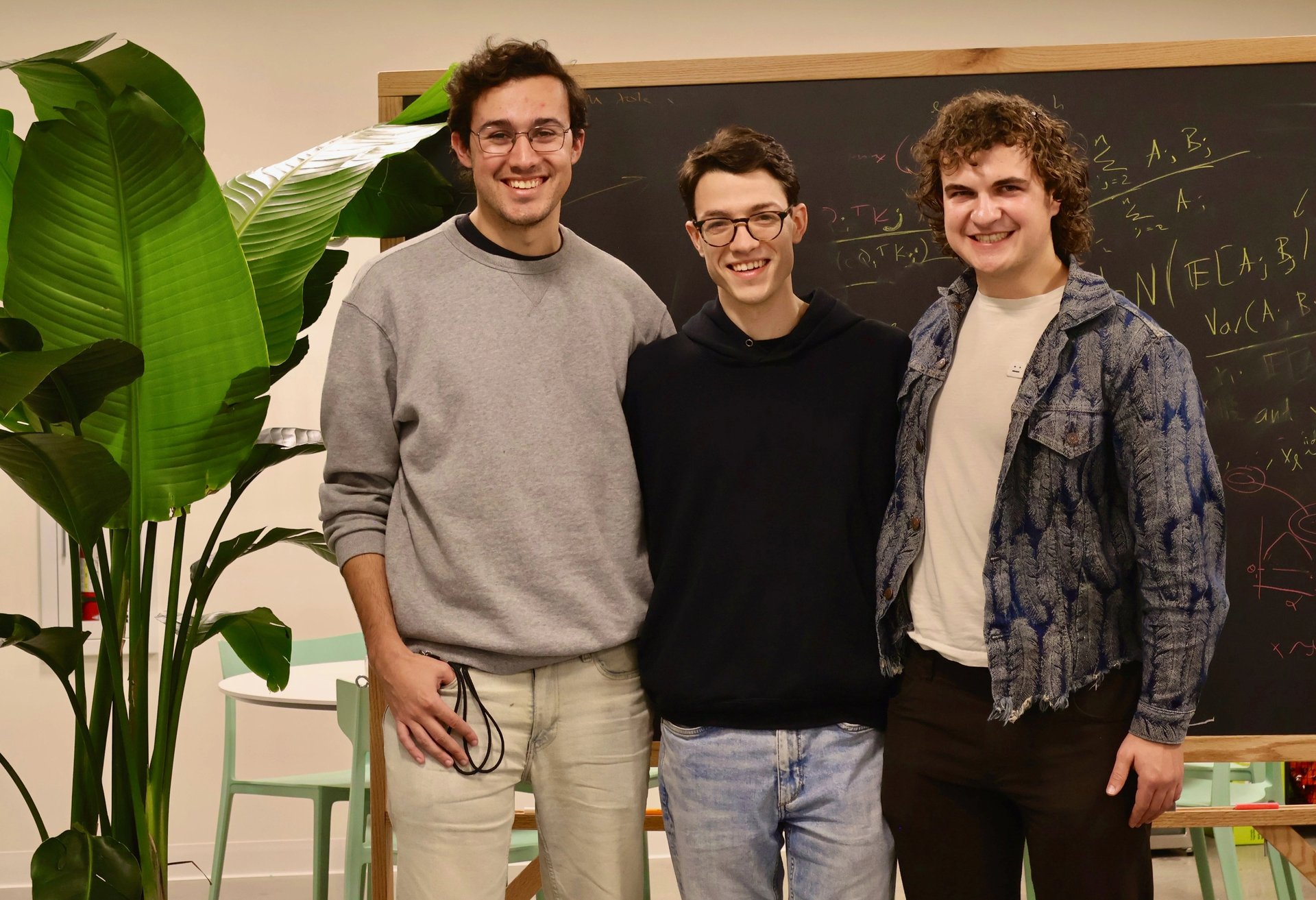
The company was founded by Ben Spector,[3] Asher Spector, and Aidan Smith.[2]
Team Composition
The company describes its team as a combination of "world-class research scientists" and highly talented "younger researchers." The lab has highlighted that its team includes medalists from prestigious academic competitions such as the International Mathematical Olympiad (IMO), the International Olympiad in Informatics (IOI), and the International Physics Olympiad (IPhO). The company also noted the employment of "two US debate champions."[1] One team member publicly announced, Cyris Kissane, stated they were joining the company to "help close that gap" between human learning efficiency and the data requirements of current AI.[2]
Angels and Advisors
Flapping Airplanes is advised by a group of prominent figures in the AI and technology sectors. The company's website lists its angels and advisors as:
- Chris Re, a professor at Stanford University known for his work in data systems and AI.
- Andrej Karpathy, an AI researcher who was a founding member of OpenAI and the former Director of AI at Tesla.
- Jeff Dean, the lead of Google AI.[1]
Additional advisors mentioned in the context of the company's launch include Suhail Nimji and Jml Campbell.[2]
Public Commentary
The launch of Flapping Airplanes drew commentary from investors and prominent figures in the AI community.
Lead investor Index Ventures stated its enthusiasm for the founding team: "Some founders you meet, and it doesn’t matter what they’re building. You just know you want to be part of it. We’re thrilled to co-lead this investment in ..."[2]
Advisor Suhail Nimji described the founders as a "dynamic duo defined by grit, drive, and authenticity."[2]
Andrej Karpathy, listed as a company advisor, commented on the challenges and potential for new AI research startups. In a reposted comment regarding the Flapping Airplanes announcement, he noted: "A conventional narrative you might come across is that AI is too far along for a new, research-focused startup to outcompete and outexecute the incumbents of AI. This is exactly the sentiment I listened to often when OpenAI started..."[2]
Co-founder Asher Spector articulated the economic motivation behind the company's research focus: "To the extent that AI has been hard to integrate into the economy, I really think it's because models are much less data-efficient than humans."[2]
See something wrong?

Official Website:
Social Profiles: