Subscribe to wiki
Share wiki
Bookmark
Codatta

0%
Codatta
Codatta is an on-chain knowledge layer that converts human and AI-produced data into ownable, tradable, revenue-sharing assets by combining on-chain provenance commitments, encrypted off-chain storage, programmable royalty settlement, and a network of human and AI agents for sourcing, labeling, verification, and evaluation. [1] [2]
Overview
Codatta’s design centers on three interlocking components: (1) provenance and commitments that log contribution fingerprints and lineage; (2) an access and privacy layer that keeps sensitive payloads off-chain but verifiable; and (3) a royalty engine that embeds licensing and executes automated payouts to contributors, verifiers, and backers as assets are used in AI training, fine-tuning, evaluation, or inference. A network of identity
The protocol is presented as backend infrastructure rather than a single marketplace, intended to plug into existing data or AI platforms to add provenance, policy, metering, and royalty settlement without requiring frontend migration. The model aims to make training data and derived knowledge auditable and financially rewarding for contributors while providing buyers with verifiable lineage and quality signals. [2]
In public materials, Codatta articulates roles such as Knowledge Providers (contributors), Knowledge Verifiers (validators), and Knowledge Backers (financial supporters), alongside reputation-weighted validation and staking mechanisms to signal confidence and align incentives. The project emphasizes programmable payout options for royalty distribution and highlights compatibility with privacy-preserving approaches like zero-knowledge proofs and fully homomorphic encryption. [1]
Use Cases
- AI training and Fine-tuning: Curated, attributed datasets can be licensed for training and fine-tuning, with provenance enabling attribution and royalty flows tied to downstream usage.
- Retrieval-Augmented Generation (RAG) and Prompting: Proprietary knowledge assets can serve as retrieval memories or prompt augmentations, with controlled access and metering for compensation. [1]
- Evaluation and Benchmarking: Labeled and validated assets can be used to assess model performance; validators’ work is recorded for attribution and potential reward. [2]
- Risk Intelligence and Labeling at Scale: Early pipelines focused on address labeling and risk classification with real-time data sharing for partner use cases. [1]
- Backer Financing and Marketplaces: Knowledge Backers may underwrite asset development and participate in future royalties as AI consumers license or use those assets. [1] [2]
Roadmap
2026 — Forge
- Establishes end-to-end functionality of the hybrid protocol in production environments
- Implements data lineage tracking, access control, and attribution systems
- Introduces tokenized ownership and royalty distribution mechanisms
- Integrates the protocol with real-world business use cases
- Expands contributor networks and regional participation
- Enables practical utility for the native token across operational processes
2027 — Mesh
- Focuses on decentralizing the core system and improving interoperability
- Plans a modular protocol upgrade with cross-chain compatibility
- Introduces governance mechanisms and treasury management
- Launches a dataset and ownership marketplace
- Expands contributor structures toward decentralized organizational models
- Enhances privacy features and agent-based participation
2028 — Nexus
- Aims to establish the protocol as infrastructure for the knowledge economy
- Develops fully auditable, end-to-end data lineage systems
- Implements on-chain usage-based payment and settlement mechanisms
- Enables autonomous protocol upgrades through governance
- Expands integration of AI agents within the ecosystem
- Positions the platform as a backend layer for provenance, access control, and revenue distribution [5]
Tokenomics
The native token of the Codatta ecosystem is $XNY, which is issued on the BNB Smart Chain using the BEP-20 token standard. The token has a maximum supply capped at 10,000,000,000 XNY, as defined on-chain, and serves as the primary asset within the platform’s token framework. [3] [4]
Public listings show multi-exchange availability, including decentralized venues (e.g., PancakeSwap v3 on BNB Smart Chain) and centralized exchanges. The presence of these venues indicates external liquidity and access to the token but does not, by itself, define token utility or governance rights. [4]
Token Utilities
- Gas for on-chain actions: Used by all participants to record contribution fingerprints, mint ownership and rights, and support network integrity.
- Staking & slashing: Used by contributors (providers, validators, backers) to establish trust, with penalties applied for low-quality or fraudulent activity.
- Task launch gating: Required by clients to create tasks or bounties and define service-level parameters.
- Task promotion: Used by clients to increase task visibility and accelerate execution within the marketplace.
- Data and API access: Required by clients to unlock datasets, higher rate limits, and private environments.
- Ownership functions: Used to mint and transfer ownership rights, with automated royalty distribution on reuse.
- Governance and curation: Used by governance participants to vote on protocol decisions, with influence based on staked tokens and reputation. [6]
Token Allocation
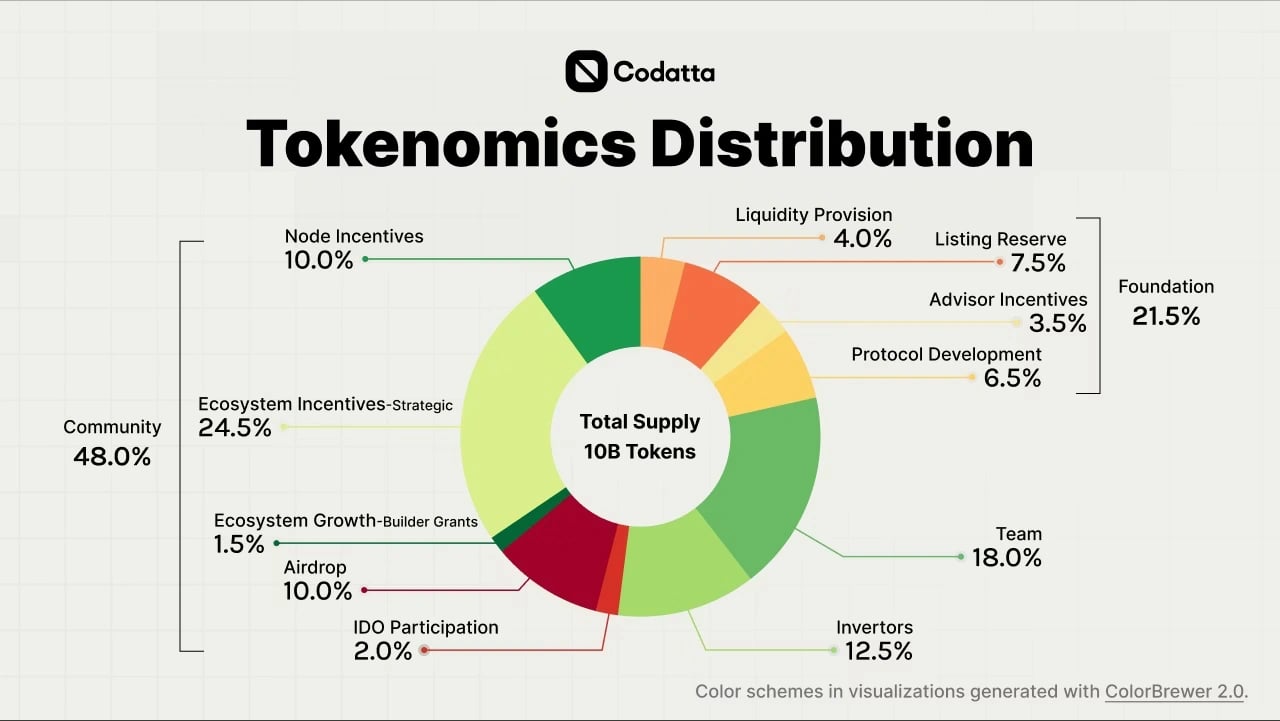
Governance
Codatta presents an open-protocol approach with governance grounded in on-chain rules, role definitions, reputation-weighted validation, and staking dynamics. While public-facing materials reference governance and treasury topics, they do not, in the reviewed pages, publish a complete DAO constitution or proposal/voting mechanics. The 2025 decentralization milestone foregrounds tokenization and the activation of DID and provenance features as part of the governance pathway. [1] [2]
See something wrong?