0% read
Last updated:
Auryn Macmillan
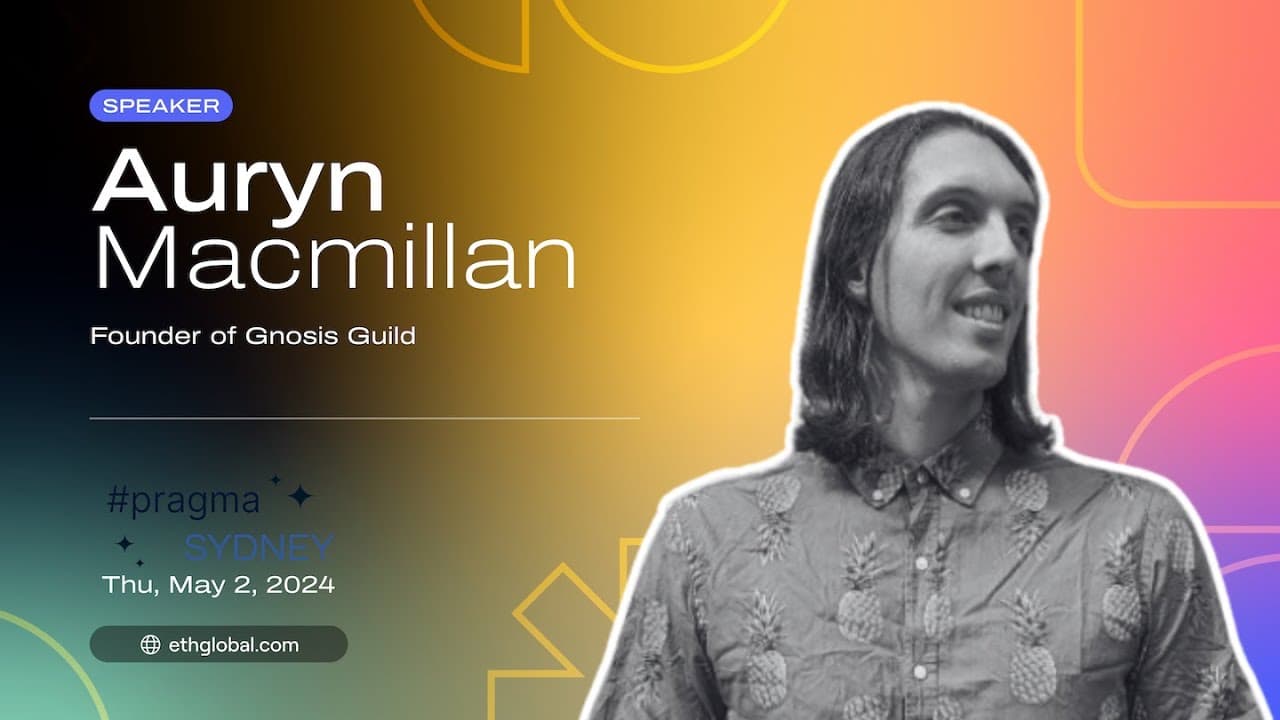
Auryn Macmillan is the co-founder of Gnosis Guild and The Interfold, a venture studio that develops infrastructure for decentralized systems. Macmillan leads the strategy for key projects including Zodiac, a modular DAO tooling framework, and Enclave, a confidential computing platform. Before his career in technology, he was a professional basketball player. [1] [2]
Education
Macmillan’s higher education reflects his dual interests in sports and technology. After high school, he completed one year of a computer science degree at Swinburne University in Melbourne before leaving to accept a basketball scholarship in the United States. He attended Gardner-Webb University in North Carolina, where he majored in psychology, a choice he reportedly made to allow for a greater focus on basketball. [2]
Over the course of his career, he has pursued further education in various fields. He holds a Bachelor of Information Technology from James Cook University, which he completed in 2010, and a Master of Business Administration (MBA) from Bond University, completed in 2015. [1] Some sources also note an MSc in Psychology & Research Methods. [3]
Career
Macmillan's career is marked by a significant transition from professional sports to becoming a leading figure in the blockchain industry.
Professional Basketball
Despite starting at the relatively late age of 16, Macmillan's height of 6 feet, 8 inches and athleticism allowed him to progress quickly in basketball. He played professionally for over a decade, from approximately 2005 to 2017. His career spanned leagues in Australia, Germany, and the United Kingdom. He played for several teams, including the Australian national team, Kilsyth Cobras, Illawarra Hawks, Melbourne United, Langen Giraffes, and the Plymouth Raiders. His transition to a full-time career in technology was reportedly accelerated by a career-ending Achilles tendon injury he sustained in 2016. [2] [4] [5]
Transition to Technology and Ethereum
Macmillan's interest in cryptocurrency began around 2013-2014 when he discovered Bitcoin while exploring the Tor browser. He was particularly captivated by early forum posts from Vitalik Buterin about Ethereum and the potential of DAOs. He followed the project closely and was a participant in the Ethereum crowdsale. Another account of his entry into the space highlights a practical need; while playing basketball in the UK, he faced difficulties sending money back to Australia, and a friend suggested he look into Bitcoin. [2] [1]
In 2016, Macmillan co-founded DAOhub, an information aggregator designed to organize conversations for the emerging community around "The DAO," the first major DAO on Ethereum. The platform became a central hub and connected him with other influential figures in the space. His early GitHub activity includes creating the 'DAOForum' repository to facilitate design discussions for the DAO being developed by Slock.it. [2] [6]
His early roles in Web3 included serving as Community Director at the esports platform First Blood in late 2016 and freelancing for Gnosis and a project called Ethercamp. In 2018, he joined the DAO-focused project Colony before transitioning to a full-time product role at Gnosis in 2019, where he initially worked on the company's conditional tokens framework. [2]
Ethereum Foundation and Gnosis
From January 2018 to January 2020, Macmillan served as the Team Lead for the Ethereum Foundation's flagship developer conference, Devcon. His involvement began as a volunteer for Devcon 3 in Cancun, and his performance led to him leading the organization for Devcon 4 in Prague and Devcon 5 in Osaka. [1]
After his time at the Ethereum Foundation, he became a Product Manager at Gnosis. During this period, he was credited with leading product development for the Gnosis Safe (now known as Safe), a multi-signature smart contract wallet. Under his guidance, the platform grew to become a foundational piece of infrastructure for DAOs and institutions to manage digital assets. [7] [8]
Key Projects and Contributions
Gnosis Guild
In 2021, Macmillan co-founded Gnosis Guild with Kei Kreutler, spinning it out from Gnosis to operate as an independent venture studio. The organization focuses on building infrastructure, tools, and what it terms "radical software primitives" for a decentralized future, with a primary focus on DAOs. Macmillan serves in a leadership role described as "Pathfinder" and CEO, guiding product, strategy, and business development for projects developed within the Guild. Gnosis Guild self-identifies as "a keeper of the zodiac open standard for DAOs." [1] [2] [9]
Zodiac
As the product and strategy lead at Gnosis Guild, Macmillan has guided the development of Zodiac, which he describes as "the expansion pack for DAOs." Zodiac is an open standard and a composable toolkit designed to enhance the capabilities of DAOs, particularly those built on the Safe multisig platform. The framework's core principle is to allow DAOs to add and remove functionalities through modular plug-ins, which Macmillan compares to "Lego bricks," enabling greater flexibility, security, and upgradeability without having to alter a DAO's core treasury contract. [1] [7]
Key modules developed under the Zodiac standard include:
- Reality Module (formerly SafeSnap): Enables on-chain execution of transactions based on the outcome of off-chain governance votes (e.g., on Snapshot).
- Exit Module: Allows DAO members to "rage quit" by redeeming their governance tokens for a proportional share of the treasury's assets.
- Bridge Module: Facilitates cross-chain governance by allowing a DAO on one blockchain to control a Safe wallet on another.
The Zodiac framework was designed with a multi-chain future in mind. Macmillan has led integrations with cross-chain messaging protocols like Connext to enable a DAO to manage assets and execute transactions across multiple networks from a single Safe account. [4] [7]
Enclave
Macmillan is also a Pathfinder for Enclave, a project incubated by Gnosis Guild focused on confidential computing. Enclave is a platform for building applications that use "encrypted execution," a method where data remains private and encrypted even while being processed on-chain. [1]
Early work on Enclave explored the use of hardware-based trusted execution environments (TEEs) like Intel SGX. In a podcast appearance in September 2025, Macmillan described the protocol as combining cryptographic techniques such as Fully Homomorphic Encryption (FHE), Zero-Knowledge Proofs (ZKPs), and Multi-Party Computation (MPC). The project aims to enable critical use cases like secret ballots for DAO governance, sealed-bid auctions, and the management of sensitive personal or corporate data, directly addressing Macmillan's stated concerns about the lack of privacy in decentralized governance. [10] [1]
clr.fund
Macmillan is the founder of clr.fund, a protocol designed to fund public goods within the Ethereum ecosystem using the Quadratic Funding (QF) mechanism. The project aims to create a more democratic and efficient method for allocating funds by weighting the number of individual contributors to a project more heavily than the total amount contributed. To enhance security and prevent collusion, the protocol leverages Minimal Anti-Collusion Infrastructure (MACI). [3] [4]
Views and Philosophy
Macmillan is a frequent speaker and commentator on DAO governance, privacy, and decentralized coordination. His views are reflected in his work and public statements.
-
On DAO Governance: He considers DAOs a "fascinating and important design space" and a "primitive for human coordination in a digital world." A primary concern for him is the lack of privacy in DAO voting. He has stated, "Is anyone else as worried as I am that all our DAO voting is fully transparent? Secret voting is such a cornerstone of Democratic systems." This view is a key driver for his work on the Enclave project. [1]
-
On Digital Identity: A pinned message on his X (formerly Twitter) profile reads, "Identity is overrated. Prove you're unique. The rest is redundant." This points to a philosophical interest in Sybil resistance mechanisms and reputation systems over traditional, personally identifiable information-based identity verification. [1]
-
On Entering Web3: He advocates for a passion-driven, contribution-first approach for newcomers to the industry. He has advised, "Find projects you’re passionate about, make real contributions... You should be contributing because it’s something valuable that you want to see in the world. Weirdly, that’s the best way to work on something that could become a long-term career." He believes that making valuable contributions is the most effective way to become a legitimate part of a community and build a career. [2]
The Interfold
The Interfold is a project focused on governance, founded by Auryn Macmillan. The project explores innovative voting mechanisms and privacy-driven coordination models. This initiative emphasizes receipt-free voting, aiming to enhance the accountability and effectiveness of decentralized governance frameworks. [13] [14]
Interviews
Modularity Matters #01
According to Auryn Macmillan, in an interview published on the ETHGlobal YouTube channel on May 31, 2024, modularity is presented as a structural approach relevant to the evolution of blockchain systems, with particular reference to the Ethereum ecosystem.
In his explanation, modularity refers to the organization of systems into discrete components that can be developed, modified, or replaced independently. This approach is contrasted with monolithic architectures, in which functionality is tightly coupled and changes to individual elements often require modifications across the entire system. He associates increased system complexity with higher maintenance constraints in monolithic designs.
Auryn differentiates between closed and open modularity. Closed modular systems are described as relying on permissioned components governed by a central control layer, which can limit interoperability and constrain external development. Open modularity, by comparison, is characterized by permissionless participation, standardized interfaces, and the ability for independently developed modules to interoperate without centralized authorization.
He references Ethereum as an example of a system that adopts modular characteristics, citing the separation of consensus and execution functions, the use of multiple client implementations, and the emergence of rollups and specialized layers. He also points to the Zodiac standards developed within Nosa Guild, which describe a modular account model where authentication and execution logic are treated as separate components, enabling integration of externally developed modules.
From his perspective, open standards are a necessary element in modular ecosystems, as they allow system specifications to reflect a range of technical requirements and use cases. Within this framework, modularity is described as an architectural property associated with system extensibility and long-term maintenance, rather than as a mechanism for short-term optimization or differentiation. [11]
Stop Worshipping Tokens, Build Better DAOs #02
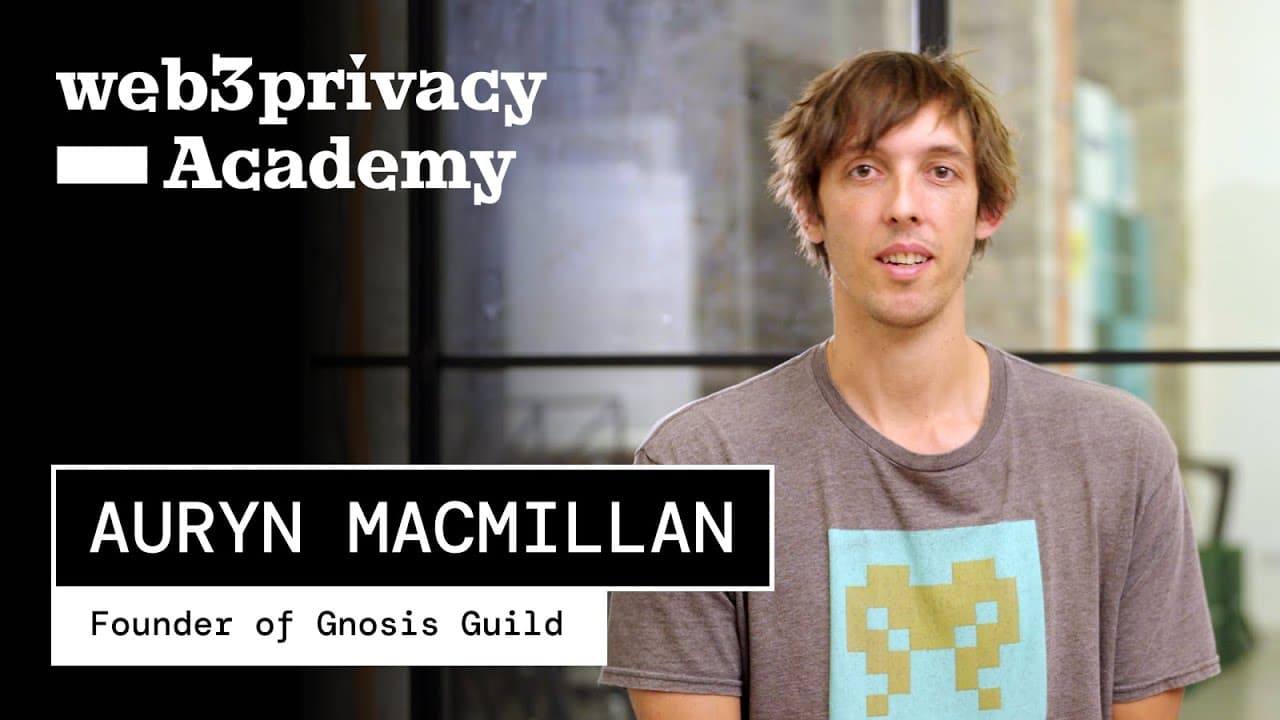
This article summarizes an interview with Auryn Macmillan, founder of Gnosis Guild, published on September 1, 2025, on the YouTube channel Web3Privacy Now. In the interview, Macmillan outlines his views on the development of decentralized autonomous organizations (DAOs), drawing on his experience with Bitcoin, Ethereum, and early DAO implementations. He characterizes DAOs as organizational systems that evolve over time rather than as fixed structures defined exclusively by token-based governance.
According to Macmillan, modular on-chain organizations are designed to accommodate gradual changes in governance and operational control. He describes progressive decentralization as a process in which permissions and responsibilities are adjusted as organizations mature. These views are informed by his work on conditional tokens at Gnosis and by organizational frameworks developed within Gnosis Guild. Within this context, privacy is described as an infrastructural element that supports decision-making processes and limits exposure to operational risks, rather than as a mechanism solely intended to conceal information.
The interview also addresses Macmillan’s assessment of current DAO implementations. He references projects such as Aave, Lido, Gnosis, and Nouns as examples of different organizational models in operation. He further discusses tools intended to structure participation and authority within DAOs, including Hats Protocol and Metal X, focusing on their role in defining responsibilities and formalizing organizational relationships.
Macmillan presents Enclave as an approach to confidential computation based on cryptographic techniques rather than hardware-based trusted execution environments. He explains that the system combines zero-knowledge proofs, fully homomorphic encryption, and multi-party computation to support processes such as secret ballots and sealed-bid auctions, in which inputs remain undisclosed while results can be verified.
Throughout the interview, Macmillan introduces the concept of practical pluralism, which emphasizes the use of multiple technical and governance approaches within decentralized systems. He also comments on his transition into engineering from a non-traditional background, noting that familiarity with programming concepts can inform participation in technical environments even without formal training. [12]
See something wrong?

Average Rating
No ratings yet, be the first to rate!
How was your experience?
Give this wiki a quick rating to let us know!
Edited By
On July 20, 2026. 02:45 UTC
Edit summary:
Updated media (5 -> 5 items) and images (1 -> 1 items)