0% read
Last updated:
Artemis
Artemis is a data and analytics company that provides fundamental metrics and analytical tools for the digital asset market. [1] [2] Founded in 2022 and headquartered in New York City, the platform organizes and standardizes on-chain data for blockchains, tokens, and stablecoins to serve institutional investors, analysts, crypto protocols, and researchers. [1] [3] Artemis aims to be an all-in-one source for crypto data, establishing data standards to bring the analytical rigor of traditional finance to the digital asset space. [3] [4]
Overview
Artemis's stated mission is "to help anyone understand what’s happening onchain and the core drivers of markets" and "to empower anyone, anywhere, to become a world-class investor in digital finance." [5] [1] The company operates on the belief that global economic activities, including financial services, payments, and real estate, are migrating to public blockchains, creating a new system termed "digital finance." [3]
The platform was conceived to address the challenges faced by crypto investors who had to manually collect and compare data from numerous disparate sources. The founding idea, inspired by the workflow of investors at Modular Capital, was to create a unified, no-code platform to streamline fundamental analysis. Artemis's vision is to build trust and transparency in the digital asset market through data standards that can be used by investors, builders, governments, and consumers. [3]
The company's first Minimum Viable Product (MVP) was launched in 2022 under the name gokustats.xyz. This origin is reflected in one of the company's internal values, "Gokumode," which represents customer obsession and an iterative development process. [3] Artemis's legal entity is Artemis Analytics Inc., incorporated in the United States. [2]
History
Artemis was founded in 2022 and launched its initial MVP, gokustats.xyz, that same year. [1] [3] On May 22, 2022, the company completed its Seed funding round. [1] The official company X (formerly Twitter) account, , was created in April 2022. [4]
By March 2024, the platform's research arm was actively analyzing market and regulatory events. It published analysis on the U.S. Commodity Futures Trading Commission's (CFTC) first draft of a digital asset taxonomy, viewing it as a move toward regulatory clarity. During the same period, Artemis provided forecasts on the impact of Ethereum's Dencun upgrade, which occurred on March 13, 2024, projecting significant reductions in transaction costs for Layer 2 networks. [6]
In 2025, Artemis continued to publish a series of in-depth research reports in collaboration with other firms, covering topics from stablecoin usage in May to token supply metrics in August and protocol-specific deep dives throughout the fall. [7] On October 1, 2025, the company launched ART Chat, its AI-powered analytics tool. [2] In late 2025, Artemis announced the hiring of a new Product Manager, Quantitative Analyst, and Research Analyst, indicating a period of team expansion. [1]
Methodology and Technology
Artemis's core methodology is centered on sourcing, transforming, and aggregating raw blockchain data into standardized, comparable metrics. This allows for direct, "apples-to-apples" comparisons of performance and activity across different blockchains. The company focuses on curating high-signal "metrics that matter" to distill relevant information for investors, rather than providing undifferentiated raw data. [5] [8]
The platform operates on a "source available" basis, promoting transparency by allowing users to view its data sources and methodologies. [5] Artemis utilizes open-source dbt (data build tool) models for its data transformation processes, with the code available on the company's GitHub repository. [8] The primary programming language used in its public repositories is Python, and the company uses Dagster for data orchestration. [9]
Artemis advocates for a valuation framework for blockchains based on revenue and activity, summarized by the formula: Capital on-chain → transfer volume → take rate → earnings. This approach frames blockchains as marketplaces for capital. For example, a network like Solana is viewed as a marketplace where its global transfer volume is analogous to the Gross Merchandise Volume (GMV) of traditional marketplaces like Uber or Airbnb. Key sectors monitored through this lens include stablecoins, prediction markets, and Real-World Assets (RWAs). [1]
Products and Services
Artemis offers a suite of products designed to deliver on-chain data across various workflows, from visual dashboards to programmatic integration. [3]
Artemis Terminal
The Artemis Terminal is the company's main product, described as a "Bloomberg-like" web-based platform for accessing curated data and charts. [1] It is a no-code dashboard for comparing the performance of major blockchains and dApps, visualizing trends in developer activity, and building custom charts. [5] A key feature is the Activity Monitor, which allows users to segment and analyze user behavior by categories, applications, or specific smart contracts. [5]
Artemis Sheets
Artemis Sheets is a spreadsheet plugin for Google Sheets and Microsoft Excel, designed to integrate on-chain data directly into financial models. [5] It is described as "The CapIQ-like plugin for crypto analysts" and utilizes a custom function, =ART(), to pull data. [2] [[app.artemisanalytics.com/docs/welcome/overview]] The plugin provides real-time data from Artemis as well as integrated third-party sources like CoinGecko, Dune, and TokenTerminal, and it includes pre-built templates for tasks such as market screening and valuation. [5]
ART Chat
Launched in October 2025, ART Chat is an AI-powered analytics assistant. [2] It is designed to interpret natural language queries to generate charts, tables, and comparative analyses of blockchain protocols and assets. [2] The tool is integrated into the Artemis Terminal and Sheets products and is marketed as "the AI for crypto analysts." [4]
Data-Level Products
- Artemis API: A REST API that provides programmatic access to the firm's core fundamental metrics for use in custom applications, models, and systems. [5]
- Snowflake Data Share: An enterprise-level solution that provides clients with direct access to all of Artemis's curated datasets via a private Snowflake Data Share, enabling large-scale analysis using direct SQL queries. [5]
Artemis Research
This is the content and analysis arm of the platform. The research team publishes analytical reports, protocol deep dives, and weekly market summaries. [5] The team also runs an "Analyst of the Month" program to feature the work of prominent analysts in the crypto space. [8]
Key Concepts and Research
Artemis's research focuses on establishing standardized methods for fundamental analysis in the digital asset industry.
Fundamental Metrics
The platform prioritizes metrics analogous to those in traditional finance to assess network health. These include daily active users, transaction counts, fees, protocol revenue, and developer activity, such as weekly code commits. [7] [6]
"Outstanding Supply"
In an August 2025 report co-authored with Pantera Capital, Artemis proposed the concept of "Outstanding Supply" as a more accurate alternative to "Circulating Supply." The paper argued that Outstanding Supply, which accounts for tokens that are locked but still part of the economic base, better reflects a token's economic reality, similar to how outstanding shares are used in equity markets. [7]
Stablecoin Analysis
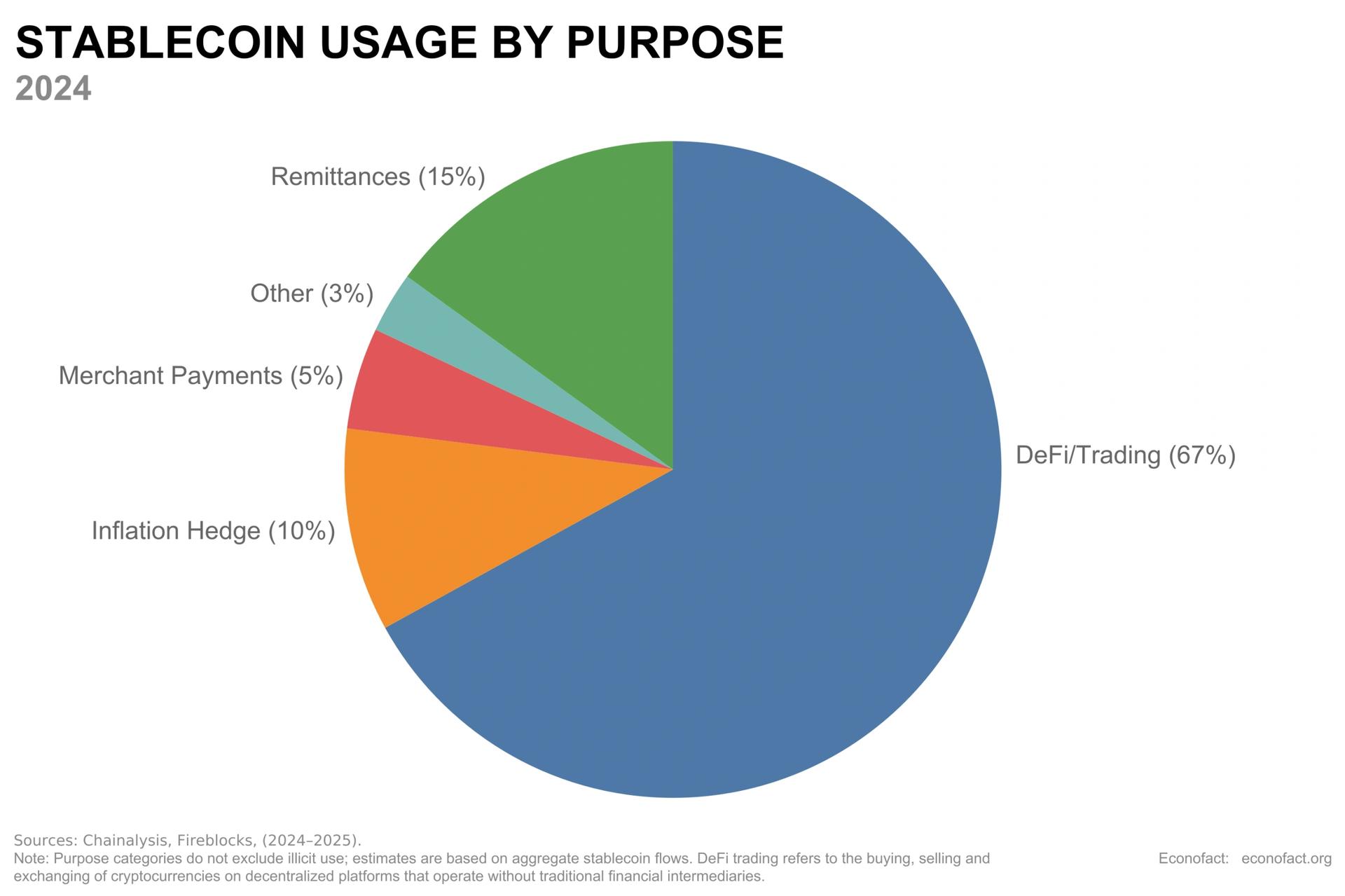
The stablecoin ecosystem is a major research focus. In May 2025, Artemis collaborated with Dragonfly and Castle Island Ventures on a report titled "What are stablecoins used for?". [7] A later update in November 2025 noted a 123% surge in B2B stablecoin payments and a total stablecoin supply reaching $300 billion as of October 2025. [7]
Other Research Areas
- Factor Investing: Artemis applies quantitative finance principles to crypto, publishing research on factor models (e.g., beta, size, value, momentum) to identify systematic drivers of crypto asset returns. [7]
- Protocol Revenue: The firm works to create clear definitions for crypto protocol revenue, distinguishing between gross fees paid by users and the net revenue retained by a protocol's treasury. [7]
- Protocol Highlights: The research team publishes deep dives on specific protocols, with reports in late 2025 covering Pendle, Cap, and the privacy-focused protocol Aztec. [7]
Key People
The Artemis team includes individuals with backgrounds in venture capital, hedge funds, and technology from firms like Ribbit, Venmo, Coinbase, Meta, Blackrock, Whale Rock, and Insight Partners. [5] [8]
- Jon Ma: Co-Founder and CEO. He previously worked as a venture capital and hedge fund analyst and is a frequent author of the company's research. [7]
- Anthony Yim: Co-Founder and CTO. He has co-authored research reports, including deep dives on stablecoin usage. [7]
- Mario Stefanidis: Fundamental Research Lead, who leads quantitative research on topics like crypto factor models. [7]
- Andrew Van Aken: Data Scientist specializing in stablecoin data and market updates. [7]
In late 2025, the team expanded with several new hires, including:
- Anish Rane: Product Manager, formerly with internships at Base and Gemini. [1]
- Varun Aravapalli: Quantitative Analyst focusing on factor models, formerly of Balyasny Asset Management. [1]
- Tiago Souza: Research Analyst and an MBA candidate at Columbia Business School. [1]
The founding concept for Artemis was inspired by the work of Vincent Jow and James Ho of Modular Capital. [3]
Partnerships and Clients
Artemis provides data and analytics to a range of institutional clients and collaborates with other firms on research. The company states that its platform is trusted by organizations that include Visa, Grayscale, VanEck, WisdomTree, Pantera Capital, Sequoia, Franklin Templeton, Circle, and Tether, as well as blockchain protocols like Solana and Base. [4] [1]
Key research collaborations include:
- Pantera Capital: Co-authored a report in August 2025 proposing the "Outstanding Supply" metric for tokens. [7]
- Dragonfly and Castle Island Ventures: Co-authored a major research report in May 2025 on the use cases for stablecoins. [7]
- Cap Labs: The Artemis team interviewed the Head of Growth at Cap Labs for a protocol highlight report in October 2025. [7]
See something wrong?
Average Rating
No ratings yet, be the first to rate!
How was your experience?
Give this wiki a quick rating to let us know!
Edited By
On December 16, 2025. 18:39 UTC
Edit summary:
Added Artemis wiki page