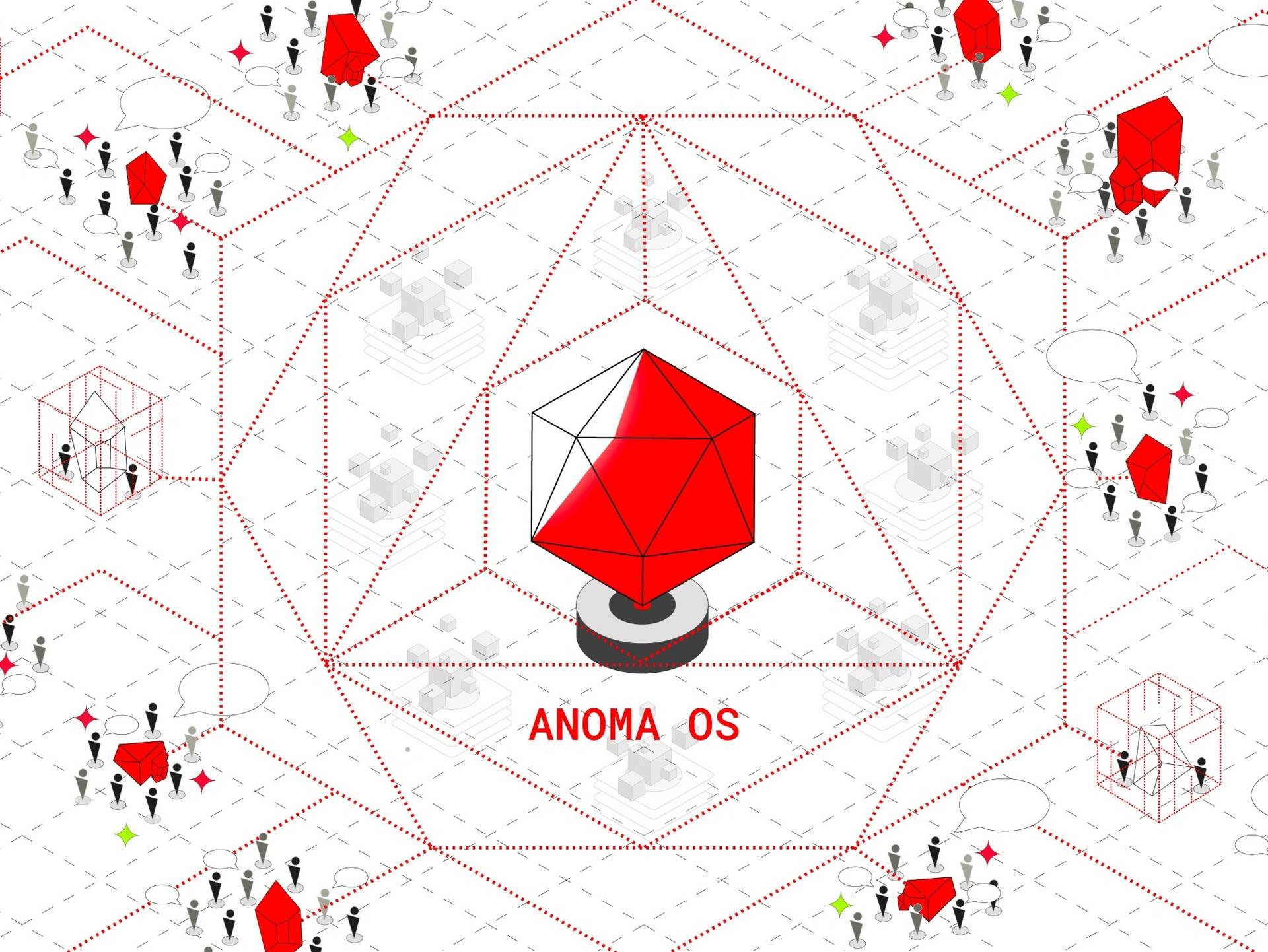
Anoma
Anoma is a decentralized, intent-centric operating system and blockchain protocol designed to unify fragmented blockchain ecosystems. It functions as an abstraction layer that allows developers to build applications capable of accessing users, state, and settlement across any connected network, shifting the user interaction model from explicit transactions to declared outcomes, or "intents." [1] [9] [3]
Overview
Anoma was developed to address several challenges prevalent in the Web3 space, including ecosystem fragmentation, poor user experience, and a lack of data privacy. The protocol's core design philosophy is to be "human-centric, not blockchain-centric," abstracting away the technical complexities of multi-chain interactions. A primary high-level goal is to facilitate "self-sovereign coordination," providing a mechanism for users and communities to plan and execute actions for mutual benefit without relying on external authorities or intermediaries. [9] Instead of requiring users to execute a series of specific, step-by-step transactions on different chains, Anoma allows them to express their desired end goal. A decentralized network of actors then finds the optimal way to fulfill this intent. The project uses the analogy of Microsoft Windows, which provided a unified operating system layer between users and diverse hardware, to describe its goal of creating a cohesive "decentralized operating system for Web3." [1] [3]
The project is managed by the Anoma Foundation, which supports the development and growth of the ecosystem. Anoma's architecture is not positioned as a direct competitor to existing Layer 1 or Layer 2 blockchains but rather as a "higher level of abstraction" that integrates them into a single, interoperable system. By simplifying and standardizing development across various networks, the project aims to deliver a unified, user-friendly experience that Web3 currently lacks. [15] This approach is intended to enable a new class of decentralized applications that require complex coordination, cross-chain composability, and user-defined privacy controls. The system is designed to be compatible with any blockchain it connects to, allowing a single application deployment to access state and users across multiple networks. [11] [2] [4]
History
The development of Anoma was driven by a desire to move beyond the "involution" of the blockchain industry, where many new projects were seen as slight variations of existing models like the Ethereum Virtual Machine (EVM) without introducing fundamental innovations. Co-founder Adrian Brink, who previously worked as a core developer at Cosmos, aimed to create a new architecture that could solve deeper problems related to user experience and fragmentation. [3]
The Anoma Foundation has conducted several fundraising rounds to support the protocol's development. Early rounds in 2021 included a $6.75 million private sale in April and a $26 million round in November. In May 2023, the foundation secured an additional $25 million. A community-driven round in January 2025 raised another $2.5 million, bringing the total funding to over $60 million. [10] [11] [12] [13]
Devnet
On January 16, 2025, Anoma launched its first private devnet, codenamed "HelloWorld." This initial phase was accessible only to a curated cohort of builder teams selected for the Anoma Builders Program. The goal was to gather feedback on the protocol's core components, including its novel resource model and the Juvix programming language, while testing early use cases in areas like DeFi, AI, and privacy. [8]
Testnet
Following the private devnet, the Anoma Testnet was launched on July 17, 2025. This phase opened participation to the broader community through an interactive experience designed to educate users on the protocol's architecture. A unique feature of the testnet was a 3D interface that offered a visual map of how intents flow through the operating system and across blockchains, serving as an educational tool to make the system's operations more understandable. [15] Access required invite codes distributed through community channels, allowing users to explore the system's conceptual layers and applications. [9]
Mainnet
The mainnet rollout began on September 29, 2025. This initial launch occurred on the Ethereum mainnet, introducing the native XAN token as an ERC-20 token and deploying the Anoma governance system. The launch also included the first version of the Anoma Portal and the opening of the claim period for the first season of the Anoma airdrop. The project's rollout strategy involves this initial Ethereum deployment, with future plans to expand support to Ethereum Layer 2s like Base, Optimism, and Arbitrum, as well as other Layer 1 blockchain ecosystems such as Bitcoin and Solana. This phased expansion is intended to minimize platform lock-in and facilitate the deployment of universal applications across Web3. [15] [11] [6]
Technology
Anoma's architecture is built on a set of core principles and components that differentiate it from traditional blockchain designs. It is described as a "decentralized world computer" composed of distinct, interoperable layers. [9]
Intent-Centric Architecture
The fundamental paradigm shift introduced by Anoma is its move from a transaction-centric to an intent-centric model. In a typical blockchain, a user submits a transaction that explicitly defines the computational steps to be executed (e.g., "call function X with parameters Y and Z"). In Anoma, a user expresses an intent, which is a declaration of a desired outcome. For example, a user could express an intent to swap ETH to USDC with a minimum-received threshold, a deadline, and a slippage cap. This approach abstracts the execution logic, allowing the system to find the most efficient path to satisfy the user's goal. This model is designed to be more intuitive for users and more flexible for developers, enabling complex, multi-step, and cross-chain operations to be expressed as a single, unified intent. [1] [6]
Validity Predicates and Digital Preference Expression
At a technical level, user preferences are expressed through validity predicates. These are user-authored programs that describe the conditions under which a user is willing to have their resources (assets or data) modified. A validity predicate can be arbitrarily complex, allowing for the expression of nuanced preferences that go far beyond simple buy or sell orders. For preferences that change rapidly, users can sign off-chain messages called "intents," which are then authenticated and interpreted by their on-chain validity predicates. These intents are broadcast across a gossip network where they can be discovered by counterparties or solvers. This system allows users to maintain control over their assets while outsourcing the computational work of finding a match or solution. [14]
The Anoma Intent Machine
The core of the protocol is the Anoma Intent Machine (IM), which functions as a distributed operating system. It is responsible for processing intents and translating them into state changes across the unified network. The IM is composed of three conceptual layers:
- The Desktop (Application Layer): This is the user-facing layer where individuals interact with intent-centric applications. These applications generate intents based on user actions.
- The Intentnet (P2P & Networking Layer): A peer-to-peer gossip network that handles the discovery, matchmaking, and solving of intents. It is powered by a proprietary state-passing protocol and supports both public and private mempools for processing intents.
- The Motherboard (Hardware Abstraction Layer): This layer abstracts all connected blockchains and decentralized services (e.g., storage, data availability) into a consistent set of resources. For example, it can treat Ethereum and its L2s as compute resources (CPUs), Filecoin or Arweave as long-term storage, and Celestia as a data availability resource. [9]
Decentralized Solver Network
A critical component of the architecture is a decentralized network of off-chain actors known as "solvers." These solvers monitor the network for user intents, discover counterparties with matching or complementary intents, and compete to find the most optimal solution. Once a valid solution is found, solvers bundle the necessary transactions and submit them for settlement on the appropriate underlying blockchain(s) via "protocol adapters." This competitive, off-chain process is designed to handle complex optimizations that would be computationally expensive or impossible to perform directly on-chain. [1] [6]
Resource Model and Juvix
Anoma introduces a novel "Resource Model" for managing state and assets within the system. Applications on Anoma are built using Juvix, a functional programming language specifically designed for creating intent-centric applications on the network. Developers interact with the Resource Model to define how their applications manage data and value, which differs significantly from the account-based model of the Ethereum Virtual Machine (EVM). [8]
Programmable Data Sovereignty
To address privacy concerns on public blockchains, Anoma incorporates a feature for programmable data sovereignty. This allows users and developers to define granular rules for data disclosure. The protocol uses advanced cryptographic technologies, such as Halo2 zero-knowledge proofs and a privacy protocol named Taiga, to enable secure and private transactions. This ensures both data confidentiality and functional security, allowing users to selectively share information and make transactions indistinguishable to enhance security. [1] [7]
Hybrid Consensus Mechanism
Anoma utilizes a hybrid consensus mechanism that offers flexibility between speed and security. It distinguishes between local and global consensus. Local consensus allows for faster transaction execution, which is suitable for smaller or less critical operations. Global consensus provides a higher level of security and decentralization, comparable to Bitcoin's model, making it appropriate for high-value transactions. This adaptability allows developers to design applications where users can choose the consensus model that best fits their needs for a specific action, rather than being locked into a single, network-wide consensus protocol. [7] [3]
Tokenomics
The Anoma ecosystem is coordinated through its native token, XAN, which facilitates network operations and governance.
XAN Token
The native token of the Anoma network is XAN. At its initial launch, XAN was deployed as an ERC-20 token on the Ethereum mainnet, making it compatible with standard Ethereum wallets like MetaMask, Coinbase Wallet, and Rabby Wallet. The primary utilities of the XAN token include:
- Payments and Fees: Used for paying fees related to network activities.
- Governance: Required for participating in the Anoma governance system. [11] [6]
Token Distribution
The total and maximum supply of XAN is fixed at 10 billion tokens. The distribution is allocated as follows: [16]
- Investors: 31%
- Community, Market, and Liquidity: 25%
- Research & Development and Ecosystem: 19%
- Core Contributors: 15%
- Anoma Foundation: 10%
Tokens allocated to the Anoma Foundation, Research & Development, Investors, and Core Contributors are subject to a 12-month lock-up period, followed by a 36-month linear vesting schedule. [16] At launch, the circulating supply was reported to be between 2 billion and 2.5 billion tokens. [8] [4] [3]
Governance
Anoma's governance is managed through a token-based voting system where XAN holders can influence protocol upgrades. To participate, token holders must lock their XAN to vote on proposals, with their voting power being proportional to the amount of XAN locked. The governance structure is a bicameral system designed with checks and balances between two bodies:
- Voter Body: Comprises all token holders who lock their XAN to vote. This body has the power to veto proposals initiated by the Governance Council.
- Governance Council: A council, initially composed of early contributors via a multisig, that can propose upgrades. This is particularly useful in cases where the Voter Body has not reached a quorum.
Either body can submit a proposal, which requires a minimum of two weeks to pass. This structure is designed to ensure that no single group has unilateral control over the protocol's evolution. Tokens locked for voting can be unlocked after a proposal is enacted, allowing holders to regain liquidity while participating in governance. [11] [6]
Ecosystem
The Anoma ecosystem consists of applications built on the protocol, developer support programs, and user-facing tools.
AnomaPay
AnomaPay is one of the first major applications built on Anoma. Developed by the team at Heliax, it is a global stablecoin router and payments network designed to offer enterprise-grade data protection. AnomaPay functions as an intelligent router that allows users to send payments in their preferred stablecoin, which is then automatically converted to the recipient's preferred stablecoin. It leverages Anoma's intent-centric architecture to abstract away the complexities of cross-chain swaps and provide opt-in confidentiality for transactions using efficient zero-knowledge proofs. The application launched with a partnership with Noble, a stablecoin issuer, to provide its users with access to confidential global payments. [10] [6]
Anoma Builders Program
To foster development on the platform, the Anoma Foundation established the Anoma Builders Program, also known as the "Intents Initiates Program." This initiative supports projects building on Anoma by providing resources, technical support, and early access to the network. The first cohort for the "HelloWorld" devnet included 15 projects exploring a range of use cases:
- Mycel: A privacy-preserving, cross-chain order book decentralized exchange (DEX).
- HeyElsa: A composable layer for Decentralized AI (DeFAI) agents.
- Fluton: An intent-centric gateway for swaps and bridges across EVM and other networks.
- Reppo: A resource coordination layer for AI developers.
- Spicenet: A unified liquidity layer for trading applications.
- SwissDAO: A framework for autonomous, intent-based matchmaking.
- Any: A private communication network for secure deal-making. [8] [9]
Anoma Portal
The Anoma Portal is a native application that serves as the primary gateway for users to interact with the Anoma ecosystem. The first version, launched with the mainnet, allows users to view and manage their XAN token balances and participate in Anoma governance. The long-term vision for the portal is to evolve it into a "Web3-native super app" that also functions as a discovery platform for applications built on Anoma. [11]
Team
The development of the Anoma protocol is led by co-founders Adrian Brink and Christopher Goes, supported by the Anoma Foundation. Project communications have also been authored by individuals such as Awa Sun Yin and Zach Cavanaugh. [9] [9] [8] [3]
Funding
The Anoma Foundation has successfully raised significant capital to fund the project's development across several funding rounds:
- April 2021 (Private Sale): Raised $6.75 million in a round led by Polychain Capital, with participation from Electric Capital, Coinbase Ventures, FBG Capital, CMS Holdings, and others. [10]
- November 2021: Raised $26 million in a round also led by Polychain Capital, joined by Fifth Era, Zola Global, and others. [11]
- May 2023: Raised $25 million in its third round, co-led by CMCC Global. Other investors included Delphi Digital, Dialectic, KR1, Spartan Group, and Anagram. [12] [5]
- January 2025 (Community Round): Raised $2.5 million in a community-driven round led by Native Crypto and CMS Holdings, conducted on the Echo.xyz platform. [13]