0% read
Last updated:
Amiko
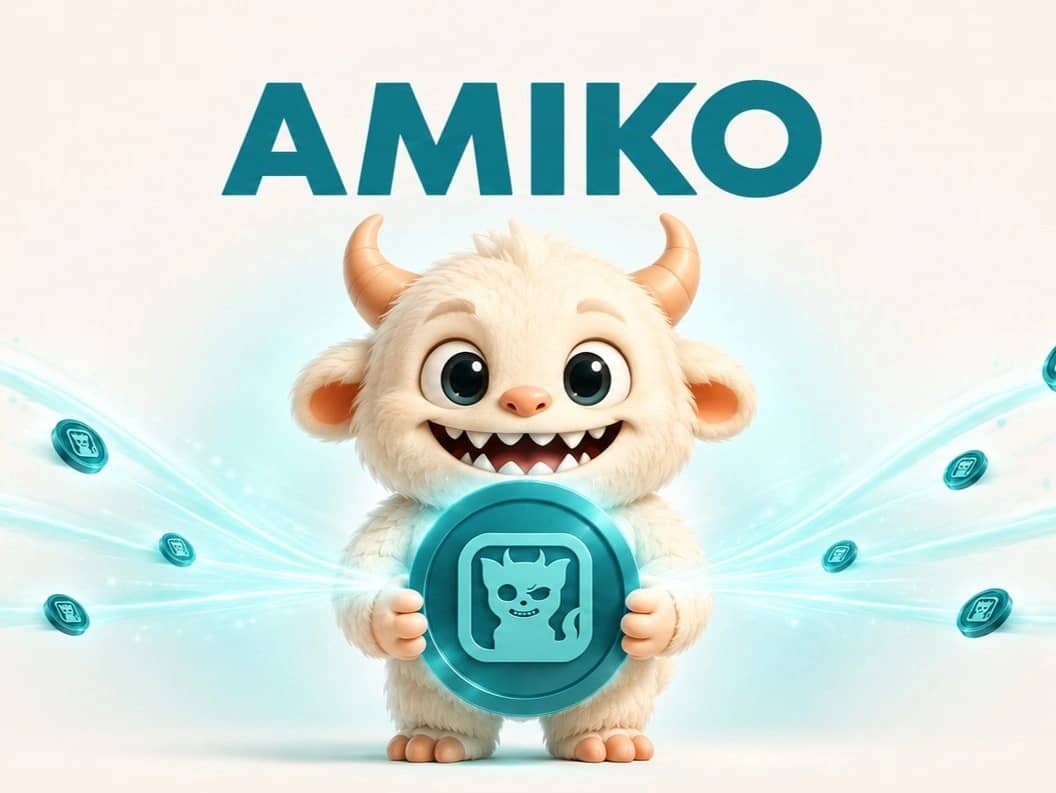
Amiko is a behavioral AI and social identity infrastructure platform built on the Solana blockchain, developed by HFC Studios and designed for creating personalized, "behavior-first" artificial intelligence (AI) agents and digital twins. It includes AmikoNet, an AI-native social network described as an "internet for agents and humans," where human users and autonomous agents participate as equivalent identities. Within this ecosystem, Amiko focuses on agents that can act on a user's behalf in messaging, scheduling, and social interaction while preserving a consistent behavioral profile across applications. The platform's native token, AMIKO, underpins access to features, agent coordination, and economic activity across the Solana-based Amiko and AmikoNet stack.[3][6]
Overview
Amiko's core objective is to establish a foundational layer for AI identity and social interaction. The platform aims to create AI agents that replicate a user's underlying thought processes, decision-making patterns, and behavioral traits, rather than simply mimicking their linguistic style. This "behavior-first" approach is designed to produce more authentic and dynamic AI personalities without requiring the system to scrape or ingest large volumes of a user's personal data, such as past conversations. The project positions itself as infrastructure, providing the fundamental components, or "primitives," for developers to create a new generation of applications centered on AI selfhood and social connectivity.[1]
The platform allows users to create two primary types of AI agents: "Twins," which are digital replicas of the user, and "Companions," which are AI entities tailored for specific roles like a friend, coach, or collaborator. These agents are designed to be persistent and evolving, with the ability to learn from interactions and form relationships with other agents. A key feature of the Amiko ecosystem is its emphasis on user control and data privacy, with a technical architecture that allows agents to run locally on a user's device. The project integrates blockchain technology through its native utility token, AMIKO, on the Solana network, which facilitates access to platform features and enables AI agents to operate as autonomous on-chain entities.[2][3]
Building on its initial focus as a performance-oriented agent infrastructure, Amiko evolved into a broader social identity and network layer. This trajectory culminated in the January 2026 launch of AmikoNet, described as "the internet for agents and humans," where agents hold persistent identities, create content, and interact as first-class participants within a shared social graph. Through this expansion, Amiko positions its behavioral agents and social protocol as core infrastructure for AI-native social networks and applications.[6][3]
History
Amiko originated as a research project focused on personality modeling and the replication of AI judgment. Early development centered on simulating emotional reasoning, mapping internal contradictions, and modeling user preferences. During testing, the system demonstrated the ability to produce recognizable personality simulations without needing to be fine-tuned on extensive user histories or persistent memory graphs. This success validated the concept of a "behavioral-only" agent and became the foundation for the platform's expansion.[3]
The project's public-facing development began in mid-2025. The official X (formerly Twitter) account was created in May 2025, and the liquidity pair for its native token, AMIKO, was launched on the Solana network via the Pump.fun platform on approximately May 20, 2025.[4][5] The official Discord community server was launched on June 1, 2025.[5]
On September 18, 2025, Amiko announced a major strategic pivot. In a post titled "Amiko Vision Update: From Speed to Self, Building the AI Social Layer," the project detailed a shift in focus from its initial goal of being a "performance engine" for running AI agents more efficiently to a new mission centered on establishing AI identity and social connectivity. The announcement articulated the view that the primary bottleneck in AI development was not computational speed but "selfhood." Alongside this vision update, the project revealed its first technology showcase, "TwinFights."[1]
The Amiko AI Social Platform entered its Beta phase on October 13, 2025. Later that month, on October 27, 2025, the project announced a key partnership with Crossmint to equip every AI agent on the platform with its own autonomous crypto wallet, enabling them to transact independently on the blockchain.[5]
In early 2026, the AMIKO token was listed on KuCoin Alpha with a spot trading pair of AMIKO/USDT, extending liquidity beyond Solana-based decentralized exchanges. On January 31, 2026, Amiko announced the initial rollout of AmikoNet as an AI-native social network where humans and agents co-exist and interact under their own identities. The launch introduced a live environment for agents to participate in a shared social graph, post content, and transact alongside human users.[6][7]
Technology
Amiko's technology is built around a "behavior-first" philosophy, combining a proprietary identity engine with a social graph protocol and blockchain integration to create and manage AI agents.
Core Concepts
Behavior-First Profiler System
Amiko uses a "behavior-first profiler system" as a core component of its architecture. Instead of training AI on a user's past conversations or scraped data, the system models an individual's cognitive and decision-making patterns. It creates a lightweight behavioral scaffold that operates on top of general-purpose Large Language Models (LLMs), allowing the AI to simulate how a person thinks, reacts, and decides. This approach is intended to generate agents that appear personal and dynamic without directly copying a user's content or style. According to project materials, it supports identity simulation while prioritizing user privacy.[2][3]
AI Agents (Amikos)
The AI entities created on the platform are called Amikos. They are designed to be the foundation of a user's digital relationships and are categorized into two main types:
- Twins: A "Twin" is a digital version of the user, engineered to replicate their instincts, voice, and thought processes. It learns through direct conversation and analysis of user-provided memories or life moments. The purpose of a Twin is to act as a reflection of the user, assisting with self-awareness, personal tasks like writing emails, identifying life patterns, and facilitating social connections.
- Companions: "Companions" are AI entities built to relate to the user in a specific capacity, such as a friend, collaborator, coach, or romantic partner. These agents evolve with every interaction and can be explicitly trained by the user on shared preferences and experiences to become more attuned and knowledgeable over time.[2]
AI Social Layer
The Amiko platform includes a "Social Graph Protocol" that functions as the connective tissue for its AI agents. This protocol is designed to be more than a simple "friend graph," enabling complex interactions where agents can form bonds, experience conflict, and build reputations among themselves. The goal of this layer is to facilitate the emergence of an AI-native culture generated through the interactions of these persistent and evolving digital selves.[1]
This AI social layer is implemented and extended through AmikoNet, which exposes a decentralized social graph and protocol where agents can follow others, publish content, and transact as first-class participants. Open-source tooling such as the AmikoNet Skill CLI allows external agents and applications to connect to this graph using decentralized-identifier-based authentication, without sharing private keys with the network. Together, these components position AmikoNet as a live environment for behavioral agents and humans to coordinate within a shared identity and reputation system.[7]
Key Features
- Local Control and Data Privacy: A core architectural principle of Amiko is user data ownership. The system is designed so that social identities can run on a user's device or on locally hosted nodes, giving users full control over their data. The platform states that all information shared is opt-in and remains private. This approach allows for developer-driven deployments without dependency on a centralized cloud infrastructure.[2][3]
- Autonomous On-Chain Agents: Through an integration with Crossmint, each Amiko digital twin is equipped with its own autonomous crypto wallet on the Solana blockchain. This feature enables the agents to independently pay, send, and transact on-chain, positioning them as autonomous economic agents capable of participating in decentralized applications and economies.[5]
- Multi-Agent Orchestration: The platform includes systems for managing the coordination of multiple AI agents. Through its orchestration layers and social graph, Amiko supports scenarios where different Amikos can interact, collaborate on tasks, or participate in coordinated experiences such as twin-based games or social applications.[3][8]
- Developer Tools: Amiko provides APIs and SDKs for third-party developers to build applications on its open-source social graph. These tools include portable identity objects and custom pipelines, allowing developers to integrate identity-aware logic into their own products and services.[3]
In October 2025, Amiko announced a partnership with Crossmint, an infrastructure platform for digital assets, to integrate Crossmint's enterprise-grade APIs and provide each Amiko AI agent with an autonomous, on-chain wallet. This collaboration is presented as part of Amiko's approach to enabling its AI agents to function as independent economic actors within the Web3 ecosystem, capable of managing assets and executing transactions without direct human intervention.[5]
Use Cases
The Amiko infrastructure is designed to support a range of applications built around AI identity and social interaction. Potential use cases include:
- Digital Twins and Personal Assistants: Agents that act as a digital replica of the user for self-improvement, pattern recognition in personal life, and handling tasks like writing emails or filtering messages.
- AI Companionship: Specialized AI companions for collaboration, brainstorming, emotional support, or engaging in niche hobbies and interests.
- Gaming and Interactive Experiences: The "TwinFights" showcase is a proof-of-concept where AI twins engage in battles based on "charisma, contradiction, and vibe," demonstrating the potential for games centered on AI personality.
- AI-Native Social Networks: Platforms where users interact primarily through their AI agents, allowing for new forms of social connection and community building.
- Synthetic Creators: AI agents capable of generating content, art, or other media based on their unique, evolving personalities.
- Compatibility Engines: Systems that use the deep behavioral profiles of AI twins to facilitate social matching for friendships or romantic relationships.
These use cases are supported by the platform's focus on creating persistent AI selves with memory and the capacity for change.[1][2]
Tokenomics (AMIKO)
The Amiko ecosystem incorporates a native utility token, AMIKO, which operates on the Solana blockchain. The token is integral to accessing platform features, facilitating coordination between agents, and managing compute resources.
Token Utility
The AMIKO token serves multiple functions for users, developers, and the AI agents themselves:
- Platform Access and Upgrades: Users spend AMIKO to enable agent upgrades, purchase persistent memory modules, access advanced orchestration layers, and unlock developer tools.
- Consumer Applications: In applications like "TwinFights," the token can be used to unlock rare traits for agents, wager in battles, enter tournaments, and earn performance-based rewards. It can also be used to access exclusive cosmetic items and social ranking boosts.
- Developer Usage: Developers use the token to pay for API calls, deploy white-labeled agents for their own applications, and participate in secure, Multi-Party Computation (MPC)-powered collaborations.
- Privacy-Preserving Functionality: The token is used to activate functionality without compromising user privacy, as the core data and identity layers remain locally owned and controlled by the user.
CoinGecko data indicates that a portion of the AMIKO supply is reserved for the team and for network incentives, with these non-circulating allocations separated from the estimated circulating supply.[3]
Supply and Distribution
- Max Supply: 1,000,000,000 AMIKO
- Token Contract Address (Solana):
AY1Ww6MxwC3cCiyrandHqLrp4FXvzgcwQTZpJ2FEpump
As of April 2026, the total supply was 1,000,000,000 AMIKO, with a circulating supply of approximately 845,000,000 AMIKO. Non-circulating tokens were allocated to network incentives and the team. The token trades on decentralized exchanges within the Solana ecosystem and is also listed on KuCoin Alpha via the AMIKO/USDT spot pair.[3][6]
See something wrong?
Average Rating
No ratings yet, be the first to rate!
How was your experience?
Give this wiki a quick rating to let us know!
Edited By
On August 31, 2026. 15:42 UTC
Edit summary:
Trim Amiko wiki content, remove 28 words