Algorand
Algorand is a blockchain protocol that allows anyone to build applications and transfer value on a decentralized, permissionless network. It was founded by Silvio Micali in 2017, a professor at MIT who is renowned for his work in cryptography. The protocol uses a decentralized agreement system called Pure Proof-of-Stake (PPoS) to address the three main challenges that blockchain technology faces: security, scalability, and decentralization. The network is designed for high performance, with the capacity for up to 10,000 transactions per second and block times under three seconds.[1][17]
Overview
The Algorand blockchain relies on a decentralized Byzantine agreement protocol called Pure proof-of-stake (PPoS), which can tolerate an unlimited number of malicious users as long as honest users (those who follow the protocol) hold more than two-thirds of the total stake on the network. The protocol is based on three key concepts: transactions, blocks, and consensus. Transactions are the basic units of account in the Algorand network and are used to transfer value. They are verified by all participating nodes in the network. Blocks are collections of transactions that are bundled together and verified by the consensus algorithm. Consensus is the process by which blocks are verified and checked to ensure that they meet the requirements of the Algorand protocol. It also rewards users who participate in its operation.[8][3]
Architecture
Protocol Structure
Algorand consists of two layers. Layer 1 is primarily used for the creation and management of assets, such as tokens, and the execution of simple smart contracts. These assets and contracts are known as Algorand Standard Assets (ASAs) and Algorand Smart Contracts (ASC1s), respectively. Layer 2 is reserved for more complex smart contracts and dApps. This separation allows simple transactions to be processed more efficiently on Layer 1, without being slowed down by more complex activity on Layer 2. [14]
Pure Proof-of-Stake
In contrast to proof-of-work (PoW), which requires a significant amount of energy to validate transactions, Pure proof-of-stake (PPoS) relies on randomly selecting holders of the Algorand (ALGO) cryptocurrency who have staked their tokens and generated a participation key to validate each block in the chain. Because participating in malicious activity would negatively impact the value of their ALGO, holders are incentivized to act in the best interests of the network. PPoS allows for the creation of new blocks without requiring significant energy consumption.[1]
Unlike proof-of-stake (PoS) blockchains, Algorand does not have a minimum stake requirement, making it easier for users to become validators by staking their tokens. The influence that a user has on the creation of a new block is proportional to the number of tokens they own. This ensures that the security of the network is distributed among a larger number of users, rather than being concentrated in the hands of a few large stakeholders.[3][8]
Core Protocol
To participate in the Algorand protocol, users must generate and register a participation key, which allows them to take part in the creation of new blocks. Each block in the Algorand chain includes a random seed that determines which users will be selected as validators. These users are selected through a process called Verifiable Random Function (VRF), which uses their private participation key and the selection seed. The selection is done randomly and secretly, and only the chosen user knows if they have been selected. Other users do not know who will generate the next block until the chosen user participates in the consensus process. When a new block is proposed, a group of voters, or a committee, is chosen to vote on it. Consensus must be reached for the block to be approved and added to the blockchain.[3][8]
Consensus Steps
Block Proposal
Firstly, accounts are chosen to propose new blocks. All nodes in the network verify the accounts and use a process called Verifiable Random Function (VRF) to determine if the account has been selected to propose a block. If the account is selected, the information is disseminated through the nodes to confirm that the account is a valid proposer. This process allows the Algorand network to select accounts to propose new blocks in a secure and transparent manner.[3][8]
Soft Vote
After the accounts are selected to propose new blocks, the nodes in the network use the Verifiable Random Function to determine which accounts have been chosen to have a "soft vote." This process involves filtering the proposals to confirm the block, and votes are used to select the proposed block with the lowest VRFCertify value, which helps to ensure the security and integrity of the protocol.[3][8]
Certify Vote
After the accounts have been selected to participate in the block proposal process and the proposed block with the lowest VRFCertify value has been chosen, a new committee is selected to check the block proposal. Similar to the previous stage, each node goes through its managing accounts to participate in the voting process. When a quorum is reached, the node creates the new block and writes it to the ledger. This helps to ensure that the new block is valid and meets the requirements of the Algorand protocol.[3][8]
State Proofs
In September 2022, Algorand announced a protocol upgrade that introduced State Proofs, which allow for trustless cross-chain communication, an increase in performance to 6,000 transactions per second, and new tools to facilitate development and introduce on-chain randomness capabilities for dApps. Subsequent upgrades have continued to enhance performance, with the network now capable of up to 10,000 TPS and average block times of less than three seconds. These features establish Algorand as a leading Layer-1 blockchain for real-world Web3 applications. State Proofs are an interoperability standard that enables secure connections between blockchains and external systems without requiring trust in intermediaries.[13][17]
Use Cases and Ecosystem
Algorand's technology supports a variety of applications across finance, humanitarian aid, and enterprise solutions. The ecosystem has formed key partnerships to drive real-world adoption.[18]
In December 2022, it was announced that the Algorand ecosystem would be utilized to support bank and insurance guarantee platforms in Italy. A digital securities platform, backed by blockchain technology, was developed by the Catholic University of Milan's Research Center on Technologies, Innovation, and Finance as part of Italy's National Recovery and Resilience Plan.[15]
More recent developments include:
- Enterprise and AI Payments: In late 2025, Algorand became an official partner in Google Cloud's Agent Payments Protocol (AP2), a framework for automated, agent-led payments within Google's ecosystem. This integration leverages Algorand's instant finality and low fees for enterprise and AI-driven payment systems.[18]
- Humanitarian Aid: HesabPay, an interoperable digital payment platform in Afghanistan powered by Algorand, was highlighted by the New York Times in January 2026 for its role in local crypto innovation.[17]
- Regulated Payments: The ecosystem expanded its regulated payment rails through an integration with Coinify in November 2025, enabling USDC payments on Coinify's gateway, and a partnership with Noah to connect traditional finance with DeFi in the US, Europe, and India.[17]
- Exchange and Stablecoin Access: In January 2026, the crypto exchange Kraken made USDC on Algorand available to its customers, expanding access to low-cost digital dollar transactions.[17]
- Sustainability and RWAs: Bullfrog Power, a Canadian green energy provider, launched a pilot program for tokenized environmental certificates on the Algorand blockchain in December 2025.[17]
ALGO
ALGO is the cryptocurrency that is used on the Algorand blockchain. It was launched in June 2019, along with the mainnet for Algorand. The initial coin offering for ALGO took place in June 2019 at a price of $2.4 per token. ALGO is used to facilitate transactions and reward users who participate in the operation of the Algorand network.[4]
Tokenomics
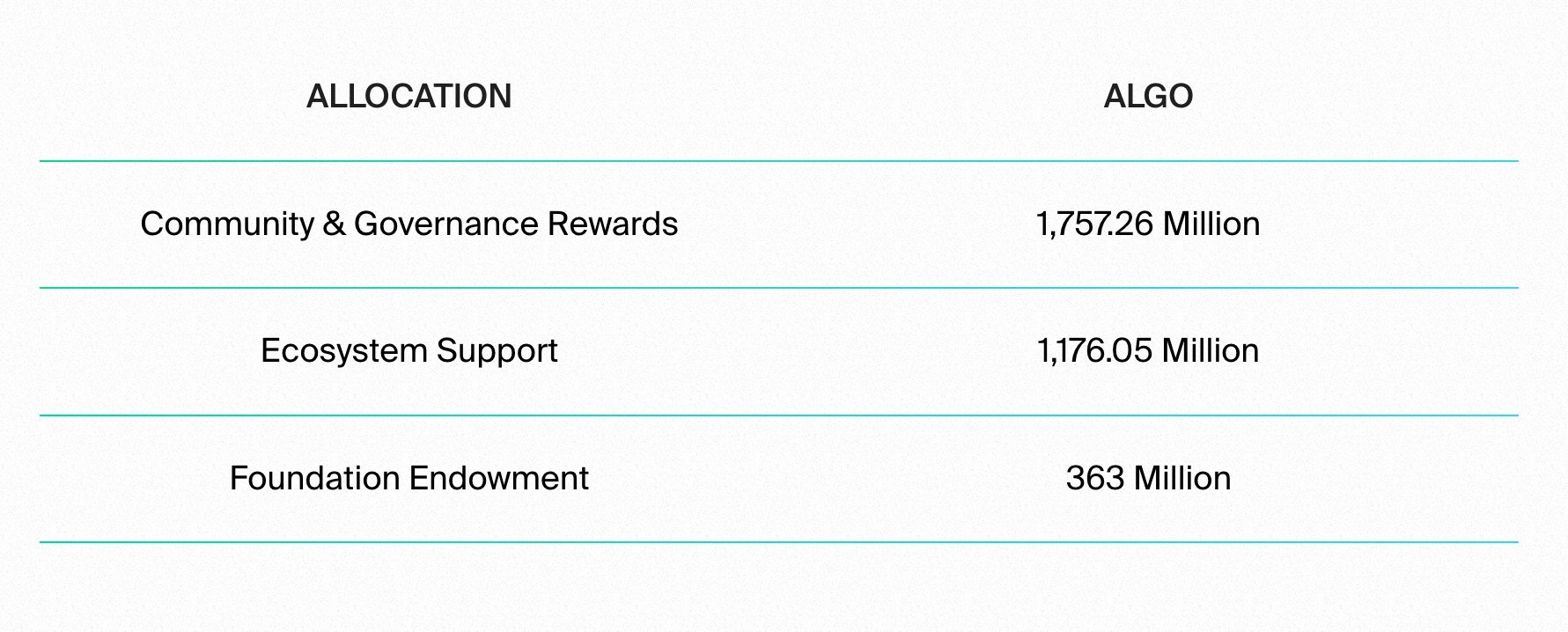
At the inception of the Algorand protocol, 10 billion ALGO tokens were created. As of March 2026, the circulating supply is over 8.8 billion ALGO. The initial distribution of tokens was designed to support the growth and development of the Algorand network through various channels, including community incentives and ecosystem support. The Algorand Foundation holds a portion of the total ALGO supply, with a 2022 allocation showing 1,757.26 million for community and governance rewards, 1,176.05 million for ecosystem support, and 363 million for the foundation endowment.[5][17]
Sustainability
Algorand claims to be the "world's most powerful and sustainable blockchain." According to its founder, the protocol was designed with a focus on sustainability from the outset. Through partnerships with organizations focused on sustainability, such as ClimateTrade, Algorand is committed to being a sustainable blockchain. In December 2025, Canadian green energy provider Bullfrog Power launched a pilot program issuing tokenized environmental certificates on Algorand. By prioritizing sustainability in its design and partnerships, the protocol aims to contribute to the broader goal of promoting environmentally-friendly technology.[6][17]
Algorand developed a public blockchain that runs on a version of proof-of-stake, which drives electricity consumption to almost zero…on a fundamental level - Silvio Micali
Algorand Foundation
The Algorand Foundation is a non-profit organization established to support the development and adoption of the Algorand blockchain, including protocol governance, token dynamics, and open-source development.
In early 2026, the Foundation underwent a strategic repositioning to ensure long-term sustainability. It announced its return to the United States from Singapore in January 2026 to seek regulatory clarity and align with institutional markets.
In March 2026, the Foundation reduced its workforce by 25%, citing the "uncertain global macro environment" and a downturn in crypto markets. [19]
"Today, the Algorand Foundation made the difficult decision to reduce our workforce by 25%. This decision was not taken lightly and is in response to the uncertain global macro environment as well as the broader downturn in crypto markets.
These employees have been best-in-class contributors to this ecosystem and to the Foundation, and this was an incredibly tough decision. We are sincerely grateful to them, and we are, of course, committed to supporting them through this transition.
We believe that we now have a more sustainable alignment of Algorand Foundation resources with the protocol’s long-term business, technology, and ecosystem priorities. We remain fully focused on our mission of financial empowerment and the continued development and growth of the Algorand protocol, network, and ecosystem."
In January 2026, the Foundation also announced a new Board of Directors and the formation of an Ecosystem Advisory Council (EAC) to strengthen communication between the ecosystem and the Foundation's leadership. The foundation collaborates with the ecosystem on creating projects and initiatives that help drive the adoption of the Algorand blockchain.[17] It supports the education of developers in universities through its Global University Program and has launched accelerator programs in Asia and Europe to support developers building on Algorand.[14]
The Algorand Foundation Board is composed by Kieron Guilfoyle, Pino Persiano, and Staci Warden. Some of their featured projects include Folks Finance, Algofi, Gard, Tinyman, Humble Defi, Pact, Lofty AI, Algodex, Nfdomains, and C3.[12]
Team
The team behind Algorand consists of researchers, mathematicians, cryptographers, economists, and leaders from global businesses. The founder, Silvio Micali, is a renowned figure in the field of cryptography, having received the Turing Award and the Godel Prize.[7]
Other important members include:
- W. Sean Ford, Interim CEO
- Paul Riegle, CPO
- Jing Chen, Head of Theory Research and Chief Scientist
- Yossi Gilad, Head of Systems Research and Chief Technology Officer
- Gary Malouf, Head of Engineering
- Regina O’Brien, Head of People and Talent
- Chris Peikert, Head of Cryptography
- Michele Quintaglie, CMO
- Anne T. Warner, General Counsel
Decipher Conference
Decipher Conference is an annual gathering organized by Algorand where builders, founders, investors, and strategists reunite to discuss the protocol’s future. During the event, participants can engage in conversations, networking, and hands-on sessions exploring the ecosystem. [9]
Decipher 2024 took place in Barcelona in June 2024. [16]
Decipher 2021
The first edition took place in Miami, Florida, from November 29 to 30, 2021. Some of the speakers included Michael Arrington, the Founder of Arrington Capital, Meltem Demiors, the Chief Strategy Officer of CoinShares, Antony Scaramucci, the Founder and Managing Partner of SkyBridge Capital, and Perianne Boring, the Founder, and President of the Chamber of Digital Commerce. The INNOVATE Global Hackathon took place during the event, where participants could participate in one of the following categories: Open Track, the Future of Finance (FutureFi) Track, and the Digital Art / Collectibles Track. Prices over $100,000 worth were given.[10]
Decipher 2022
Decipher 2022, held in Dubai from November 28 to 30, attracted over 2,000 attendees, an increase from the previous year. Several significant announcements were made at the conference, including the introduction of Algorand Ventures by the Algorand Foundation, which will provide funding and support to those building and investing in the Algorand ecosystem. St. Vincent De Paul Disaster Services also unveiled Kokua, a disaster relief platform built on the Algorand blockchain. Additionally, the Algorand Foundation announced its support for USDC on the Binance exchange and the appointment of Anil Kakani as the India Country Head to lead the AlgoBharat initiative.[11]
Technical Developments and Roadmap
Algorand's development is focused on enhancing network performance, security, developer experience, and economic sustainability. Major upgrades in 2025 laid the groundwork for the 2026 roadmap, which prioritizes adoption and long-term protocol health.[18]
2025 Key Upgrades
Throughout 2025, Algorand rolled out several significant protocol enhancements. An upgrade featuring Dynamic Round Times reduced the average block time from 3.4 seconds to approximately 2.8 seconds while maintaining instant finality. The Algorand Virtual Machine (AVM) was also upgraded to version 10, introducing powerful opcodes for advanced cryptography and more flexible smart contract development.[18]
In late 2025, the protocol introduced post-quantum secure accounts using Falcon-based signatures, a NIST-selected standard, to protect against future threats from quantum computers. The Algorand Foundation also publicly released the full Algorand Specifications, providing a comprehensive technical blueprint of the protocol to enhance transparency and encourage deeper research and development.[18][17]
2026 Roadmap
The roadmap for 2026 focuses on improving developer tools, user experience, and the network's economic model.[18]
- AlgoKit 4.0: Scheduled for the first half of 2026, this next-generation developer toolkit will feature AI-assisted development, support for new programming languages like Rust and Swift, and composable smart contract libraries to simplify building dApps.
- Rocca Wallet: After a preview in late 2025, a full release is planned for the first half of 2026. Rocca is a self-custody wallet designed for mainstream adoption, featuring passkey logins to eliminate the need for seed phrases.
- Project King Safety: This is a long-term initiative rolling out through 2026 to redesign the protocol's economic model. A foundational paper detailing the project is expected to be released, with the goal of ensuring long-term network security, fair validator incentives, and sustainable tokenomics.