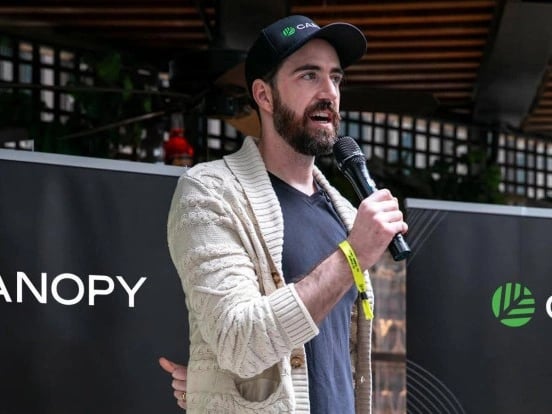
Alexander Pack
Alexander Pack is Co-Founder and Managing Partner of Hack VC and Co-Founder and Board Member of Imperii Partners. His career has spanned venture capital, investment banking, technology, and policy, with an increasing focus on cryptocurrency, blockchain infrastructure, and other emerging technologies. [1]
Education
Pack earned his BA in Philosophy, Politics, Economics, and History from Wesleyan University. [2]
Career
Pack began his career in Legislative Policy at the United States Senate from 2011 to 2012 before moving into the private sector as a Product Marketing professional at McGraw-Hill Education from 2012 to 2013. He then worked as a Product Manager at Microsoft from 2013 to 2014 and served as a University Lecturer through a teaching fellowship with Princeton in Asia in Hong Kong in 2014. He subsequently worked in fintech venture capital at Arbor Ventures from 2014 to 2015 and joined AngelList as a Partner from 2015 to 2016, focusing on early-stage technology investing. From 2016 to 2018, Pack was Director of Network Investing at Bain Capital Ventures, where he established the firm's network investing program and expanded its investments into seed and early-stage companies, cryptocurrency, and open-source infrastructure software. He then co-founded Dragonfly Capital and served as Managing Partner from 2018 to 2020, working across the U.S. and China on investments in the cryptocurrency sector. During this period, he also served as a Senior Advisor to Huobi Global from 2020 to 2021. In 2019, Pack co-founded Imperii Partners, an investment banking and advisory firm focused on companies operating across Web3 and AI, where he remains a Board Member. In 2021, he co-founded Hack VC and became its Managing Partner, focusing on venture investments in crypto, AI, and other emerging technologies. [3]
Interviews
Modular ETH
In December 2024, Pack appeared on Empire to discuss Ethereum’s architecture, valuation, and prospects for institutional adoption. He argued that Ethereum’s development had placed too much emphasis on decentralization while relying on Layer 2 networks to address scaling, and that the resulting modular architecture had reduced fees and network revenue in the short term, contributing to pressure on ETH’s valuation while supporting longer-term ecosystem development. Pack examined how crypto networks are valued through factors such as market share, total value locked, and network effects, noting Ethereum’s continued dominance despite competition from chains such as Solana. He also argued that modularization had increased competition among tokens and shifted some value away from ETH, while Ethereum remained an important institutional network because of its security, developer base, and established ecosystem. The discussion further considered ETH’s role as a monetary asset, given that Layer 2 activity and many DeFi applications remain denominated in ETH, as well as the potential for new Layer 1s, Layer 2s, cryptographic advances, AI, and privacy technologies to reshape the market. Pack expected continued venture funding and development across blockchain infrastructure, potentially extending existing market cycles and creating further changes in the relative position of major networks. [4]
Panels
Autonomous Capital
In October 2025, Pack participated in a panel at TOKEN2049 alongside Amjad Masad of Replit, Jordi Alexander of Selini, and Tarun Chitra of Gauntlet, moderated by Irene Wu, discussing the intersection of AI, crypto, and autonomous capital. The panel examined how autonomous capital could evolve from algorithmic trading strategies into systems in which AI agents independently manage capital and execute activities onchain, while also considering earlier visions of decentralized, AI-managed services. Pack and the other panelists discussed the risks associated with autonomous agents, including exploit attribution, vulnerabilities in trusted computing environments, hardware dependencies, and the difficulty of assigning responsibility within complex decentralized systems. They also considered the relationship between AI and crypto talent, regulatory constraints, infrastructure requirements, and crypto’s potential to attract technical talent through early financial incentives. The discussion concluded with the possibility of using crypto-based incentives to connect human and machine intelligence, including applications such as decentralized contests and incentive-aligned software infrastructure, while emphasizing the importance of developing technically simple and understandable products. [5]